
A new guide highlights 29 reliable, free data sources that content marketers and SEOs can use to make their articles more accurate, credible, and useful.
The list shows how good data supports E-E-A-T signals (experience, expertise, authoritativeness, trustworthiness) and helps brands fight misinformation while improving search performance.
From search trends to government statistics and global health data, these tools give writers evidence they can safely rely on in their content.
Key Free Data Tools Marketers Should Know
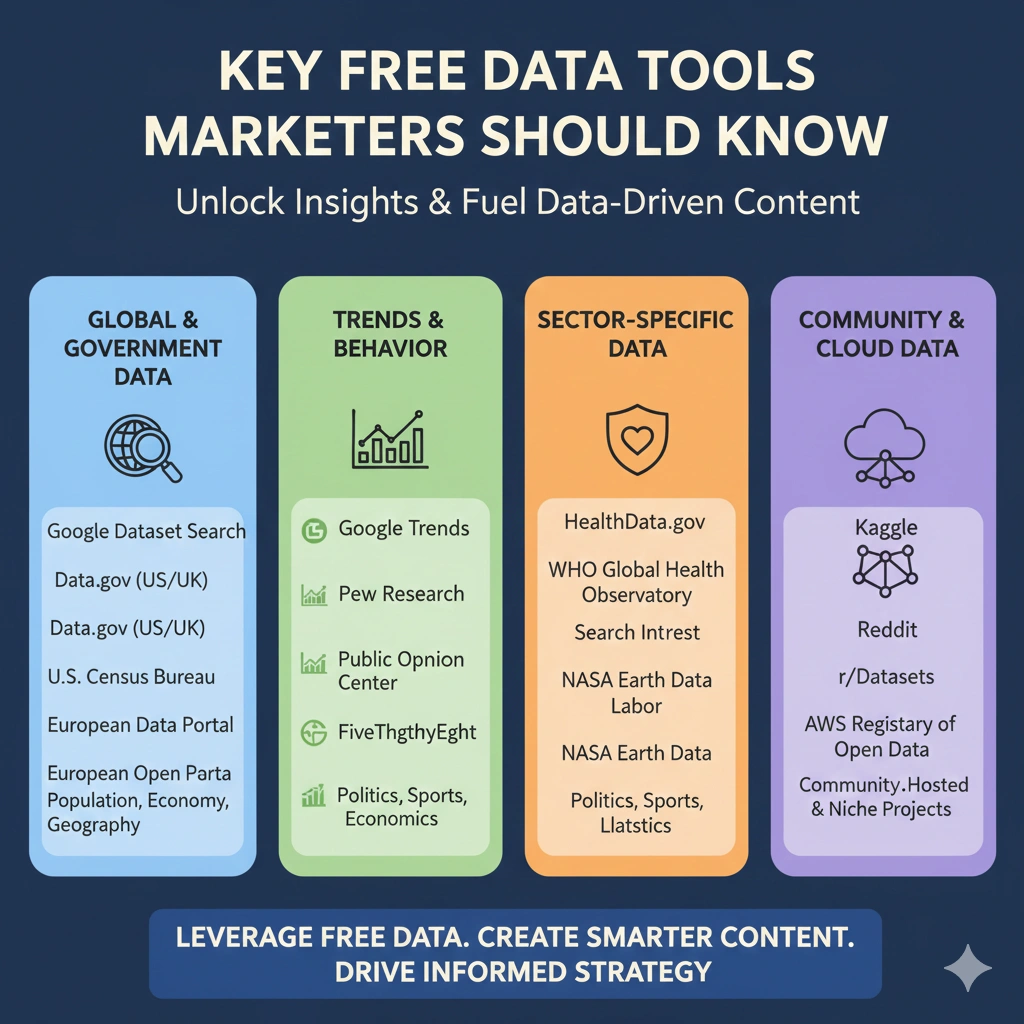
The article begins with Google Dataset Search and Google’s Data Commons MCP Server, which make it easier to find and plug public datasets into AI tools or workflows.
Marketers can then explore Google Trends to understand search interest over time, by region, and by related queries, which is ideal for keyword, topic, and seasonal planning.
Major government portals like Data.gov (US and UK), the U.S. Census Bureau, and the European open data portal offer large collections of free statistics on population, economy, geography, health, transport, and more that can power data-led articles and reports.
Researchers and content creators can also tap into sector-specific sources such as HealthData.gov, WHO’s Global Health Observatory, NASA’s Earth data, environmental information from NOAA’s National Centers for Environmental Information, and labor market data from the U.S. Bureau of Labor Statistics.
For social and opinion insights, Pew Research Center and Latin American public opinion datasets provide survey-based data, while FiveThirtyEight shares cleaned data behind its politics, sports, and economics stories.
Platforms like Kaggle, Reddit’s Datasets community, and AWS Registry of Open Data give access to thousands of community and cloud-hosted datasets for more technical or niche projects.
Also read about: AI Content Creation 2025: Adobe Upgrades GenStudio Tools
Using Archives, Corporate, And Media Data
For business and corporate research, OpenCorporates offers records on over 200 million companies worldwide, while various development banks and regional portals (such as AfDB, ADB, and others) publish socio-economic indicators for Africa, Asia, and beyond.
The CIA World Factbook provides up-to-date country profiles, and IMDb’s non-commercial datasets support projects related to films and entertainment.
Finally, the Internet Archive’s Wayback Machine gives historic snapshots of over 800 billion web pages, helping marketers analyze how sites, messaging, and industries evolved over time.
The guide recommends treating these sources as building blocks for data-driven campaigns, while always fact-checking and verifying context before publishing.
Used wisely, this wide range of free data helps marketers tell stronger stories, back claims with evidence, and earn audience trust.
More news to read:
