
Oxylabs

- 175M+ global IP pool
- Coverage in 195+ countries
- IP authentication
- Username/password authentication
- Proxy endpoint generator
Decodo

- 125M+ global IP pool
- 195+ proxy locations
- Carrier targeting for mobile proxies
- Third-party tool integration
- Automation-friendly proxies
Webshare

- 80+ million IPs
- 195+ countries
- 99.7% success rate
- 24/7 Expert Support
- Flexible pay-as-you-go pricing
The residential proxy market is growing fast. According to recent data, it is projected to reach $1.92 billion in 2026 and hit $3.05 billion by 2031, growing at a CAGR of 9.7%. Over 72% of businesses now rely on proxy networks for web scraping, ad verification, price monitoring, and competitor research. With dozens of providers competing for your money, picking the right one can save you hundreds of dollars every month — or cost you dearly if you choose wrong.
This guide covers the 9 best residential proxy providers in 2026, with accurate, up-to-date pricing pulled directly from each provider’s website. Whether you are a solo developer, a growing agency, or an enterprise team, you will know exactly which provider fits your needs by the end of this article.
9 Best Residential Proxy Providers in 2026
#1 Oxylabs — Best for Enterprise and Large-Scale Operations
Website: https://oxylabs.io
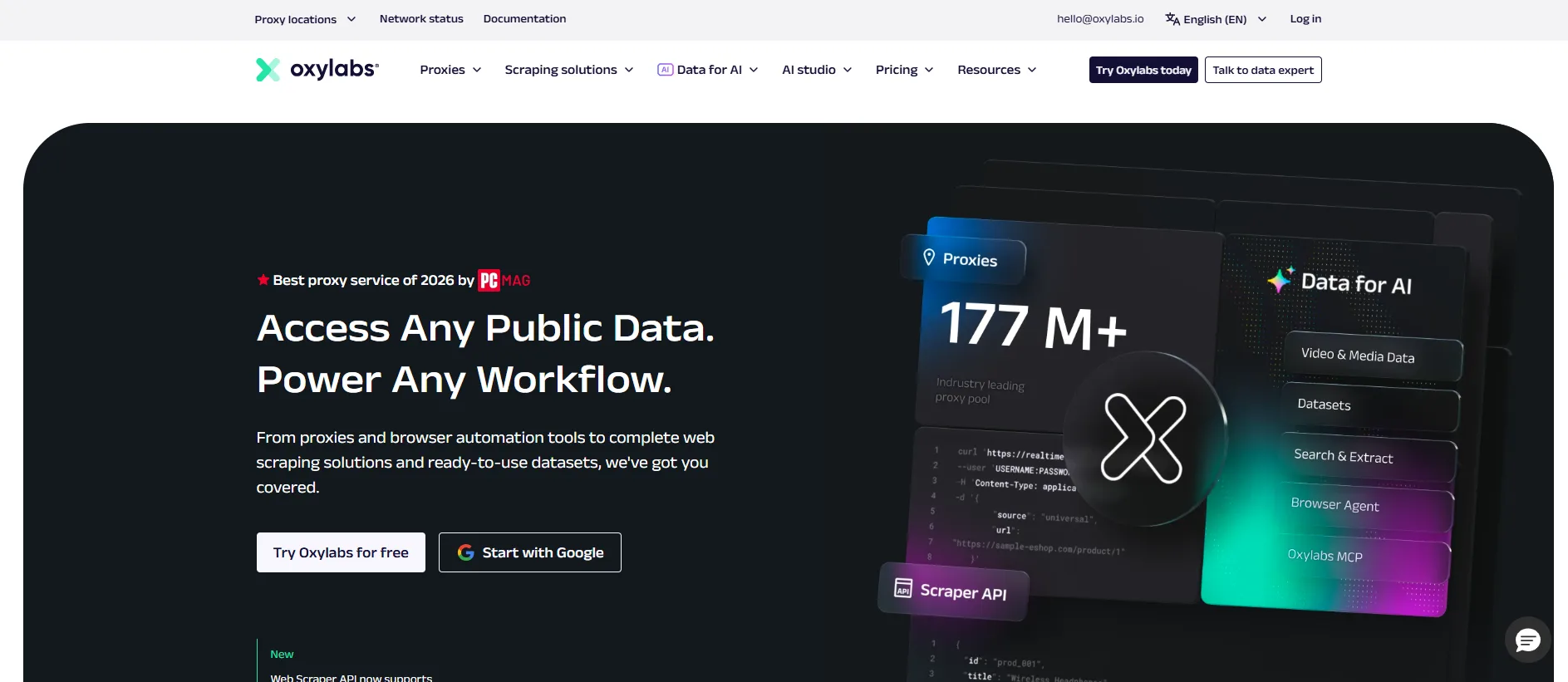
Oxylabs is the biggest name in the residential proxy space, and for good reason. With 175 million+ residential IPs spread across 195 locations, it has the largest pool of any provider on this list. CNET named it the best proxy server for larger businesses in 2026, and that reputation is well-earned. Oxylabs reports an average 99.95% success rate and a response time of just 0.6 seconds, making it one of the fastest options available.
The platform supports HTTP, HTTPS, and SOCKS5 protocols, offers flexible rotating and sticky sessions, and allows country, city, state, and ZIP-code-level targeting. You also get unlimited concurrent sessions, which is rare among enterprise providers. Oxylabs has ISO/IEC 27001:2022 certification, which matters if you handle sensitive business data.
Pricing (from oxylabs.io/pricing/residential-proxy-pool):
Plan | Data | Price per GB | Monthly Total |
Starter | 5 GB | $6/GB | $30 |
Basic | 20 GB | $5/GB | $100 |
Advanced | 125 GB | $4/GB | $500 |
Corporate | 1 TB | $2.50/GB | $2,500 |
Top-up bandwidth is available on all plans. There is a free trial to test before committing.
Best for: Enterprises, large agencies, and teams running high-volume scraping operations that need maximum reliability and zero tolerance for failures. Not ideal if you are on a tight budget.
#2 Decodo — Best for SMBs and Balanced Price-to-Performance
Website: https://decodo.com
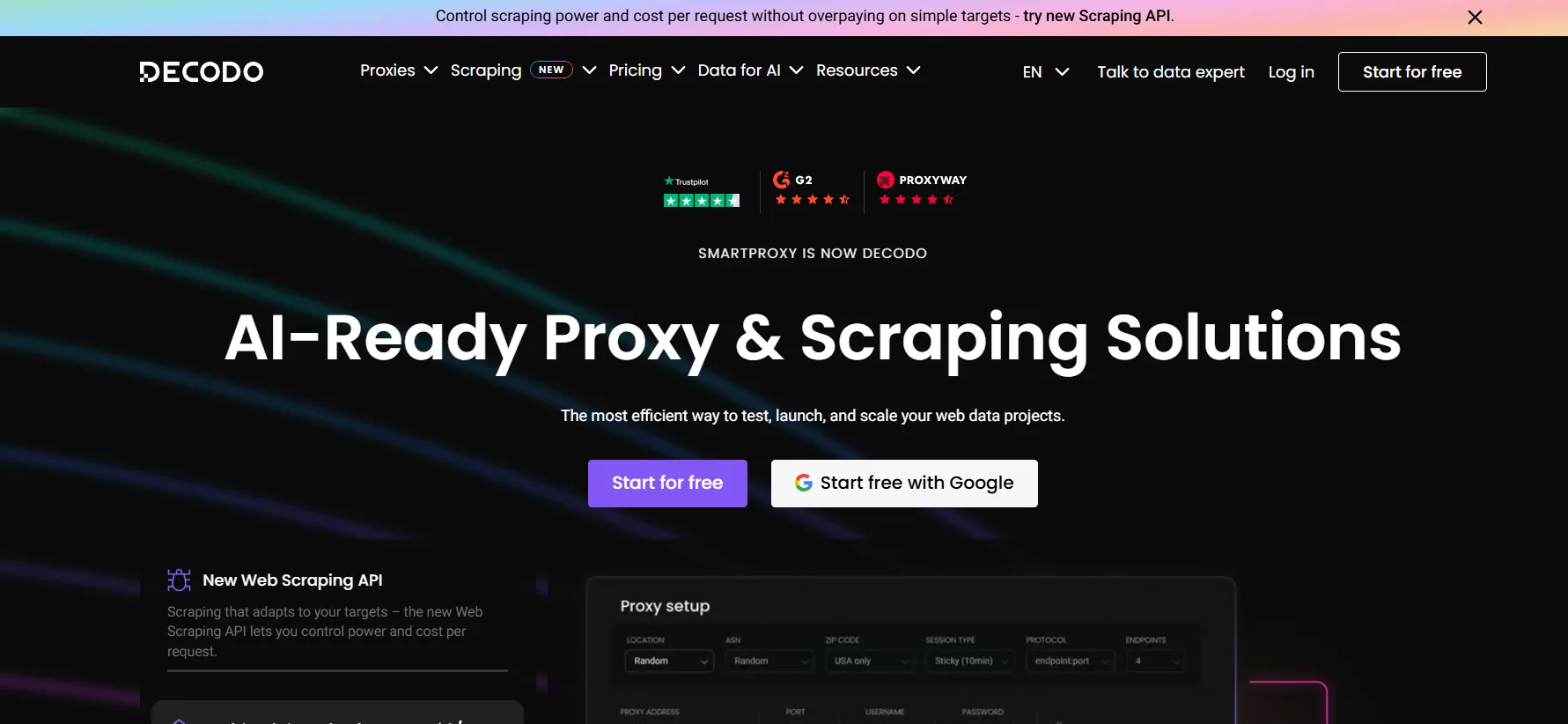
Decodo, formerly known as Smartproxy, rebranded in 2025 and has quickly become the go-to choice for small and medium businesses. With 115 million+ ethically sourced IPs across 195+ locations, it offers a pool size that rivals much more expensive competitors. Decodo’s standout stats are hard to ignore — a 99.86% success rate, 99.99% uptime, and an average response time of under 0.6 seconds, which puts it neck-and-neck with Oxylabs at a much lower price point.
Proxyway has awarded Decodo “Best Value” for five consecutive years. G2 gave it “Best Usability 2025” and “Best User Adoption 2025” badges, reflecting how easy it is to set up and start using. The 3-day free trial with 100MB gives you a real taste before you commit. Decodo supports HTTP(S) and SOCKS5, city and ZIP code targeting, rotating and sticky sessions, and seamless integrations with popular scraping tools.
Pricing (from decodo.com/proxies/residential-proxies/pricing):
Plan | Data | Price per GB | Monthly Total |
Pay-as-you-go | Flexible | $4.00/GB | As needed |
3 GB | 3 GB | $3.75/GB | $11.25 |
10 GB | 10 GB | $3.50/GB | $35 |
25 GB (Popular) | 25 GB | $3.25/GB | $81.25 |
50 GB | 50 GB | $3.00/GB | $150 |
100 GB | 100 GB | $2.75/GB | $275 |
1000 GB | 1000 GB | $2.00/GB | $2,000 |
A 14-day money-back guarantee applies to all plans.
Best for: Startups, freelancers, and growing businesses that want enterprise-grade performance without paying enterprise prices. The sweet spot is the 25–100 GB range, where the price-to-quality ratio is unbeatable.
#3 Webshare — Best for Beginners and Budget-Conscious Users
Website: https://webshare.io
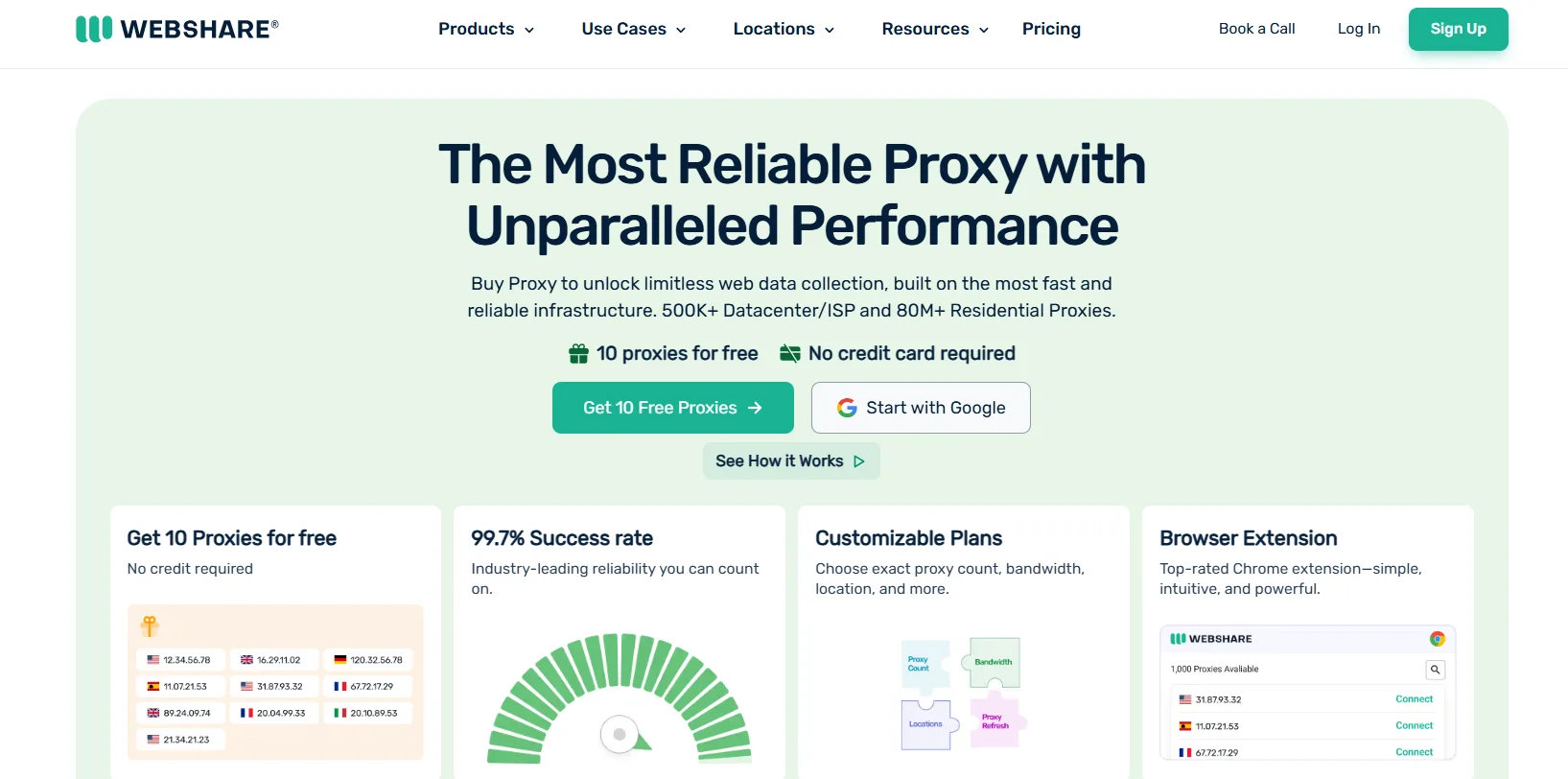
Webshare is the friendliest entry point into residential proxies. It is one of the very few providers that offers 10 free proxies forever — no credit card required — making it the easiest way for beginners to test residential proxies without spending a cent. Its rotating residential proxies start at just $1.40/GB during a 50% promotional sale, making it one of the most affordable options on the market.
Webshare boasts a 99.7% uptime across its network. It supports rotating residential, static residential, and datacenter proxies from a single dashboard. Yearly plans offer an additional 30% discount on top of already low prices. The platform is simple to use, with a clean dashboard that does not overwhelm new users. HTTP/HTTPS proxies are standard, and the setup process is fast even for non-technical users.
Pricing (from webshare.io/pricing):
Plan | Price | Notes |
Free | $0 | 10 proxies, up to 1GB/month, forever free |
Rotating Residential | From $1.40/GB | With 50% promo applied |
Standard Rotating | From $2.80/GB | Without promo |
Static Residential | From $0.30/IP | Per IP per month |
Annual billing saves an additional 30% on most plans.
Best for: Beginners who want to test residential proxies for free first. Also great for small projects, individual developers, and anyone who needs reliable proxies without a big monthly commitment. Not suited for enterprise-level scraping at scale.
#4 Bright Data — Best for Fortune 500 Companies and Enterprise Teams
Website: https://brightdata.com
Bright Data (formerly Luminati) is the oldest and most established name in the proxy industry. It operates the world’s largest residential proxy network, trusted by Fortune 500 companies across industries from finance to retail. Its enterprise reputation is unmatched, and it is the default choice for companies that need not just proxies, but a full data infrastructure platform.
Beyond residential proxies, Bright Data offers a complete suite including scraping APIs, a dataset marketplace, a proxy manager, and a browser automation tool. This makes it far more than just a proxy provider — it is a data collection ecosystem. However, all of this comes at a premium price. At $5.88/GB as a starting price, it is one of the more expensive options on the list. That said, the raw performance, reliability, and feature depth justify the cost for teams with serious data requirements. G2 lists residential pricing at around $8.40–$8.50/GB for standard plans.
Pricing (from brightdata.com/pricing/proxy-network/residential-proxies):
Plan | Starting Price | Notes |
Pay-as-you-go | $8.40/GB | No commitment |
Subscription (5 GB) | $5.88/GB | $75+/month |
Higher tiers | Scales down | Custom enterprise pricing available |
A free trial is available on signup.
Best for: Large enterprises, Fortune 500 teams, and businesses that need a full data platform — not just proxies. If you are a small business or solo developer, the pricing will feel steep compared to alternatives like Decodo or Webshare.
#5 SOAX — Best for Clean IPs and Flexible Session Control
Website: https://soax.com
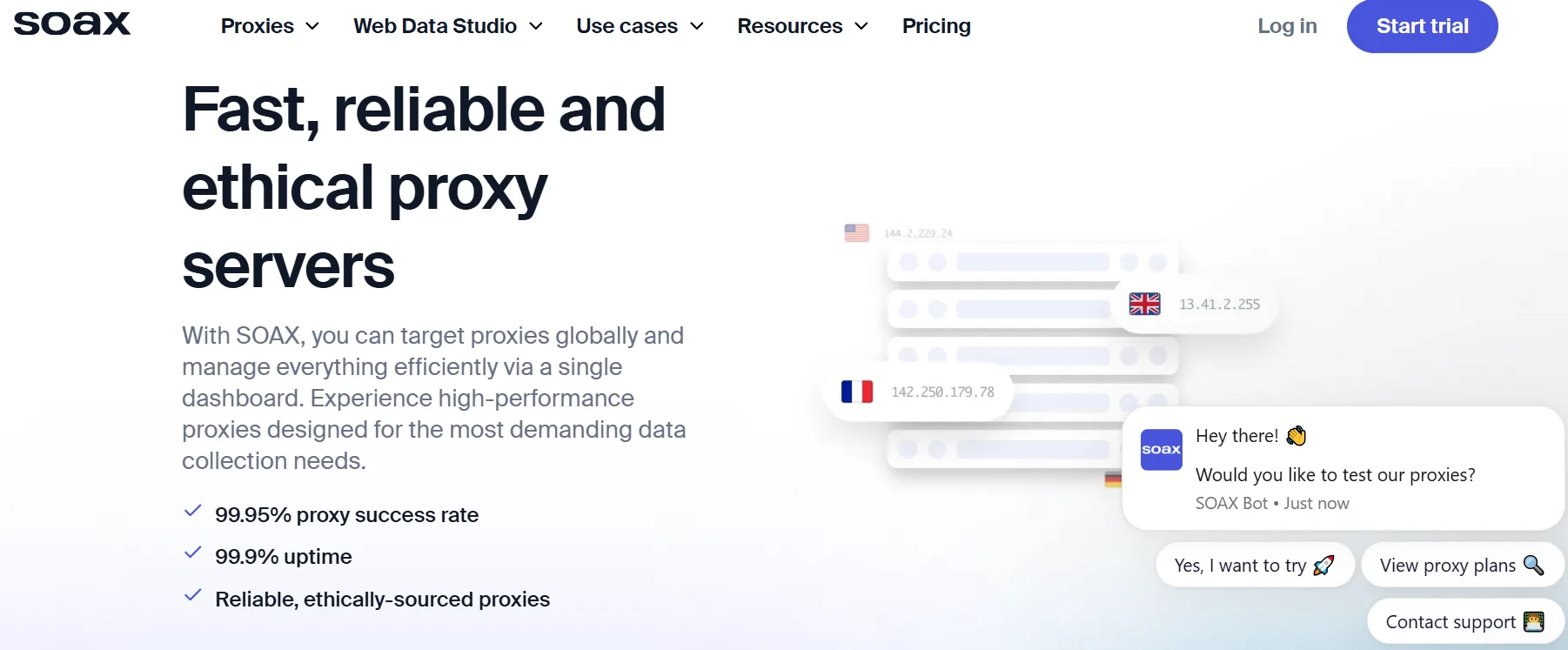
SOAX is a premium provider that focuses heavily on the quality of its IP pool rather than just the size. With 155 million+ residential IPs across 195 locations, it is one of the largest pools available. What sets SOAX apart is its emphasis on ethically sourced proxies from real users, which means fewer bans, fewer CAPTCHAs, and higher trust from target websites. Cybernews rated it as one of the most reliable proxy services in its 2026 review.
SOAX offers unlimited concurrent sessions, automatic IP rotation, sticky sessions, 99.9% network uptime, and a bundled Web Data API with every plan. The ability to filter by country, city, ISP, and ASN gives you very precise control over which IPs you use. This makes SOAX especially useful for geo-sensitive tasks like localized price monitoring and ad verification.
Pricing (from soax.com/pricing):
Plan | Data Included | Price per GB | Monthly Total |
Starter | 25 GB | $3.60/GB | $90 |
Advanced | 50 GB | $3.40/GB | $170 |
Business | 800 GB | $2.00/GB | $1,600 |
All plans include access to all proxy types and the Web Data API.
Best for: Businesses that prioritize IP quality and need precise geo-targeting with high session control. SOAX is perfect for ad verification agencies, price intelligence tools, and brand protection teams that cannot afford to be blocked.
#6 IPRoyal — Best for Pay-As-You-Go Flexibility
Website: https://iproyal.com
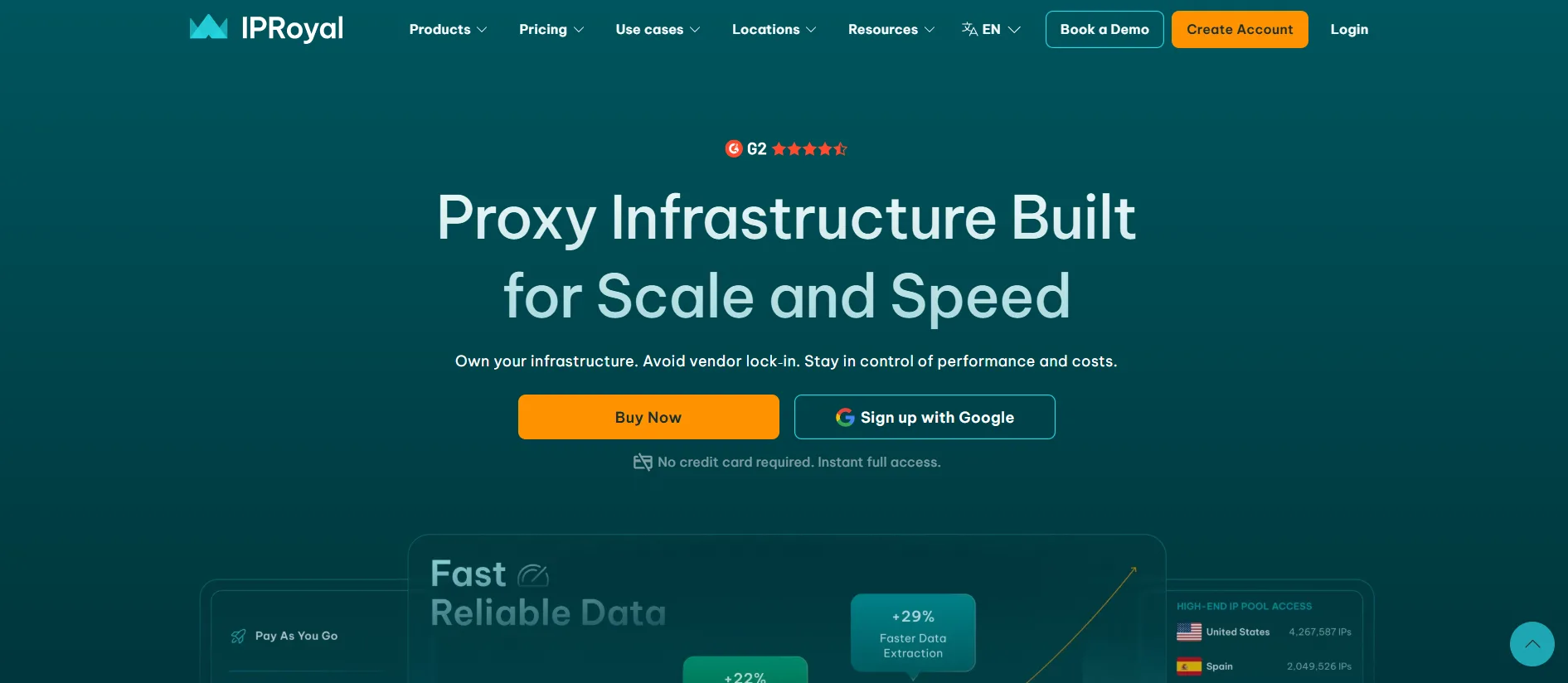
IPRoyal is one of the most straightforward and budget-friendly options on this list. It is especially popular with users who have irregular proxy usage — sometimes needing a lot of bandwidth, sometimes barely any — because its non-expiring traffic model means any bandwidth you buy never goes to waste. You pay for it once and use it whenever you need it, which is a genuinely rare feature in the industry.
IPRoyal’s residential proxies cover 195+ countries, support rotating and sticky sessions, and offer country, city, and ISP-level targeting. The dashboard is simple and clean. G2 lists the starting price at $1.75/GB, while their own site shows pricing that scales well as your volume increases. The network is ethically sourced, and the support team is generally well-reviewed for responsiveness.
Pricing (from iproyal.com/pricing/residential-proxies):
Volume | Price per GB |
1 GB | $1.75/GB |
Higher volumes | Scales down progressively |
Non-expiring traffic | Never expires — use anytime |
Pay-as-you-go is also available with no monthly commitment required.
Best for: Freelancers, developers, and small businesses that use proxies inconsistently and do not want to lose unused bandwidth at the end of a billing cycle. Also a great starting point for anyone testing residential proxies for the first time on a very tight budget.
#7 Rayobyte — Best for Ethically Sourced Proxies with Transparent Practices
Website: https://rayobyte.com
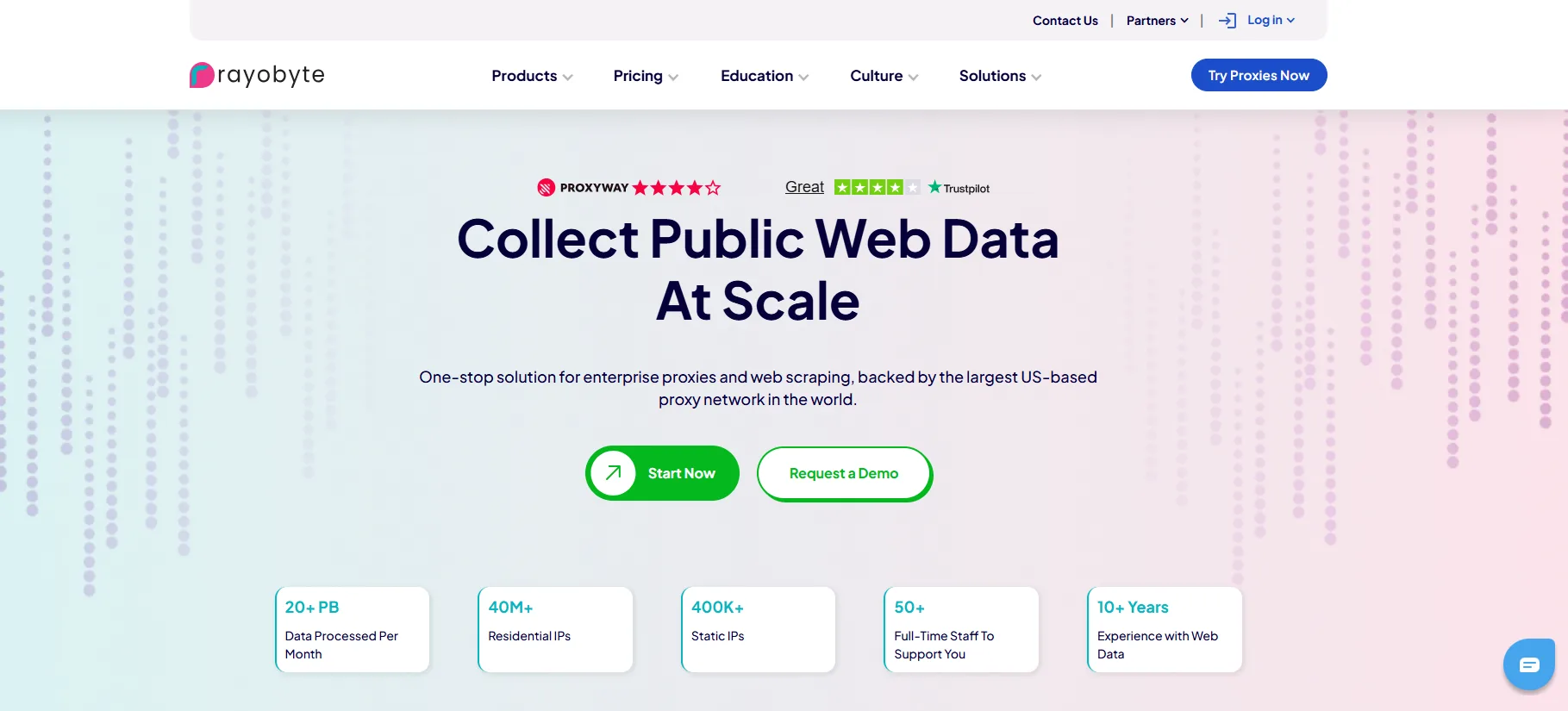
Rayobyte stands out in the industry for its commitment to ethical IP sourcing and transparent business practices. The company openly publishes how it acquires its IPs, which builds trust with users who care about responsible data collection. Its rotating residential proxies start at $3.50/GB for 1–49 GB, dropping significantly at higher volumes with enterprise plans going as low as $0.50/GB.
The platform supports rotating residential, static ISP, dedicated ISP, and datacenter proxies. Rayobyte’s residential proxy network spans a broad geographic footprint, and it includes pay-as-you-go pricing so you are not locked into a monthly commitment. Concurrent sessions are supported across all plans, and the setup process is developer-friendly with thorough documentation.
Pricing (from rayobyte.com/pricing):
Volume Tier | Price per GB |
Starter (1–49 GB) | $3.50/GB |
Consumer (50–149 GB) | Scales down |
Business (150–349 GB) | Scales down further |
Enterprise (350+ GB) | As low as $0.50/GB |
A free trial is available for new users.
Best for: Developers and businesses that specifically care about ethical IP sourcing and transparent pricing. Also good for teams that need to scale from small to very large volumes without switching providers.
#8 ProxyEmpire — Best for Unused Bandwidth Rollover
Website: https://proxyempire.io
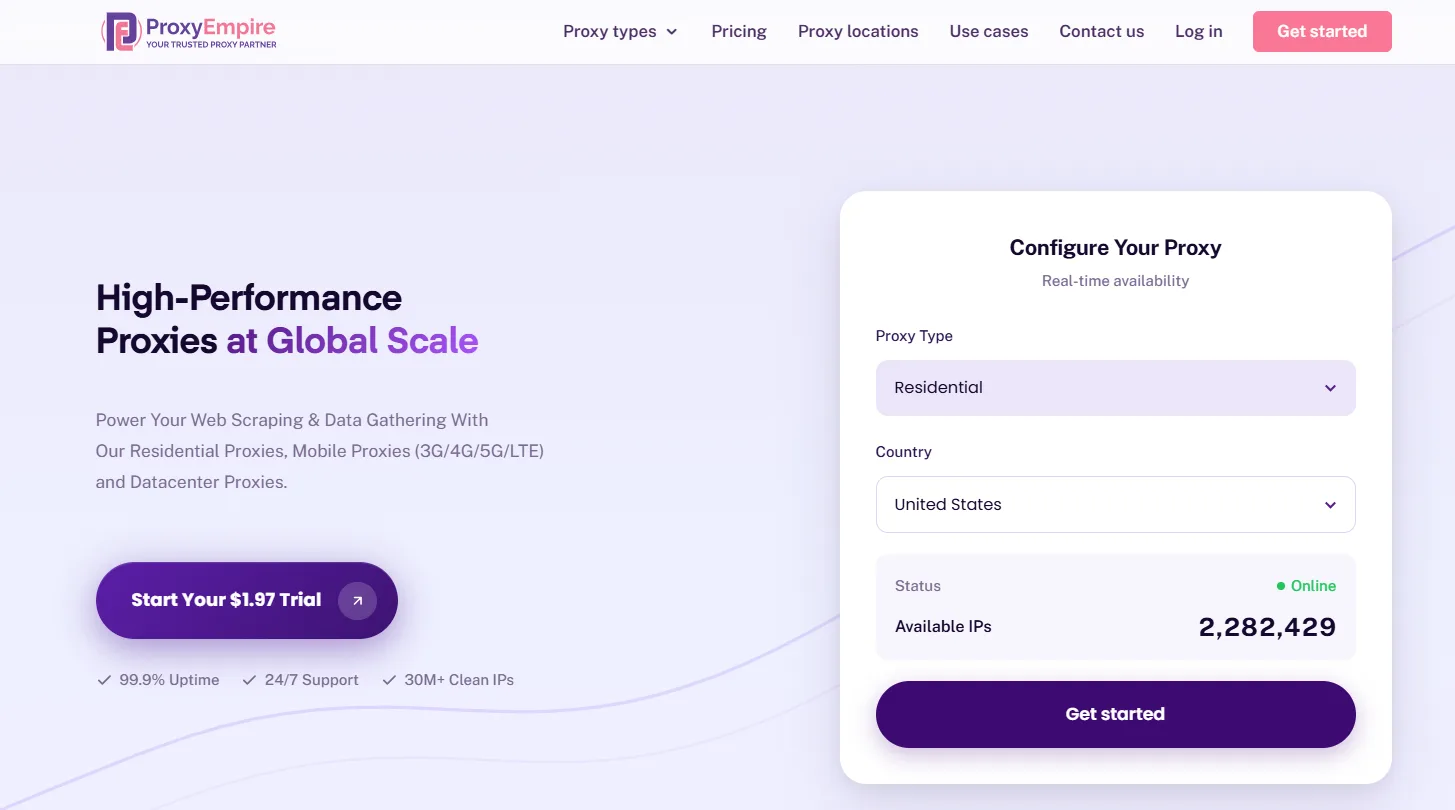
ProxyEmpire is a mid-market provider with a genuinely useful feature that most competitors do not offer: unlimited monthly bandwidth rollover. Any data you do not use in a billing cycle carries over to the next month automatically. This means you never lose money on unused bandwidth, which is a major pain point with other providers.
ProxyEmpire’s rotating residential proxy pool has 30 million+ IPs across 170+ countries, with a reported 99.56% success rate. It supports country, region, city, and ISP targeting. You can start with a $1.97 trial that gives you 100MB of residential data and 50MB of mobile data immediately — no big upfront commitment. The pricing for full plans starts at $0.75/GB going up from there depending on the tier. Static residential proxies are available in 20+ countries for users who need a fixed IP.
Pricing (from proxyempire.io/proxy-pricing):
Plan Type | Starting Price | Notes |
Trial | $1.97 | 100MB residential + 50MB mobile |
Rotating Residential | From $0.75/GB | Scales with volume |
Static Residential | Available | 20+ countries |
Mobile Proxies | Available | 5M+ IPs, 170+ countries |
Unused bandwidth rolls over every month on all plans.
Best for: Users with variable monthly usage who want to make sure they never waste a dollar. Also great for multi-use-case teams that need both residential and mobile proxies under one account at a competitive price.
#9 ProxyCheap — Best for the Tightest Budgets
Website: https://proxy-cheap.com
ProxyCheap does exactly what its name says — it offers some of the lowest-priced residential proxies in the entire market without completely sacrificing quality. Rotating residential proxies start at around $1.40/GB (matching Webshare’s promotional price), and it also offers an unlimited bandwidth plan that is genuinely rare in the residential proxy space. Their own blog ranks them as the cheapest proxy service with the best overall value for most users.
ProxyCheap supports rotating residential, static residential, and datacenter proxies. The network covers a broad range of global locations, supports HTTP/HTTPS/SOCKS5, and offers features like geo-targeting, IP rotation, and high anonymity. The dashboard is basic but functional. Support is decent for the price point, and the setup process is simple enough for beginners.
Pricing (from proxy-cheap.com/services/rotating-residential-proxies):
Plan | Starting Price | Notes |
Rotating Residential | From $1.40/GB | Pay-as-you-go available |
Unlimited Bandwidth | Available | Fixed price, no data cap |
Static Residential | Available | Per-IP monthly pricing |
Best for: Users who need residential proxies on an absolute minimum budget. Perfect for students, hobby scrapers, and small-volume use cases where spending under $10–15/month is a priority. If you need high reliability at enterprise scale, look at Oxylabs or Bright Data instead.
Quick Comparison Table:
Provider | Pool Size | Locations | Starting Price | Best For |
Oxylabs | 175M+ IPs | 195 | $6/GB | Enterprise & large-scale scraping |
Decodo | 115M+ IPs | 195+ | $2/GB | SMBs & balanced performance |
Webshare | Large pool | Global | $1.40/GB | Budget users & beginners |
Bright Data | Largest pool | 195+ | $5.88/GB | Fortune 500 & enterprise |
SOAX | 155M+ IPs | 195 | $2.00/GB | Clean IPs & flexible sessions |
IPRoyal | Large pool | 195+ | $1.75/GB | Pay-as-you-go users |
Rayobyte | Large pool | Global | $3.50/GB | Ethical sourcing focus |
ProxyEmpire | 30M+ IPs | 170+ | $0.75/GB | Rollover bandwidth users |
ProxyCheap | Large pool | Global | $1.40/GB | Tightest budgets |
How to Choose the Right Provider in 2026
Picking the right residential proxy is simpler when you match your needs to a few key factors. If you are an enterprise or Fortune 500 team, go with Oxylabs or Bright Data — both offer the scale, reliability, and compliance that large organizations need. If you are a small or medium business looking for the best value, Decodo is the top pick with its five-year “Best Value” award and near-enterprise performance at mid-range prices. For the tightest budgets, Webshare and ProxyCheap both offer plans starting around $1.40/GB, with Webshare even offering 10 free proxies forever.
If you use proxies inconsistently and hate losing unused bandwidth, IPRoyal’s non-expiring traffic and ProxyEmpire’s rollover bandwidth are both designed specifically for you. For teams that prioritize IP quality and ethical sourcing, SOAX and Rayobyte lead the way. And if you need a flexible, mid-range provider with mobile proxies and rollover, ProxyEmpire offers an unusually generous $1.97 trial to get started.
FAQs: Best Residential Proxy Providers
What is a residential proxy and how is it different from a datacenter proxy?
A residential proxy uses a real IP address assigned to an actual home device by an internet service provider. Datacenter proxies come from servers in data centers and are easier to detect and block. Residential proxies are far less likely to be flagged by websites, which makes them better for scraping, ad verification, and account management.
Which residential proxy provider has the largest IP pool in 2026?
Oxylabs leads with 175 million+ residential IPs, followed by SOAX with 155 million+ and Decodo with 115 million+. Bright Data also operates one of the largest networks, though it does not publicly state an exact pool size for residential IPs.
Are residential proxies legal to use?
Yes, using residential proxies is legal in most countries for legitimate purposes like web scraping public data, price monitoring, and ad verification. However, using them to access private accounts, bypass security systems, or violate a website’s terms of service can be illegal. Always check local laws and the target site’s terms before use.
What does “ethically sourced” mean for residential proxies?
Ethically sourced means the real device owners have knowingly consented to share their IP address in exchange for a service or compensation. Providers like SOAX, Rayobyte, Oxylabs, and Decodo emphasize ethical sourcing to ensure their proxy networks do not exploit unknowing users.
Can I use residential proxies for social media account management?
Yes, residential proxies are the preferred choice for managing multiple social media accounts because they use real IPs that platforms trust. Datacenter proxies are much more likely to trigger bans. ProxyEmpire, IPRoyal, and Decodo are popular choices for this use case.
What is the difference between rotating and sticky residential proxies?
Rotating proxies automatically assign a new IP address with every request or at a set interval, which is ideal for scraping. Sticky sessions keep the same IP for a longer period — typically 1 to 30 minutes — which is better for tasks that require a consistent identity, like logging into accounts or completing multi-step forms. Most providers on this list offer both options.
Quick Links
Conclusion: Best Residential Proxy Providers in 2026
Residential proxies are no longer just a tool for tech companies — they are essential infrastructure for competitive intelligence, price monitoring, ad verification, and web scraping across industries. With the market heading toward $3 billion by 2031, the number of providers will only grow. The nine providers in this list cover every price point and use case, from the free tier at Webshare to enterprise-grade infrastructure at Bright Data and Oxylabs. Use the comparison table at the top of this article to narrow down your options, take advantage of every free trial available, and pick the provider that matches your actual usage — not just the cheapest headline price.
