
The Fundamental Shift in How Google Evaluates Local Businesses
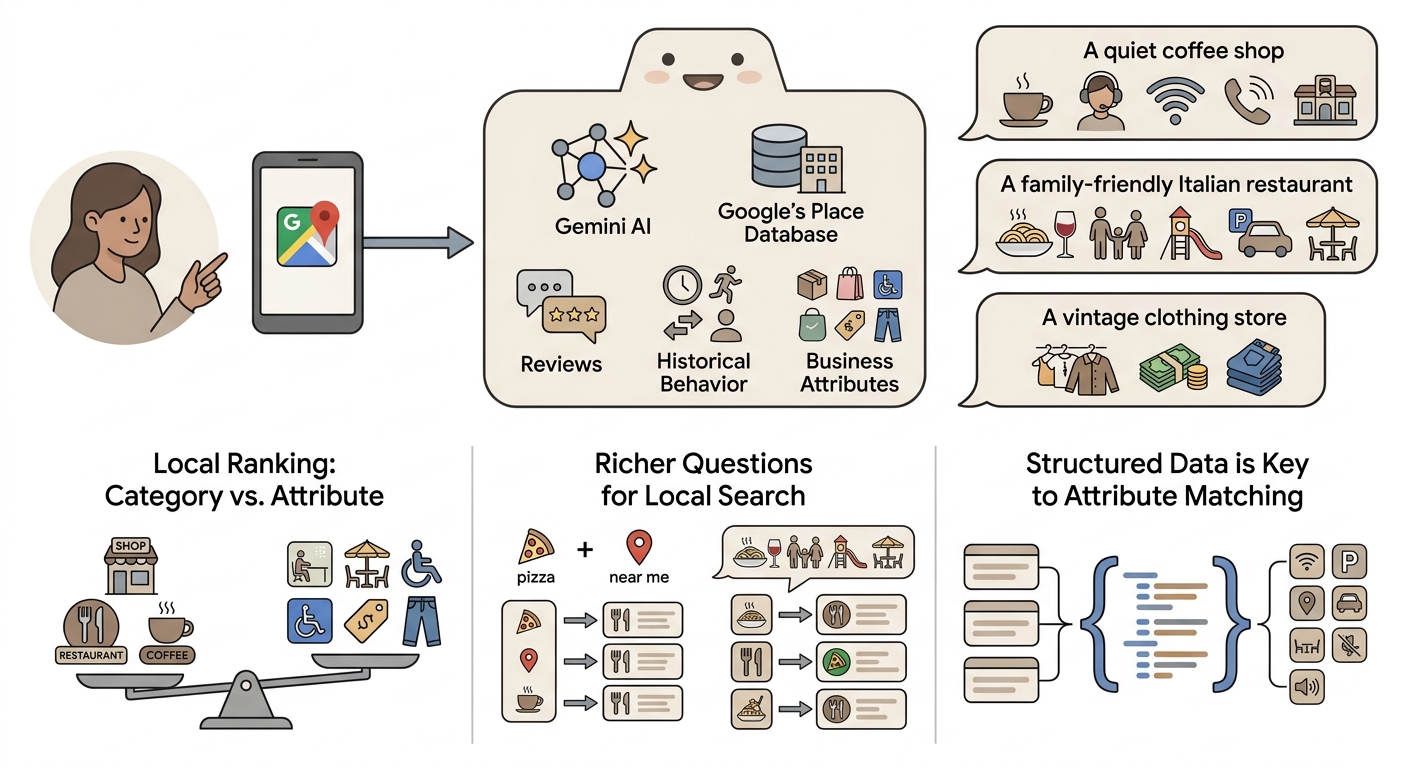
Users can ask richer questions inside Google Maps, and Google uses Gemini plus its place database, reviews, historical behavior, and business attributes to shape recommendations. The local ranking game is becoming less about simple category relevance and more about attribute comprehension.
Think less like a keyword tool and more like a real person speaking. Queries may sound like: quiet coffee shops with strong WiFi for calls near the station. Or: family-friendly Italian restaurants with parking and outdoor seating. Or: vintage stores with fair prices and good denim selection.
Attribute comprehension is the new local SEO paradigm and it has direct schema implications that most local SEO practitioners have not yet addressed. Traditional local SEO optimized for category keywords — restaurant, coffee shop, venue.
Ask Maps and conversational local search optimizes for specific attribute combinations — quiet workspace, outdoor seating, good denim selection. The difference is that attribute combinations cannot be conveyed through keyword matching alone. They require structured data that explicitly declares each attribute in machine-readable form.
The Local Business schema types support dozens of attributes that most implementations leave blank. For a coffee shop: amenity Feature can declare WiFi availability, seating type, noise level if specified, and accessibility features.
For a restaurant: serves Cuisine, has Menu, opening Hours Specification with day-level accuracy, and accepts Reservations are all query able attributes that Ask Maps can match against conversational queries. For a retail store: product category focus, price range, and specific inventory attributes can all be structured.
The Gap Between GBP Attributes and Website Schema
The practical problem most local businesses have right now is a misalignment between their Google Business Profile attributes — which are generally well-maintained — and their website schema — which typically declares only the most basic Local Business properties. Ask Maps draws from both sources simultaneously and the businesses that are most consistently recommended are the ones where both sources agree and reinforce each other.
Ask Maps makes complete, current, machine-readable business data more important than ever. Reviews, categories, amenities, photos, and hours now help Google summarize and recommend businesses for conversational local search queries. Clear positioning and fresh profile updates improve your odds of being surfaced.
The synchronization check every local business website needs to run right now: compare every attribute you have declared in your Google Business Profile with the attributes present in your LocalBusiness schema.
Every attribute in the GBP that is missing from the website schema is a missed reinforcement signal. Adding those attributes to your schema does not replace GBP — it creates the cross-source consistency that AI recommendation systems use as a trust signal.
💬 Reddit — r/TechSEO on Ask Maps attribute comprehension and schema: 🔗 https://www.reddit.com/r/TechSEO/search/?q=Ask+Maps+attribute+comprehension+local+schema+2026
🐦 X/Twitter — local SEOs discussing attribute-based schema for Ask Maps: 🔗 https://x.com/search?q=local+schema+attribute+Ask+Maps+Google+2026&f=live
💬 Quora — how does schema markup help with Google Ask Maps recommendations: 🔗 https://www.quora.com/search?q=schema+markup+Google+Ask+Maps+local+attribute+2026
Quick Links:
