
Search Console Adds Weekly and Monthly Views, and Google Confirms Core Updates Never Really Stop

Affiliate disclosure: In full transparency – some of the links on our website are affiliate links, if you use them to make a purchase we will earn a commission at no additional cost for you (none whatsoever!).

The quick version:

  • Google announced at Search Central Live in Zurich that Search Console performance reports now offer weekly and monthly views.

  • The new views give more granular data to spot trends across longer windows.

  • Google also updated its docs to confirm smaller core updates happen continuously, not just in big named events.
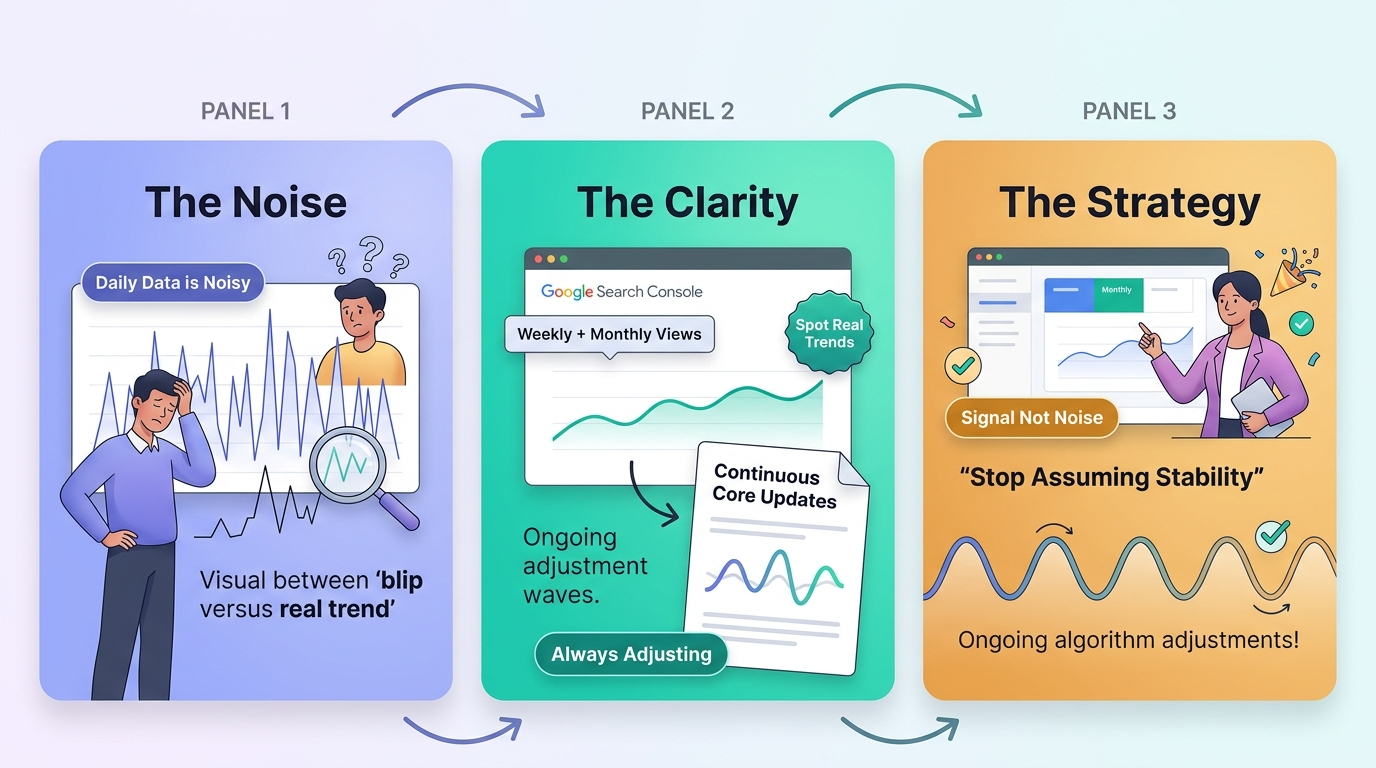
Create a premium visual storyboard infographic based on the section below.  CONTENT: The quick version: Google announced at Search Central Live in Zurich that Search Console performance reports now offer weekly and monthly views. The new views give more granular data to spot trends across longer windows. Google also updated its docs to confirm smaller core updates happen continuously, not just in big named events. More useful reporting Search Console now lets you switch performance reports into weekly and monthly views, which sounds small but changes how you spot trends. Daily data is noisy. Rolling it up to weeks and months makes a real shift easier to see and harder to mistake for a blip. The bigger admission Google quietly updated its core updates documentation to confirm that smaller core updates run on an ongoing basis, not only during the big named rollouts everyone tracks. That reframes how you should read ranking movement. If your traffic shifts outside a named update window, it is not necessarily a fluke or a technical bug. The practical move Use the new monthly view to separate signal from noise, and stop assuming stability between named updates. The systems are always adjusting. Barry Schwartz, who covers this relentlessly on X, has been making the same point for years, and Google just put it in writing: https://x.com/rustybrick   GOAL: Convert this blog section into a short visual story that shows the reader the problem, the process, and the outcome.  LAYOUT: Use a 3-part storyboard structure: 1. Problem or situation 2. Key action, method, or insight 3. Result, benefit, or takeaway  DESIGN REQUIREMENTS: - Use 3 clean panels or connected cards - Each panel should include a short title, simple label, and relevant illustration - Use arrows or visual progression between panels - Keep the layout premium, clean, and easy to understand - Avoid overcrowding the image  VISUAL STYLE: - modern editorial infographic - polished vector + soft 3D illustration - SaaS/marketing blog aesthetic - light theme - soft shadows - clean typography - subtle gradient background - professional and helpful, not cartoonish  CONTENT RULES: - Use only the concepts from the pasted section - Do not invent extra story elements - Keep text concise and readable - Make the image feel custom-made for this exact content   OUTPUT: 16:9, high-resolution, crisp text, blog-ready, no watermark.

More useful reporting

Search Console now lets you switch performance reports into weekly and monthly views, which sounds small but changes how you spot trends. Daily data is noisy. Rolling it up to weeks and months makes a real shift easier to see and harder to mistake for a blip.

The bigger admission

Google quietly updated its core updates documentation to confirm that smaller core updates run on an ongoing basis, not only during the big named rollouts everyone tracks.

That reframes how you should read ranking movement. If your traffic shifts outside a named update window, it is not necessarily a fluke or a technical bug.

The practical move

Use the new monthly view to separate signal from noise, and stop assuming stability between named updates. The systems are always adjusting. Barry Schwartz, who covers this relentlessly on X, has been making the same point for years, and Google just put it in writing: https://x.com/rustybrick

Quick Links:

Sonia Allan

Hey, I’m Sonia Allen- a freelance content writer and senior SEO analyst at Digiexe, where I geek out over content and data-driven SEO. With seven years of digital marketing and affiliate marketing experience, I love sharing tips on everything from eCommerce to social media. You’ll catch my work on sites like AffiliateBay, and Digiexe.com and SchemaNinja, where I break down big ideas into practical advice. When I’m not writing or tweaking SEO strategies, I’m probably sipping coffee and dreaming up my next project!

Leave a Comment