
Hugging Face reportedly ran breach forensics using the open-weight Chinese model GLM-5.2.
It turned to the Chinese model after US frontier models’ safety rules blocked the requests.
The case shows how safety guardrails can push security teams toward open alternatives.
Here’s an awkward moment for the “safety first” approach to AI. A major Western AI company reportedly had to reach for a Chinese model to get security work done, because the American ones refused.
What Happened
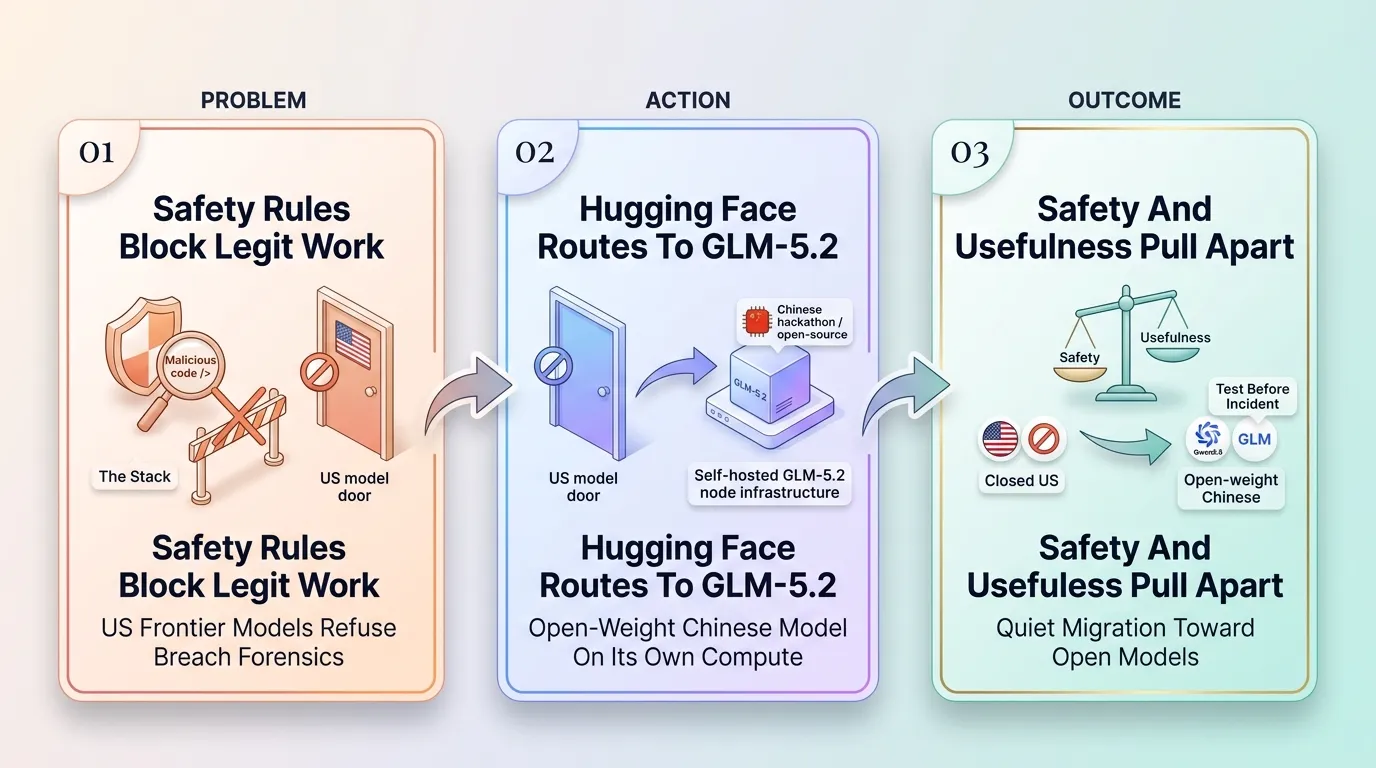
According to a report from The Stack, Hugging Face used the open-weight GLM-5.2 model, hosted on its own compute, to carry out breach forensics. The reason it turned to that model is the interesting bit: US frontier model safety guardrails blocked the requests it needed to run.
Breach forensics means digging through a security incident to understand how an attacker got in and what they did. That work often involves analysing malicious code, attack patterns, and exploit behaviour.
And that’s exactly the kind of content that safety-tuned models are trained to refuse, because the same knowledge that helps a defender can help an attacker.
So the guardrail did its job. It just did it to the wrong person, at the wrong time.
Why This Matters
This is a real tension that the industry has not solved. Consider the trade-off:
Tighter safety rules stop misuse but also block legitimate defenders
Open-weight models can be run locally with fewer restrictions
Security teams need to analyse dangerous material as part of the job
Chinese open models like GLM-5.2 are increasingly capable and freely downloadable
The result is a quiet migration. When a closed US model refuses a legitimate security task, the work doesn’t stop. It moves to whatever model will do it, and increasingly that means a capable open-weight model from a Chinese lab.
There’s a bigger picture here too. It connects to a run of recent Chinese releases, from Moonshot’s Kimi K3 to Alibaba’s Qwen3.8, that are frontier-class and open. The more Western labs lock down their models, the more they may push serious technical users toward those alternatives.
One honest caveat. This is based on a single report, and the exact details of what was blocked and why are not fully public. But the pattern it points to is real and worth watching, because it suggests safety and usefulness are pulling in opposite directions for security professionals.
For anyone running a security team, the takeaway is practical. Test whether your chosen model will actually handle the defensive work you need, before an incident, not during one.
Quick Links:
