
Every major AI system today belongs to a private company. OpenAI, Google, Anthropic, all of them. A nonprofit called Current AI thinks that’s a problem, and it’s building a public option to fix it.
In an interview published Sunday by TechCrunch, CEO Ayah Bdeir laid out the plan: open AI infrastructure modelled on the early World Wide Web, where no single company owns the rails and communities keep control of their own data.
From A Paris Summit To Real Products
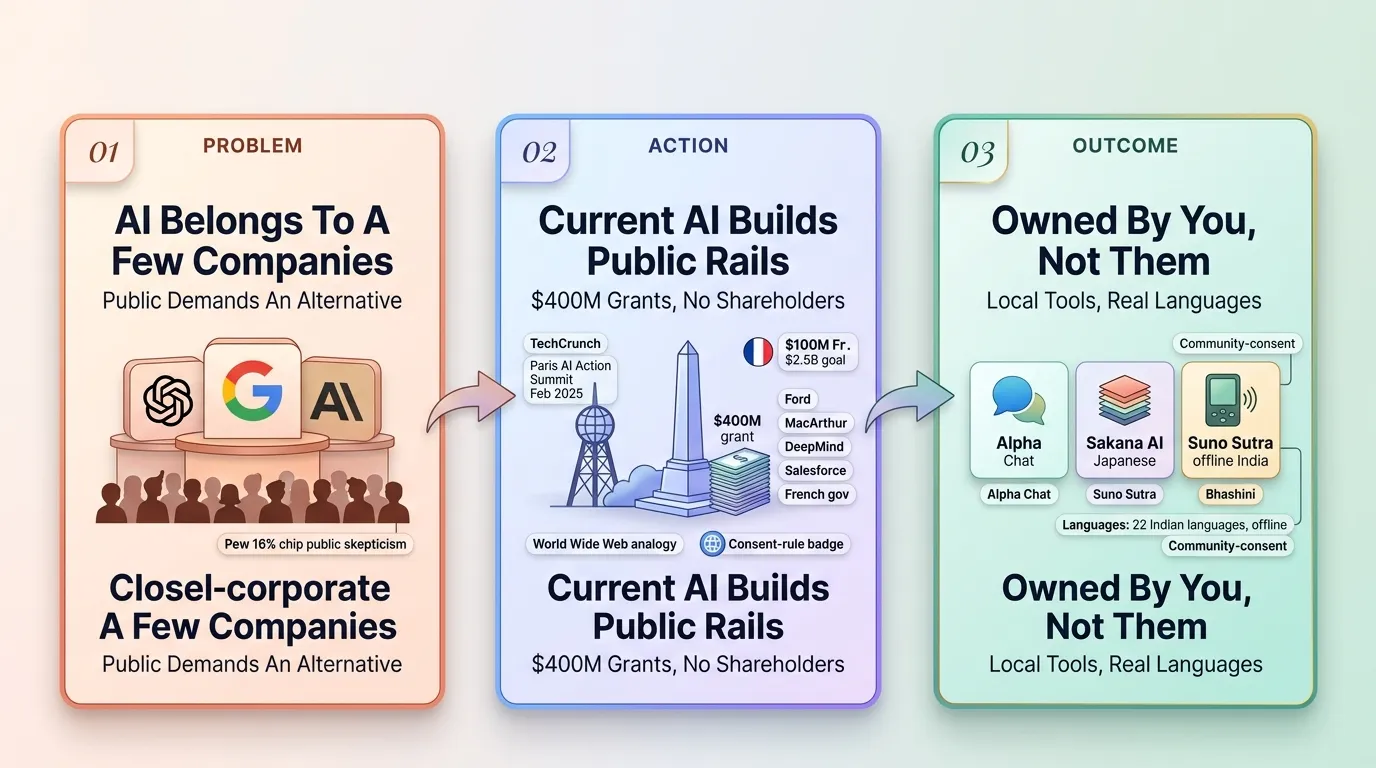
Current AI was founded in February 2025 at the AI Action Summit in Paris. Since then it has pulled together serious money, and notably, none of it comes from investors.
Here’s the funding picture:
$400 million in total committed funding
$100 million from the French government, the seed
Backers include the Ford Foundation, MacArthur Foundation, Google DeepMind, and Salesforce
The goal is to mobilise $2.5 billion over five years
All funding is structured as grants, not investment
That last point is the whole idea. As Bdeir puts it, the backers “are not investors; they’re funders.” With no shareholders to answer to, the organisation stays focused on open-source work rather than returns.
It also has high-profile political backing, with endorsements from UN Secretary-General Antonio Guterres and European Commission President Ursula von der Leyen.
“If AI is truly a transformative technology, if it’s going to change every aspect of everyone’s life, there has to be a public alternative,” Bdeir told TechCrunch. “Like the World Wide Web, available to anyone, for free.”
Real Tools, Not Just Talk
Current AI is already shipping. The work leans heavily toward languages and communities that big AI models ignore.
Recent projects include:
Alpha Chat, a no-login open-source chatbot built in seven weeks by ten groups, including Hugging Face, Mozilla, and MIT Media Lab
A partnership with Tokyo’s Sakana AI on a shared open-source stack for Japanese
$3.2 million in grants to four groups in Kenya, Lebanon, and the Brazilian Amazon
Suno Sutra, built with India’s government Bhashini division: a pocket-sized offline device running AI in 22 Indian languages, no internet needed
The India project is the clearest example of the mission. “In India, there are hundreds of different languages and dialects, and right now AI is not representing them,” Bdeir said. The device is open-sourced, so local developers can build on it.
The obvious question is whether a grant-funded nonprofit can compete with companies spending tens of billions. Bdeir’s answer is to reject the premise. Scale, she argues, shouldn’t be measured only by model size or cloud spend.
For many communities, usable local tools, consent rules, and language coverage matter more than benchmark scores. Current AI stores data locally and builds community consent into every stage, a deliberate contrast with Silicon Valley’s data-extraction habits.
The timing fits a sceptical public mood. A Pew Research study in June found only 16 percent of Americans believe AI will have a positive impact on society over the next two decades.
Whether a public option can scale is still an open question. But Current AI is betting that “good enough and owned by you” beats “world-class and owned by them.”
Quick Links:
