

Aimeos is a flexible and powerful eCommerce platform that allows businesses to create customized online stores. It’s ideal for developers seeking complete control over store features, though it requires technical knowledge to set up.
- Highly customizable
- Scalable solution
- Open-source platform
- Strong developer support
- Requires technical knowledge
Suppose you are already using Laravel, Symfony, or TYPO3 and plan to use it as a base for your eCommerce business. In that case, it’s important to consider existing extensions to speed up your time-to-market.
Building a complete platform from scratch can be very time-consuming. To find a reliable platform to help you grow your business, we conducted a comprehensive review of Aimeos.
Aimeos is a powerful e-commerce extension for Laravel, Symfony, and TYPO3 that seamlessly integrates into leading PHP frameworks and content management applications.
Aimeos Review 2026: An Overview
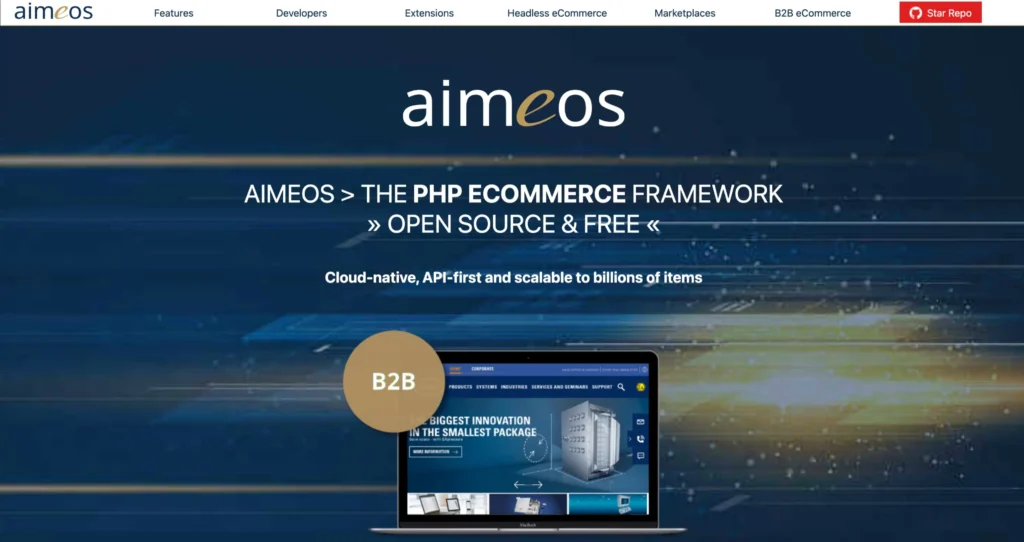
Aimeos is an extremely popular PHP e-commerce framework that is available as a Laravel package, Symfony bundle, and TYPO3 extension and seamlessly integrates into the named frameworks and applications.
It allows you to set up, customize, and adapt everything to your needs, making it suitable for both standard online shops and highly customized e-commerce applications.
Aimeos is an advanced e-commerce framework created for custom shops and e-commerce applications of any complexity.
The platform focuses on performance and speed, providing scalable solutions for businesses of all sizes, even those with over a billion articles, and surpassing Amazon’s offerings.
You can use your existing platform to sell products or services and grow your business without limitations.
Aimeos Technical Details
Here is a list of technical details about Aimeos that you should know about:
Supported platforms
- Laravel
- Symfony
- TYPO3
Operating systems
- Linux
- Unix
- MacOS
- Windows
Web servers
- Apache
- Nginx
- IIS
Database servers
- MySQL
- MariaDB
- PostgreSQL,
- SQL Server
Programming language
- PHP 7.1+
- PHP 8.0+
Frontend
- Headless (JSON REST API)
- HTML
Supported Languages
- English
- Japanese
- Spanish
- Spanish (Argentina)
- Chinese
- Italian
- Dutch
- French
- German
- Hindi
- Portugese
- Russian
- Swedish
- Turkish
- Polish
- Bulgarian
- Ukranian
- Hungarian
- Danish
- Arabic
- Romanian
- Serbian
- Croatian
- Slovak
- Czech
- Estonian
- Persian
- Latvian
- Vietnamese
- Burmese
- Norwegian
Aimeos: Key Features
So, here is a list of some popular Aimeos use cases:
1. Marketplace and SaaS platform
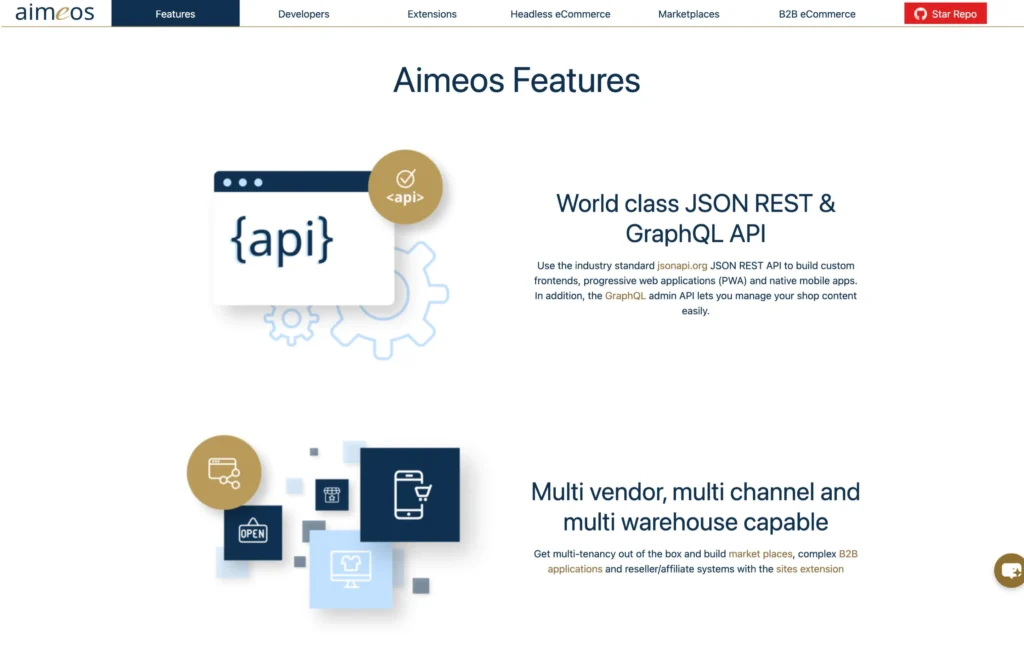
The marketplace extension will help you design your personalized multi-vendor marketplaces, loaded with useful, performant features.
All vendors will be able to create their shops for customers in your area, segment, or target group. This marketplace extension enables you to create a tailored e-commerce platform that can be scaled according to your needs.
2. Countless Vendors in a Single Marketplace
Enable your clients to use a single basket with just one checkout and payment to purchase goods from any vendor in your marketplace.
Each seller has access to the items customers have ordered, including the necessary order information, and can update the delivery status themselves.
3. Every Vendor Gets a Fully Functional Shop
Give merchants their stores where they can only sell their goods. Although still using the marketplace site, these vendor shops may also have their own domains. For each commodity, merchants with many warehouses may also add several stock levels.
4. Create Multiple Specialized Marketplaces
Would you like to create marketplaces of your own for various segments and merge all goods into a single parent marketplace?
With AIMEOS, you can build a multi-level tree of marketplaces without performance loss, and it provides you with fine-grained control over what is available at each level.
5. Ideal for Marketplaces Having Unlimited Items
While being ultra-fast, AIMEOS and Laravel scale up your marketplace. A regular relational database, such as MySQL, PostgreSQL, or SQL Server, can be used to store 1+ million products and combined with Solr for fast searching.
For nearly an infinite number of items, use Elasticsearch and the Aimeos #gigacommerce extension.
6. Use for Drop-shipping
Added items can be inherited for drop-shipping. These items can be made available by your merchants in their shops, and they can add your pricing, texts, and images that are only accessible in their shops.
7. Full-featured Admin Interface and Permission Handling
See complete information on all orders as the marketplace owner, and assist vendors in the admin backend with their products and content.
Restrict merchant access by assigning limited rights so they can only manage products, prices, and other vendor-related data.
8. Full support of the JSON: API
In all frontends, all marketplace features are equally accessible and administration is also possible using the web interface or the admin API.
Aimeos Vs Magento – A Quick Comparison
Are you unsure which e-commerce solution is better: Aimeos or Magento? In this section, we compare Aimeos and Magento to determine which eCommerce software is the better choice.
You should look into the details, such as available resources, pricing, and the plans offered by each vendor.
Features
AIMEOS
- Data Security
- Email Marketing
- Discount Management
- Inventory Management
- Kitting
- Mobile Access
- Multi-Channel Marketing
- Multi-Store
- Promotions Management
- Reporting/Analytics
- Reviews Management
- SEO Management
- Templates
- eCommerce Integrations
MAGENTO
- Alerts/Notifications
- Cataloguing/Categorization
- Discount Management
- Inventory Control
- Mobile Access
- Reporting/Analytics
- Returns Management
- SEO Management
- Shipping Management
- Website Management
- eCommerce Integrations
What Do Customers Think?
When comparing products and services, the most important and insightful source of information comes from customer reviews and feedback posted on online forums.
Capterra is one of the most trusted and reliable sources for authentic customer reviews of software and applications.
It allows users to post their views and opinions on a particular software and verify their sources. You will often find people sharing the pros and cons of the software, along with some additional feedback.
Using Capterra, we compared Aimeos and Magento, two leading platforms for eCommerce, and found the following results and feedback from a head-to-head comparison:
| Feature | AIMEOS | MAGENTO |
|---|---|---|
| Average Rating | 4.8 ✭ | 4.3 ✭ |
| Pros | – Seamless performance, no major issues. – Comprehensive shop framework with great features. – Strong integration with multiple PHP frameworks (e.g., TYPO3). – Excellent customer support, fast and helpful. – Feature-rich, ideal for scaling. | – Easy to learn and train others. – Large selection of extensions. – Great theme options (free and paid). – Supports large product catalogs. |
| Cons | – Occasional complexity in configuration (manageable for experienced users). | – Complex code; difficult for developers. – Expensive themes; less popular compared to other eCommerce platforms. – Unfair pricing model, causing developers to leave. |
| Overall Verdict | AIMEOS stands out with its seamless performance, powerful features, and excellent support, making it an ideal solution for businesses of any size. | Magento offers a strong set of features but suffers from complex setup, high costs, and an outdated support system |
Aimeos: Performance
With typical memory usage ranging from 3-6 MB, Aimeo’s solutions are small and very resource-efficient.
On the contrary, Magento is large and heavy due to its architecture and requires powerful hardware, including a dedicated hosting server.
Furthermore, scaling Magento beyond 50,000 products is difficult and requires significant hardware and additional caching.
Aimeos, on the other hand, scales to 100,000+ products out of the box and can scale infinitely when using Elasticsearch and the #gigacommerce extension, with only minimal hardware requirements.
It’s important to note that Magento is only a standalone framework.
At the same time, Aimeos is an open-source library that can be integrated into Laravel, Symfony, or TYPO3 CMS or used standalone in a Laravel-based online shop solution.
Aimeos: Supported Languages
Aimeos takes a healthy lead over Magento in multi-language support. Aimeos currently supports over 30 international languages, whereas Magento supports only 6 out of the box.
For Magento, additional language packs are available from 3rd-party vendors, some free and others paid.
Aimeos Vs Magento
Aimeos is a newer platform than Magento, and it takes a unique approach to e-commerce: it’s an open-source PHP library of e-commerce components that can be used to embed e-shops into various applications and frameworks, such as Laravel, Symfony, and TYPO3.
Aimeos supports an unlimited number of items, with up to 100,000 products using regular MySQL out of the box, and many millions using Solr/ElasticSearch. For online business owners using a standard LAMP stack, the Aimeos Laravel kit provides a full, tested shopping framework.
Both platforms offer powerful extensions for integrating with third-party plugins that can help boost your business online, but Magento offers many more integrations out of the box.
Many of them are of mixed quality, which can negatively affect your shop’s performance and stability, so it depends on your preferences.
If you are looking for a platform that allows you to seamlessly integrate your eCommerce store with popular PHP frameworks like Laravel and TYPO3, then Aimeos is your go-to solution!
Flexibility & Customization of Aimeos
Aimeos has been developed to be developer-friendly and highly flexible for customization.
That allows developers to build highly customized online shops, marketplaces, and B2B portals using the Aimeos framework.
When it comes to models, no other open-source competitor currently on the market can match Aimeos’ selection of design and customization choices.
It is the perfect solution for eCommerce companies and entrepreneurs looking to grow and evolve their e-shops.
Performance & Stability of Aimeos
In the fast-paced online market, every competitive e-commerce platform must concentrate on its performance to attract buyers.
With Aimeos, the response time for requests can be down to 40 ms for the first byte when using block-level caching.
Aimeos offers strong stability and efficiency, and its SEO capabilities are commendable and ideal for businesses of all sizes.
Aimeos offers fully configurable SEO, custom HTML meta tags, translatable URL segments, and Google-readable product information.
Content Commerce With Typo3 CMS
TYPO3 is a trusted content management framework used by many large, well-known businesses and is the perfect foundation for content-driven e-commerce and multi-brand portals.
TYPO3 is the right tool for you if you need to build, manage, and output any digital content.
You can start small and scale up quickly, but you’ll never need to adjust the Content Management System because TYPO3 adapts to your requirements.
After installing the Aimeos e-commerce extension, you can add Aimeos plugins like the product list or detail component to every page, even within existing content.
This lets you add products to your landing pages so customers can buy them with a single click.
Scale Up With #Gigacommerce
1. Powerful ElasticSearch
The ElasticSearch integration allows you to scale beyond your wildest dreams. Aimeos can use the default DB configured in the database.
2. Infinitely Scalable
With the #gigacommerce extension, Aimeos scales almost infinitely —from one product to 1 billion products and beyond! Your business can grow using the same platform. You can start small, keeping your initial costs low, and scale out as your business grows.
3. High Speed
#gigacommerce superfast servers ensure a superfast response time for your e-commerce platform, usually between 100 and 300 milliseconds, regardless of how many products are in your online shop.
4. Easy to Integrate
The #gigacommerce extension is extremely easy to integrate with your online store and allows you to store all product data in Elasticsearch only.
5. Use With The JSON: API
Another big advantage of using the #gigacommerce extension is that it is fully compatible with the Aimeos REST API.
Who Should Use Aimeos?
Companies in need of a highly flexible, scalable, and high-performance e-commerce platform that can fully adapt to their online store, marketplace, and complex B2B application requirements should consider Aimeos.
Aimeos can scale to any business size and seamlessly integrate with your current systems.
This integration allows you to incorporate your CRM, ERP, document management systems, or other data sources directly into the webshop, online store, or marketplace developed using Aimeos.
This provides you with an e-commerce solution that easily integrates with your existing ecosystem and supports your business model and requirements.
Quick Links:
- Best OptinMonster Alternatives
- Nestify Review
- InterServer Review
- HubSpot CRM Review
- HubSpot Vs Pipedrive
- GoHighLevel Vs HubSpot
- HubSpot Vs Constant Contact
Final Verdict: Should You Use Aimeos?
Aimeos is a reliable third-generation solution for e-commerce users, designed to enable the creation of online stores, complex B2B eCommerce applications, SaaS platforms, and marketplaces as flexible and scalable solutions that cater to businesses of all sizes.
You can integrate Aimeos into your existing application and boost your business to achieve faster growth.
