
The Data Reframing the Doom Narrative
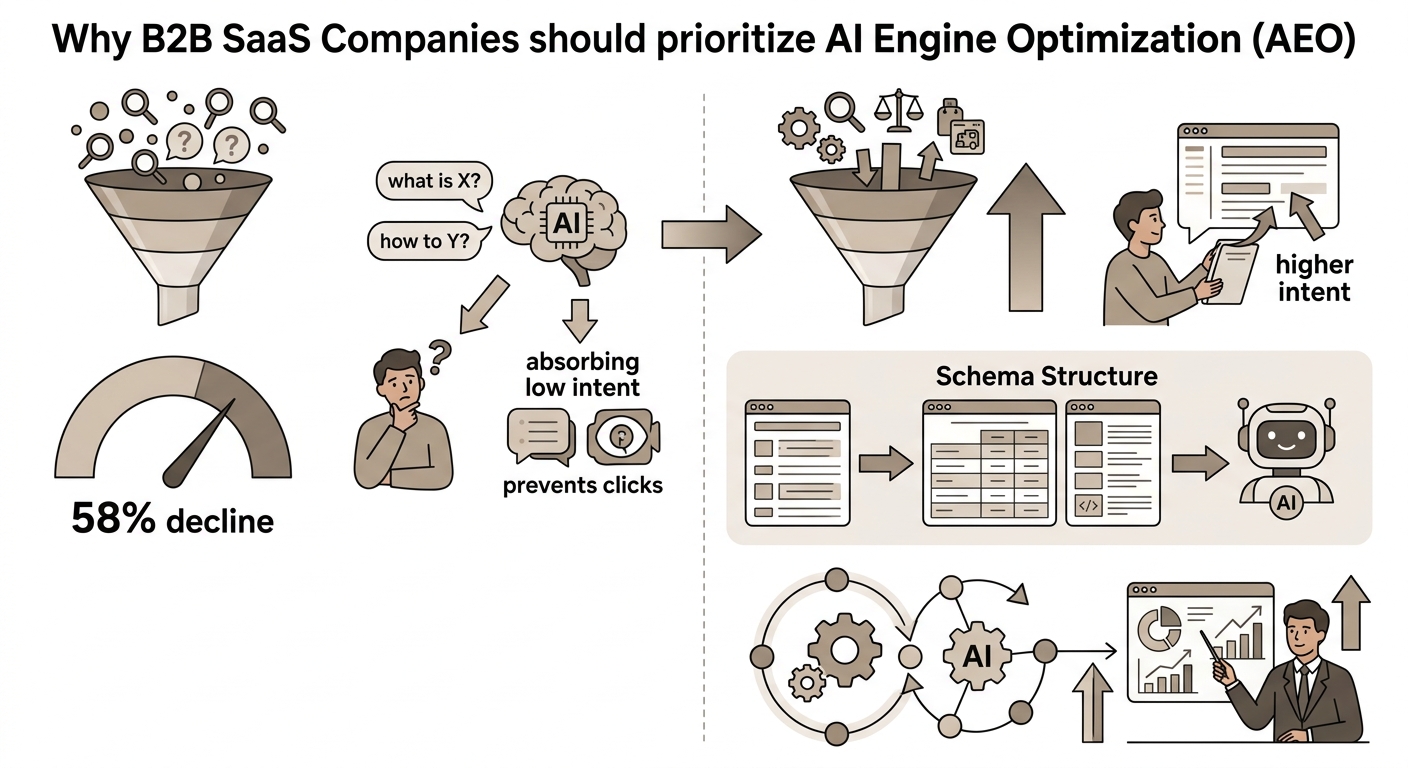
B2B SaaS companies should prioritise AEO because HubSpot reports 58% search volume decline on some queries but higher intent from remaining searches, alongside AI-assisted decisions for complex attribution.
The 58% search volume decline sounds catastrophic until you read the second half of that sentence. Higher intent from remaining searches is the qualifier that changes the business implications entirely.
When AI systems answer the basic informational queries — “what is CRM software” and “how does email marketing work” — the queries that still drive clicks to your pages are the ones from buyers who have already done the research and are now comparing specific options. These are higher-converting, shorter-funnel visitors.
For schema practitioners, this bifurcation of the search landscape creates a specific structural priority. The content worth investing schema implementation time in is not broad definitional content that AI systems will answer without sending clicks.
It is the specific comparison content, the detailed use-case content, and the expert evaluation content that AI systems cite as sources when assembling their answers for high-intent comparison queries.
The Multi-Modal Asset Requirement
AI marketing trends in 2026 include a shift toward multi-modal assets — combining text, video, image, and interactive tools — as these are harder for AI systems to fully replicate in an answer summary.
Structured content combined with multi-modal assets outperforms text-only pages for both traditional rankings and AI Overview citations
This finding has a direct schema implication. The VideoObject and ImageObject schema types — often treated as secondary priorities after Article and FAQ schema — become more important when multi-modal content is the citation advantage over pure text.
A page that includes a genuine product demonstration video with VideoObject schema is providing both a human-readable multi-modal asset and a machine-readable signal about that asset’s content that increases citation probability.
The interactive tool angle is the most underimplemented. A pricing calculator, a product comparison tool, or a configuration wizard embedded in a page — and marked up with structured data indicating its interactive nature — is genuinely difficult for an AI system to replicate in an answer summary.
The user has to visit the page to use the tool. That forces the click that zero-click trends otherwise prevent.
💬 Reddit — r/TechSEO on multi-modal assets and schema for AEO: 🔗https://www.reddit.com/r/TechSEO/search/?q=multi+modal+assets+schema+AEO+B2B+SaaS+2026
🐦 X/Twitter — SEO practitioners sharing multi-modal content and schema strategies: 🔗https://x.com/search?q=multi+modal+content+schema+AEO+SEO+2026&f=live
💬 Quora — how does multi-modal content affect AI Overview citations in 2026: 🔗https://www.quora.com/search?q=multi+modal+content+AI+Overview+citation+schema+2026
Quick Links:
