
Oxylabs

- 175M+ global IP pool
- Coverage in 195+ countries
- IP authentication
- Username/password authentication
- Proxy endpoint generator
Decodo

- 125M+ global IP pool
- 195+ proxy locations
- Carrier targeting for mobile proxies
- Third-party tool integration
- Automation-friendly proxies
Webshare

- 80+ million IPs
- 195+ countries
- 99.7% success rate
- 24/7 Expert Support
- Flexible pay-as-you-go pricing
Here is a fact that most SEO guides skip: over 89% of enterprise SEO teams now use proxy networks for data collection. And the reason is simple — Google blocks automated requests aggressively. Without proxies, your rank tracking tool is essentially blind.
But here is the part nobody talks about: choosing the wrong proxy does not just waste money. It gives you wrong data. A shared IP that was used by someone else last week might already be flagged by Google, meaning your “rank checks” are returning blocked results, not real rankings. You think you are tracking positions. You are actually tracking nothing.
This guide is different from most you will find. We are not just listing providers. We are going to tell you exactly which type of proxy fits which SEO task, what the real cost looks like when you do the math, and which providers have features that actually matter for SEO in 2026— including tracking in AI search results, which almost no other guide mentions yet.
Quick answer if you are in a hurry: Oxylabs for enterprise SEO and SERP API. Decodo for the best price-to-performance ratio for agencies. Webshare for solo operators and small teams on a tight budget. Keep reading to find out which one is right for your specific situation.
What Makes a Proxy Actually Good for SEO? (The Part Most Articles Skip)
Before the list, this section will save you money and headaches.
Most proxy guides tell you to look at IP pool size and price per GB. Those matter, but they are not the most important things for SEO work.
Here is what actually matters:
1. IP quality, not just quantity A pool of 150 million IPs is useless if half of them are already flagged by Google. What you want is a clean pool — IPs that have not been used for abuse or spam. Providers like Oxylabs and Rayobyte are known for ethically sourced IPs with low blacklist rates. Cheap providers often recycle burned IPs that will get blocked immediately.
2. Rotating vs sticky sessions — match to your task Rotating proxies change IP on every request. Good for bulk scraping. Sticky sessions keep the same IP for a set time. Better for rank tracking, where you need consistent results from the same “location”. Most tools like Ahrefs Rank Tracker or SEMrush need sticky sessions to work properly.
3. Geo-targeting depth Country-level targeting is not enough in 2026. If you are doing local SEO for a client in Chicago, you need city-level targeting — ideally ZIP code level. Not all providers offer this. Oxylabs and Bright Data go down to ZIP and ASN level. Others only go to city.
4. Protocol support matters for your tools Most SEO rank tracking tools need HTTP or HTTPS proxies. If you are running custom scrapers, SOCKS5 gives better speed and security. Make sure your provider supports both.
5. The new thing in 2026: AI search visibility tracking SEO in 2026 is not just about Google’s 10 blue links anymore. You need to track:
Google AI Overviews (whether your content appears in AI-generated summaries)
Bing Copilot results
Visibility on ChatGPT and Perplexity
All of these block automated access aggressively. You need rotating residential proxies with sticky sessions of at least 10-30 minutes to track AI search results consistently. This is something almost no proxy guide covers yet, and it is becoming critical.
How Much Do SEO Proxies Actually Cost? (Real Numbers)
The advertised price and the real cost are very different things. Here is how to think about it:
If you are tracking 1,000 keywords across 10 cities, that is 10,000 SERP requests per check. If you check daily, that is 300,000 requests per month. Each Google SERP page is roughly 0.2 to 0.5 MB of data. So you are looking at 60GB to 150GB of bandwidth per month just for rank tracking — before you add competitor scraping, backlink checking, or content auditing.
At $2/GB, that is $120 to $300 per month. At $6/GB (enterprise tier), it is $360 to $900 per month. This is why picking the right pricing tier and provider matters so much.
1. Oxylabs — Best for Enterprise SEO and SERP API
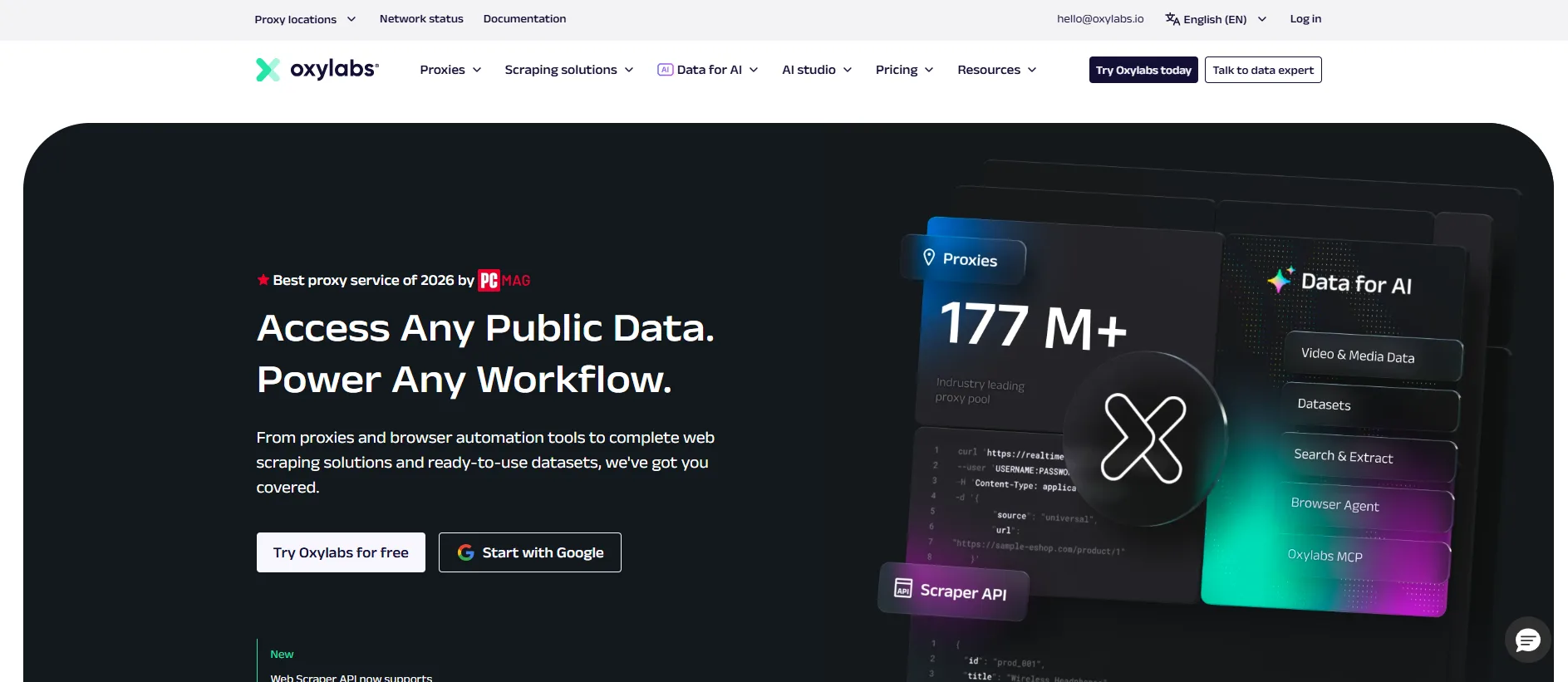
IP Pool: 177M+ residential IPs across 195 countries Pricing: Starter $30/month (5GB at $6/GB), Basic $100/month (20GB at $5/GB), Advanced $500/month (125GB at $4/GB), Corporate $2,000/month (1TB at $2/GB) Geo-targeting: Country, city, state, ZIP code, ASN, coordinates Free trial: Yes — limited trial available, contact support Website: oxylabs.io
Oxylabs has been independently ranked as the top overall SEO proxy provider in 2026. Cybernews rated it number one citing pool size, success rate, and dedicated tooling that no other provider matches at scale.
The standout feature for SEO is the SERP Scraper API. This is not just a proxy — it is a dedicated tool that sends the request, handles Google’s anti-bot systems automatically, solves CAPTCHAs, and returns clean, pre-parsed JSON data. You do not need to build a parsing layer on top of it. For technical SEO teams or developers building rank tracking products, this saves enormous amounts of engineering time.
Success rate consistently comes in above 99.5%, and independent benchmarks show it performs well even on the most protected SERP targets. The 177M+ residential IP pool is one of the two or three largest ethically sourced pools in the world.
What others do not tell you: Oxylabs is ISO/IEC 27001:2022 certified on both proxy and scraping API products. This matters if you work with clients that have compliance requirements — financial firms, healthcare companies, government agencies. Most proxy providers cannot offer this.
The honest downside: The price is high for small operations. At $6/GB on the Starter plan, you are paying a premium compared to budget alternatives. Residential, ISP, and mobile require paid plans with no instant free trial the way Decodo offers. And the product lineup can overwhelm new users.
Who should use it: Technical SEO professionals, SaaS rank tracking companies, enterprise agencies doing large-scale SERP data collection, and anyone who needs the highest possible success rate without building and maintaining their own scraping infrastructure.
Best SEO use cases: SERP scraping at scale, hyperlocal rank tracking, competitor content analysis, Google AI Overview monitoring.
2. Decodo (formerly Smartproxy) — Best Overall Value for Agencies
IP Pool: 115M+ residential IPs across 195+ countries Pricing: Residential from $1.50/GB; entry plan ~$55 for 10GB; PAYG at $8.50/GB Geo-targeting: Country, city, state Free trial: 100MB free residential trial on signup, 14-day money-back guarantee Website: decodo.com
Decodo rebranded from Smartproxy in April 2025 but the infrastructure is the same company that built one of the most trusted proxy networks in the market. Proxyway’s independent benchmark of 1.2 million requests put Decodo at a 99.86% success rate with 0.63 second average response time — making it the fastest residential proxy provider tested in their April 2025 benchmark, faster than both Oxylabs and Bright Data.
The pricing story is also strong. At the 10TB level, Decodo costs 33% less than Bright Data for the same bandwidth. At mid-market volumes, it delivers near-enterprise performance at a much more accessible price.
What others do not tell you: Decodo launched an AI Parser in 2026— you point it at any website, describe what you want in plain English, and get back clean JSON data without writing any code. They also launched an MCP Server that connects AI tools like Claude and LangChain agents directly to Decodo’s scraping infrastructure, letting your AI assistant browse the live web for real-time data. No other provider on this list has done this yet.
The 100MB free trial is genuinely useful — it is enough to test your specific target sites and rotation settings before committing to any paid plan.
The honest downside: PAYG pricing jumps to $8.50/GB which can be expensive if you forget to monitor usage. Some G2 reviewers (81 mentions) flag pricing as the top complaint, and 89 reviews mention proxy outages — though the baseline performance is still excellent.
Who should use it: SEO agencies running multi-client rank tracking, mid-market teams doing competitor scraping and keyword research, developers who want solid performance without enterprise pricing or complexity.
Best SEO use cases: SERP monitoring across multiple cities, keyword research at scale, competitor content analysis, backlink research.
3. Webshare — Best for Solo SEOs and Budget-Conscious Teams
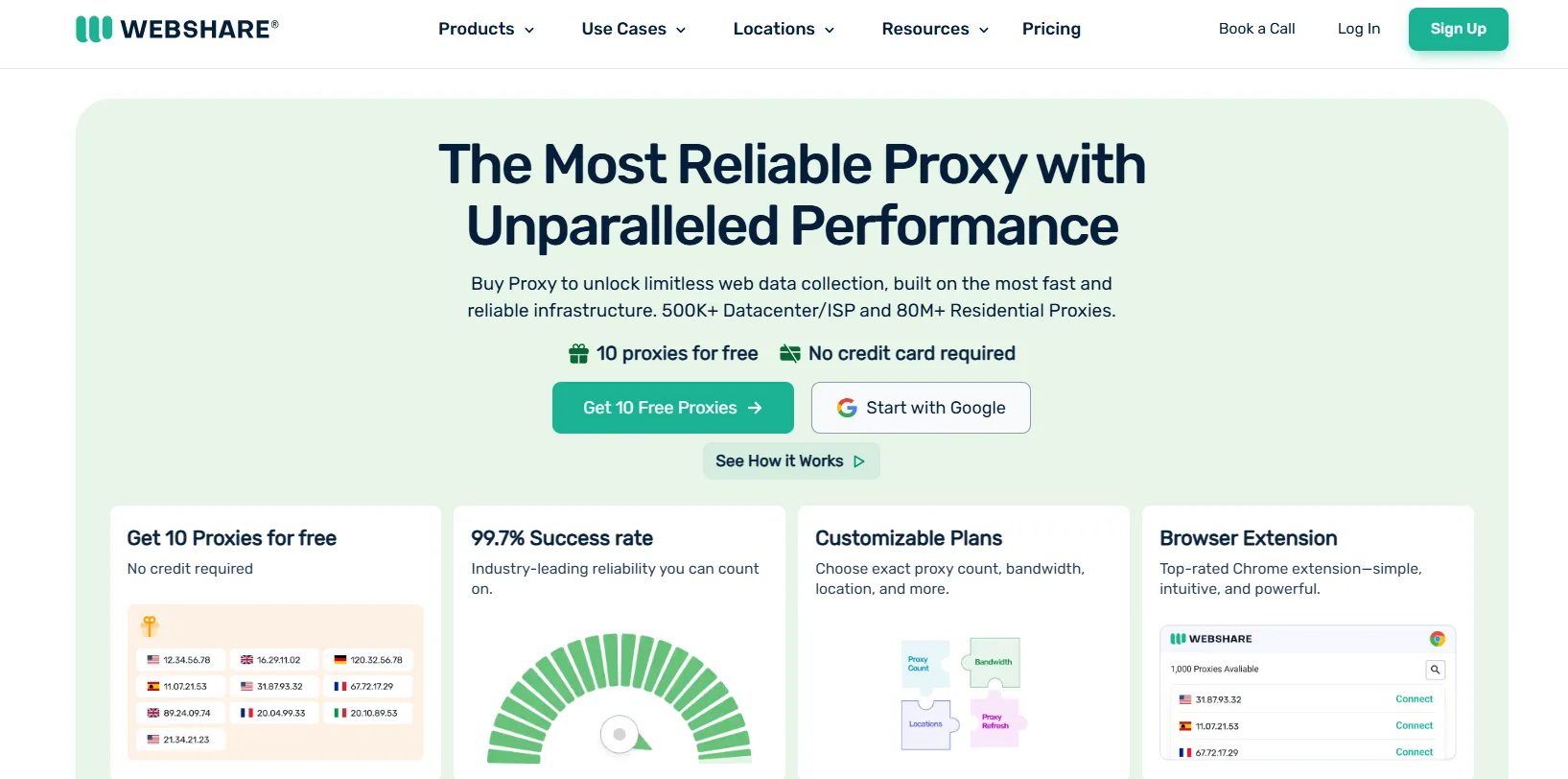
IP Pool: 30M+ Pricing: Free plan (10 proxies, 1GB/month), residential from $1.40/GB, datacenter from $0.014/IP Geo-targeting: Country and city level Free trial: Yes — genuine free plan with 10 proxies and 1GB, no credit card required Website: webshare.io
Webshare is the most accessible proxy provider on this list. It is the only provider that offers a genuine free plan — not a trial, but an ongoing free tier with 10 proxies and 1GB of bandwidth every month. This makes it an easy choice for solo SEOs who want to test before committing to any spend.
The pricing on paid plans is also among the lowest: residential proxies from $1.40/GB and datacenter proxies from $0.014/IP make Webshare one of the most affordable options available. For small teams doing basic rank tracking, competitor research, or limited keyword scraping, Webshare gets the job done without overcomplicating things.
The Simple API integrates cleanly with most SEO automation tools and is developer-friendly. Setup is fast and documentation is clear.
What others do not tell you: Webshare’s datacenter proxies at $0.014/IP are genuinely exceptional value for lower-risk SEO tasks like scraping competitor pricing pages, site audits, or pulling data from Bing and Yahoo where detection rates are lower than Google. For these tasks, you do not need residential IPs, and Webshare’s datacenter pool is the cheapest legitimate option available.
The honest downside: Webshare is subscription-based — bandwidth expires at the end of the month, unlike providers like DataImpulse where traffic never expires. The pool size (30M+) is smaller than Decodo or Oxylabs. For heavy Google SERP scraping at scale, the success rates will be lower than premium alternatives. Support response times are slower than enterprise options.
Who should use it: Freelance SEOs, bloggers, niche site owners, small in-house marketing teams, or anyone who wants to start without spending money before they know if proxies will work for their use case.
Best SEO use cases: Lightweight rank checking, basic keyword research, site auditing, scraping competitor pages, introductory SERP monitoring.
4. Bright Data — Best for Enterprise Teams That Need Everything in One Place
IP Pool: 150M+ residential IPs across 195 countries Pricing: PAYG from $4.20/GB residential, subscription plans from $499/month Geo-targeting: Country, city, ZIP code, ASN coordinates Free trial: 7-day trial for registered businesses Website: brightdata.com
Bright Data is the company that essentially invented the modern residential proxy market. It started as Luminati and evolved into a full data platform. In 2026 it competes with Oxylabs on features and scale, and matches it on ZIP code and ASN-level targeting.
The product suite is the widest of any provider: residential proxies, datacenter proxies, ISP proxies, mobile proxies, a Web Unlocker, a SERP API, browser automation, and 120+ no-code scrapers for specific websites. If you need to collect structured SEO data from Amazon, LinkedIn, Google, or any major platform, Bright Data has a scraper built for it already.
Success rates hold around 99% consistently, and geo-targeting accuracy is among the best in the market.
What others do not tell you: Bright Data offers the first 3 months at 50% off for new residential subscribers — bringing the effective cost down to around $1.77 to $2.10/GB during the trial period. This makes testing it at real scale significantly more affordable than the headline price suggests.
The honest downside: This is the most expensive provider on this list for ongoing use. The learning curve is steep — the number of products and configuration options is higher than any competitor. KYC (identity verification) is required before you can access some products. If your budget is under $300/month or you are new to proxies, start somewhere else.
Who should use it: Enterprise SEO teams with compliance needs, agencies managing many client accounts who want a single vendor for all data collection, developers building data products at scale.
Best SEO use cases: All SEO tasks at enterprise scale, structured data extraction from major platforms, programmatic SEO content research, multi-location SERP tracking.
5. SOAX — Best for Precise Geo-Targeting and Clean IP Quality
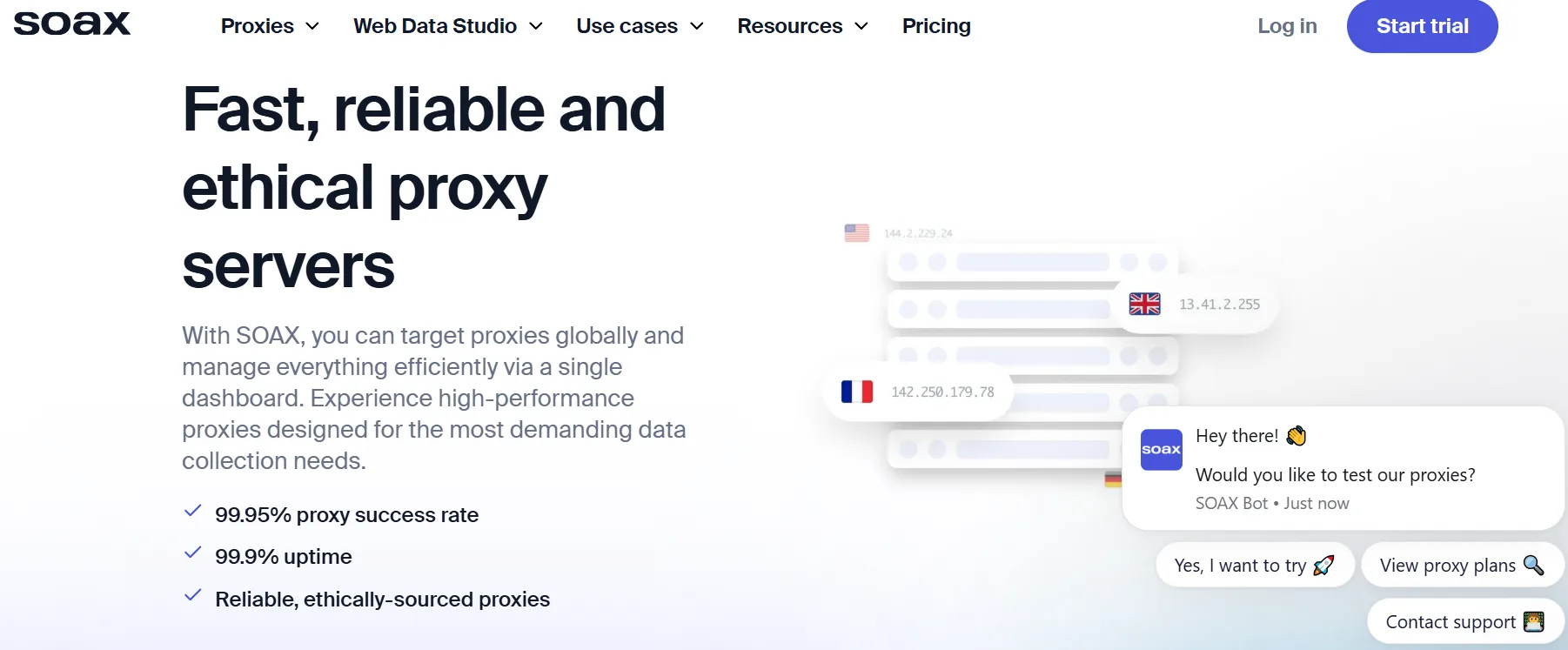
IP Pool: 191M+ claimed (independent tests suggest smaller active pool) Pricing: Residential from $3.60/GB; entry plans from $90/month for 25GB Geo-targeting: Country, city, ASN, ISP level Free trial: Paid trial available Website: soax.com
SOAX sits in the mid-market between budget providers and full enterprise platforms. Its main differentiator is clean IP pool management — the company actively filters and rotates out poor-quality IPs, meaning the pool you access has lower blacklist rates than many larger-sounding competitors.
The geo-targeting is strong, with ASN and ISP-level filtering that lets you target very specific internet infrastructure. For local SEO tasks — checking how a business ranks in a particular neighborhood or ISP zone — this precision is useful.
Sticky sessions of up to 7 days are available, which is longer than most providers offer and useful for multi-step rank monitoring workflows where you need the same IP across multiple sessions.
What others do not tell you: SOAX has a unified subscription model that covers multiple proxy types under one plan. If your SEO work needs both residential and mobile proxies (for example, checking both desktop and mobile SERPs), you can manage this under one account without separate plans. Most providers charge separately for each proxy type.
The honest downside: The IP pool size claims (191M+) have been questioned by independent testers who found the actual active pool smaller. The entry price of $90/month for 25GB is higher than Decodo’s equivalent. Monthly plans mean bandwidth expires, so it works best for teams with consistent predictable volume.
Who should use it: SEO agencies doing geo-sensitive rank tracking at city level, teams verifying localized search results for clients across different ISPs, ad verification for location-specific campaigns.
Best SEO use cases: Local SEO rank checking, ISP-specific SERP monitoring, city-level competitor analysis, mobile vs desktop SERP comparison.
6. IPRoyal — Best for Freelancers Who Need Flexibility Without Commitment
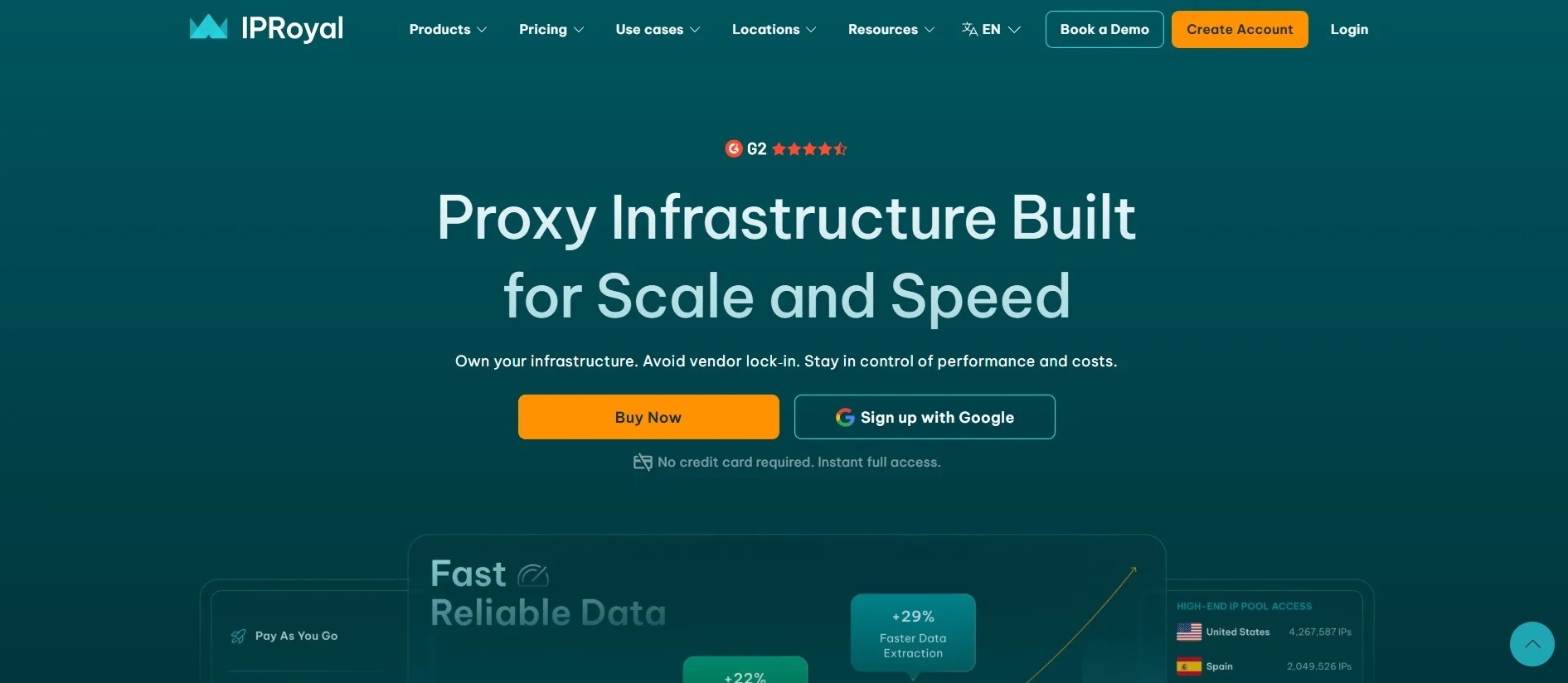
IP Pool: 32M+ residential IPs across 195+ countries Pricing: Residential from $1.75/GB; traffic never expires Geo-targeting: Country, city level Free trial: No, but non-expiring traffic means you can buy a small amount and test Website: iproyal.com
IPRoyal has grown quickly into one of the most popular budget options for individual SEOs and small teams. The key feature that sets it apart is non-expiring traffic — when you buy bandwidth, it stays in your account until you use it. For freelancers or small agencies with unpredictable workloads, this is a significant advantage over providers where unused bandwidth vanishes at the end of the month.
Independent benchmarks put IPRoyal at around a 96.5% success rate with 1.1 second average response time on residential proxies. It is not as fast as Decodo, but for daily rank checks and moderate-volume SERP monitoring, the performance is reliable and consistent.
The pay-as-you-go flexibility is genuinely low risk — you can spend $10 to test performance on your specific targets without any monthly commitment.
What others do not tell you: IPRoyal’s sticky sessions support up to 7 days — the same as SOAX. This makes it particularly good for rank tracking tools that need the same IP to return results consistently across multiple daily checks. For users monitoring the same keyword in the same location every day, 7-day sticky sessions means you are not constantly creating new session contexts.
The honest downside: At 32M+ IPs, the pool is significantly smaller than Decodo or Bright Data. Under heavy concurrent load, IP quality degrades faster than with larger pools. Some platforms and heavily protected SERP targets will see lower success rates than premium providers. Support is slower and less technical than enterprise options.
Who should use it: Freelance SEOs, niche site operators, small SEO agencies with variable monthly volume, anyone who wants residential proxy access without a monthly commitment.
Best SEO use cases: Daily keyword rank tracking, small-scale competitor research, backlink verification, moderate SERP data collection.
7. ProxyEmpire — Best for Teams That Want Multiple Proxy Types With Guided Setup
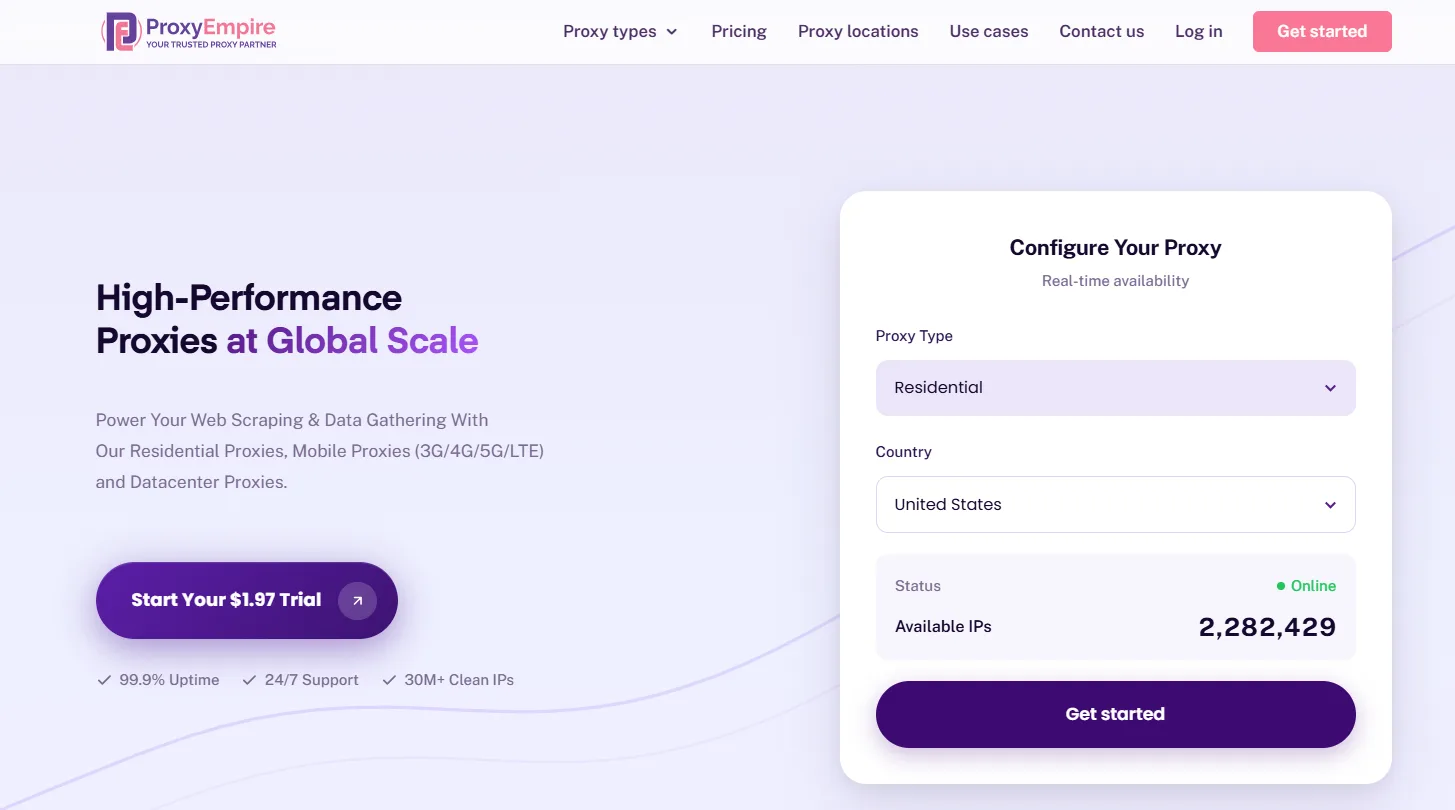
IP Pool: 170+ countries for residential Pricing: Custom; contact for pricing; discount code PROMO50 confirmed for 50% off Geo-targeting: Country, city, and ISP level Free trial: No, but VIP integration support included with every plan Website: proxyempire.io
ProxyEmpire is certified by EWDCI (Ethical Web Data Collection Initiative), which confirms the ethical sourcing of all their proxies. This matters more than many SEOs realise — using proxies sourced from devices without user consent creates legal and reputational risk. ProxyEmpire’s certification is one of only a few in the industry.
The standout feature is what they call VIP integration support — every residential proxy plan includes hands-on help from their team to get you set up. For SEO professionals who are not developers, this removes the biggest friction point in using proxies, which is configuration and integration with tools like Ahrefs, SEMrush, or custom scrapers.
They offer residential, mobile, datacenter, and ISP proxies all under one roof, which gives you flexibility to use different proxy types for different SEO tasks without managing multiple provider relationships.
What others do not tell you: ProxyEmpire has some of the most detailed documentation specifically around SEO proxy use cases — dedicated guides for rank tracking, competitor analysis, and SERP scraping that are more practical than most other providers’ generic documentation.
The honest downside: Pricing is not publicly listed in full — you need to contact sales for detailed quotes, which adds friction if you want a quick comparison. The pool size is smaller than Tier 1 providers, and independent success rate data is harder to find compared to Decodo or Oxylabs. The discount code PROMO50 is verified to apply to ongoing subscription payments, not just first purchase.
Who should use it: SEO agencies that want guided setup and do not want to figure out proxy configuration themselves, teams that use multiple proxy types and want one vendor for all of them.
Best SEO use cases: Multi-account social SEO management, rank tracking setup with assisted onboarding, mobile SERP checking, local SEO verification.
8. Rayobyte — Best for Compliance-Sensitive SEO Operations
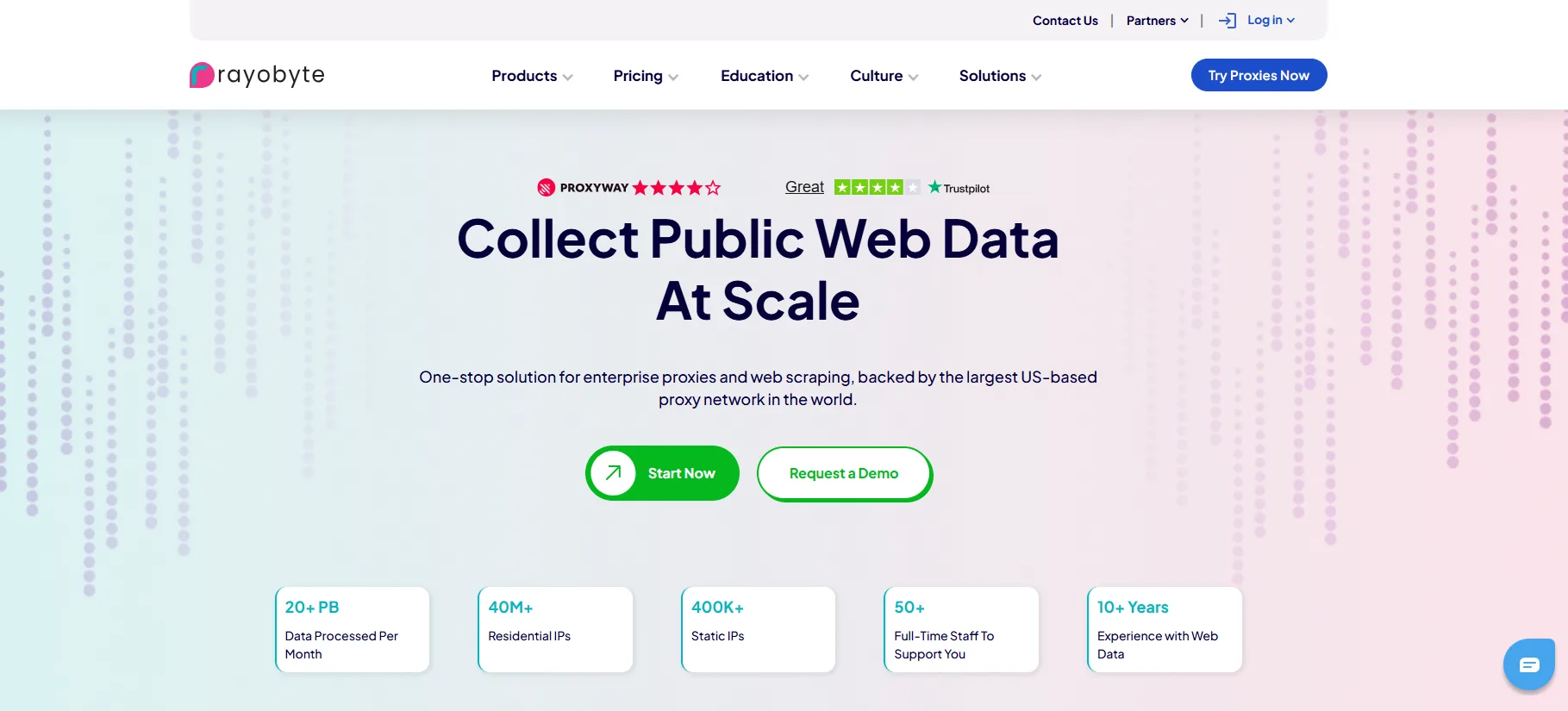
IP Pool: 40M+ residential, plus ISP, datacenter, and mobile Pricing: Custom pricing by product and volume Geo-targeting: Country, city, state level Free trial: No Website: rayobyte.com
Rayobyte (formerly Blazing SEO) is a US-based proxy company that has been operating for over 10 years. Its core differentiator is ethical sourcing with full user consent on all residential IPs, sourced through its proxyware app called Cash Raven, and strict abuse prevention policies. The company leans into trust and compliance as a core identity, which makes it the right fit for enterprise operations where IP sourcing transparency matters to clients or legal teams.
The company handles over 20 petabytes of monthly data — indicating genuine scale — and has particularly strong coverage in the United States, making it the best choice for US-focused local SEO and national SERP tracking campaigns.
Integration with automation tools is well-documented — Rayobyte works with Selenium, Puppeteer, and Multilogin without extra configuration, which matters if your rank tracking workflow involves browser automation.
What others do not tell you: Rayobyte’s ISP proxy lineup covers some major US carriers that other providers do not — this means your SEO scraping traffic looks like it comes from a real Comcast, AT&T, or Verizon subscriber, which achieves very high trust scores on Google’s systems and results in low block rates for SERP monitoring.
The honest downside: The IP pool at 40M+ is smaller than Tier 1 providers, and pricing is not publicly listed — you need to contact them. Some community reviews note occasional performance inconsistencies during peak usage. The platform can feel more complex for beginners compared to simpler options like Webshare.
Who should use it: US-focused SEO agencies, enterprise teams where compliance and IP sourcing documentation matter, operations needing large-scale US SERP tracking with low detection risk.
Best SEO use cases: National rank tracking in the US, local SEO auditing at state and city level, enterprise-grade SERP monitoring with compliance documentation.
9. DataImpulse — Best Budget Option for High-Volume Bulk SEO Scraping
IP Pool: 90M+ residential IPs across 195 countries Pricing: Residential from $1/GB; non-expiring traffic; starter pack $5 for 5GB Geo-targeting: Country, city, ASN, ZIP code level Free trial: 5GB for $5 (effectively a low-cost trial) Website: dataimpulse.com
DataImpulse is the cheapest legitimate option on this list at $1/GB with non-expiring traffic. At 1TB scale, the price drops further to around $0.80/GB. No other major provider in this comparison comes close at high volumes.
Despite the low price, DataImpulse runs 99.9% uptime and offers precise targeting down to ZIP code and ASN level — geo-targeting depth that exceeds some much more expensive providers. Response times benchmark at around 1.22 seconds with 100% success in independent speed tests. Rotation settings are flexible, with sticky sessions available up to 120 minutes.
The non-expiring traffic model is the key selling point. You buy credits and use them when you need them — there is no monthly pressure to consume bandwidth you do not need. For SEO teams with seasonal or project-based workloads, this saves significant money compared to monthly subscription providers.
What others do not tell you: DataImpulse supports UDP traffic (though you need to enable it by contacting support). This is uncommon at budget pricing and opens up some advanced scraping configurations that most budget providers cannot do. ZIP code-level targeting at $1/GB is genuinely difficult to find elsewhere in the market.
The honest downside: Some user reviews note that IP quality at the cheapest tier can be variable — lower-quality IPs may appear in the pool. For highly sensitive SERP targets like Google, you may see lower success rates than Decodo or Oxylabs. Support documentation is thinner than premium providers. It is not the best fit for teams that need reliability above all else.
Who should use it: SEO teams doing high-volume bulk scraping, budget-conscious freelancers doing large keyword research projects, teams with non-linear usage patterns who need credits that do not expire.
Best SEO use cases: Bulk keyword SERP data collection, large-scale price comparison scraping, non-critical SEO data gathering, research projects with bursty usage patterns.
Quick Comparison: All 9 Best SEO Proxy Providers
Provider | IP Pool | Starting Price | Best For | Free Trial |
Oxylabs | 177M+ | From $6/GB residential | Enterprise SERP API, technical SEO | Yes (limited) |
Decodo | 115M+ | From $1.5/GB | Agencies, mid-market, best overall value | 100MB free |
Webshare | 30M+ | From $1.40/GB | Solo SEOs, developers, tight budget | 10 proxies free |
Bright Data | 150M+ | From $4.20/GB PAYG | Enterprise, compliance-heavy teams | Yes (business) |
SOAX | 191M+ claimed | From $3.60/GB | Geo-targeted SEO, city-level accuracy | Paid trial |
IPRoyal | 32M+ | From $1.75/GB | Small teams, freelancers, non-expiring traffic | No |
ProxyEmpire | 170+ countries | Custom pricing | Multiple proxy types, VIP onboarding | No |
Rayobyte | 40M+ | Custom pricing | Ethics-first enterprise, US-focused | No |
DataImpulse | 90M+ | From $1/GB | Budget bulk scraping, non-expiring traffic | 5GB for $5 |
Which SEO Proxy Is Right for You? — Decision Guide
This is the most important section. Pick the description that matches you:
“I run an SEO agency with multiple clients and need reliable data every day.” Go with Decodo. Best success rate at mid-market pricing, 14-day money-back guarantee, and the 100MB free trial lets you test properly. If you have compliance needs or need a dedicated SERP API, go with Oxylabs.
“I am a solo SEO or niche site owner and I just want to start without spending much.” Go with Webshare. Free plan to start, then upgrade to paid residential from $1.40/GB. No commitment needed.
“I need to track local SEO rankings very precisely — city level or ZIP code level.” Go with Oxylabs (best geo-targeting depth) or SOAX (ASN and ISP level targeting, good for city-specific verification).
“I want the absolute cheapest option for bulk scraping a lot of keywords.” Go with DataImpulse at $1/GB with non-expiring credits. Test with the $5 for 5GB starter pack.
“I work for a large company and my legal team needs to know the IPs are ethically sourced.” Go with Rayobyte (10+ years, Cash Raven consent model, US-based, strict compliance) or Oxylabs (ISO 27001:2022 certified).
“I am not very technical and I want someone to help me set this up.” Go with ProxyEmpire. VIP integration support is included in every plan.
“I do not have a predictable monthly volume — some months I barely use proxies, other months I scrape a lot.” Go with IPRoyal or DataImpulse. Both have non-expiring traffic, so you only pay for what you actually use.
“I want the absolute best for enterprise SEO and money is not the main concern.” Go with Oxylabs or Bright Data. Both offer SERP APIs, dedicated scraping infrastructure, and enterprise support. Oxylabs edges ahead on SERP-specific tooling. Bright Data has a wider no-code scraper library.
The 2026 Angle Nobody Is Writing About: Proxies for AI Search Tracking
Here is something almost no proxy guide mentions yet: your SEO strategy in 2026 is incomplete if you are only tracking Google’s ten blue links.
Search behaviour is shifting. Google AI Overviews now appear above organic results for a growing number of queries. Bing Copilot, ChatGPT search, and Perplexity are generating direct answers that either include or exclude your brand. These are ranking positions too — just not the ones traditional rank trackers measure.
Tracking AI search visibility requires the same residential proxy infrastructure as SERP tracking — all of these platforms block automated access. The difference is that AI results require sticky sessions of 10 to 30 minutes to maintain a conversational context, and mobile proxies sometimes return different AI results than desktop.
If this is part of your strategy, Oxylabs is the most advanced option with dedicated SERP API parsing for AI Overview detection. Decodo works well with its MCP server that connects AI tools directly to scraping infrastructure. For budget teams, Webshare and IPRoyal can handle basic AI search tracking with rotating residential proxies set to sticky sessions.
FAQs: Best Proxies for SEO in 2026
Do I need residential or datacenter proxies for SEO?
For Google SERP scraping and rank tracking, you need residential proxies. Google is very good at detecting datacenter IPs and blocking them quickly. Datacenter proxies work fine for scraping lower-protection targets like competitor websites, Bing, or Yahoo.
Will proxies get my SEO tools banned?
No, when used correctly. The proxy takes on the IP risk, not your account. The key is to use rotating residential proxies, space out your requests, and not send hundreds of queries per second from one session.
What is the difference between rotating and sticky sessions for rank tracking?
Rotating proxies change IP on every request — good for bulk scraping. Sticky sessions keep the same IP for a set time. For rank tracking, you want sticky sessions because you need consistent location context across multiple keyword checks. Most rank tracking tools default to needing sticky sessions.
How much bandwidth do I actually need?
A rough guide: tracking 500 keywords once a day in one location uses about 5GB to 15GB per month. Tracking 5,000 keywords across 5 cities daily uses 250GB to 750GB per month. Start small, measure actual usage, and then scale your plan accordingly.
Is it legal to use proxies for SEO?
Yes. Using proxies to collect publicly available search data for SEO research is legal in most jurisdictions. What matters is that you respect the proxy provider’s terms of use and do not use proxies for activities like spamming, fraud, or circumventing paywalls.
Do I need a SERP API or can I use raw proxies?
Raw proxies are cheaper but require you to build your own scraper, parser, and rotation logic. A SERP API like Oxylabs’ handles all of that and returns clean data. If you have developer resources, raw proxies give you more control. If you do not, a SERP API saves weeks of engineering time.
Can I use proxies to track AI search results like Google AI Overviews?
Yes. Google AI Overviews appear in the same SERP HTML as organic results, so rotating residential proxies with the same setup you use for rank tracking will capture them. Parse the AI Overview section from the HTML response separately from the organic results.
Quick Links
Final Thoughts: Best Proxies for SEO in 2026
The proxy market in 2026 is bigger and more diverse than ever. Pricing has actually come down significantly over the last few years — $1/GB for residential proxies from DataImpulse would have been unthinkable five years ago.
But cheaper pricing has also created a new problem: more providers selling low-quality, recycled IP pools that give you false data. A proxy that gets blocked by Google is not cheaper than a good one — it is worthless.
The right choice depends entirely on your situation. For most agencies and SEO teams, Decodo gives the best overall balance of price, performance, and features. For solo operators, Webshare is the logical starting point. For enterprise teams where data accuracy is a business-critical requirement, Oxylabs is worth the premium.
Whatever you choose, test before you commit. Every provider on this list except ProxyEmpire and Rayobyte offers some form of trial or low-cost entry pack. Use it on your actual targets before scaling up.
