
China’s Moonshot AI has raised the bar for open AI. On July 16, 2026, the Beijing start-up unveiled Kimi K3, a 2.8 trillion-parameter model it calls the largest open-weight language model ever released.
The timing is pointed. It lands just as businesses start questioning the high cost of closed models from Anthropic and OpenAI. And unlike most challengers, K3 has independent benchmarks to back up its claims. Here’s what makes it stand out.
A New Scale For Open Models
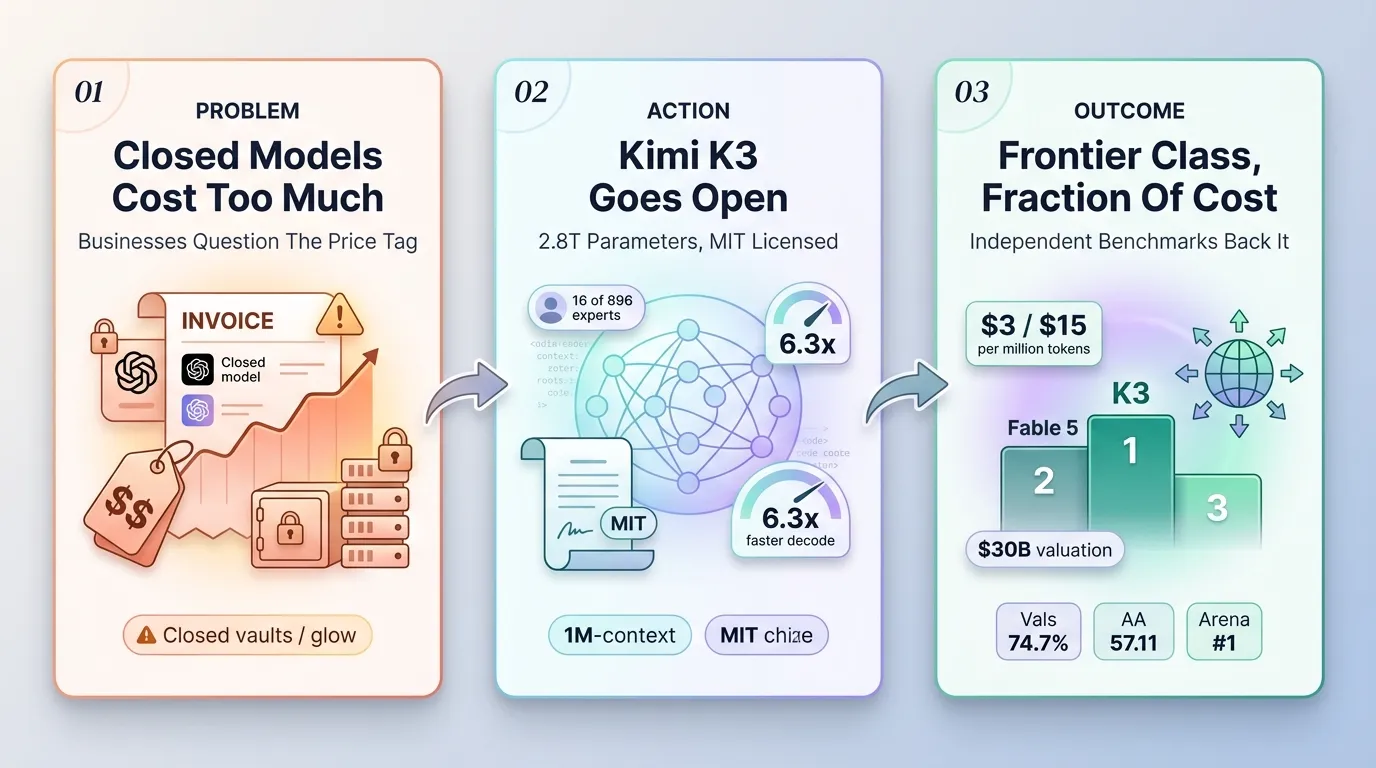
Kimi K3 is a mixture-of-experts model, which means it only uses a small slice of its huge parameter pool for any single task. That keeps costs down while the total size stays record-breaking.
Here are the core specs:
2.8 trillion total parameters, activating just 16 of 896 experts per token
1 million-token context window for handling huge inputs
Native vision and “always-on” reasoning built in
Kimi Delta Attention, a hybrid design Moonshot says decodes up to 6.3 times faster at long contexts
Attention Residuals, which the company says give roughly 25 percent better training efficiency
The benchmark results are the real story, because they don’t rest on Moonshot’s word alone. In its own tests, Moonshot says K3 “substantially outperformed” Claude Opus 4.8 and GPT-5.5, while performing “competitively” with the two most capable closed models, Claude Fable 5 and GPT-5.6 Sol.
Independent evaluators backed up strong results:
Vals AI ranked K3 second of 38 models at 74.7 percent, behind only Claude Fable 5
Artificial Analysis scored it 57.11 on its Intelligence Index
Arena.ai placed K3 first on its Frontend Code leaderboard, ahead of even Fable 5
That last result is notable. An open model beating every closed flagship in a blind coding test is exactly the kind of proof that self-reported numbers usually lack.
Pricing, Open Weights, And The Money Behind It
K3’s pricing undercuts the West by a wide margin. The API is live now:
$3 per million input tokens
$15 per million output tokens
Roughly half the price of GPT-5.6 Sol, and a third of Fable 5 on output
Full model weights are set for public release by July 27, under a modified MIT licence. That would make K3 downloadable and self-hostable.
Developer Simon Willison noted it is the most expensive model a Chinese lab has released so far, yet still cheaper than Western frontier options, and that its release would dethrone DeepSeek’s 1.6 trillion-parameter V4 Pro as the largest open model available.
The business context is just as aggressive. Moonshot is reportedly seeking up to $2 billion in fresh funding at a $30 billion valuation, which would be its third round in six months. Earlier this year it closed a $2 billion round led by Meituan’s venture arm, with Alibaba and Tencent among its backers.
Fortune reported the release narrows the gap between Chinese and US models just as global businesses question the cost of deploying Anthropic and OpenAI systems.
For companies watching their AI bills, a frontier-class model they can download and run themselves changes the maths.
Quick Links:
