
AI chatbot statistics for 2026 start with one huge number. The most popular AI chatbot now reaches 1.2 billion people every week.
Adoption is just as wide. 49% of US adults use AI chatbots, and about one in four use them every day.
This page covers usage, market size, revenue impact, costs, demographics, regions, risks and forecasts.
Key Highlights of AI Chatbot Statistics 2026
- The most popular AI chatbot has 1.2 billion weekly users in 2026, 12 times its count from three years ago.
- The global chatbot market is worth an estimated $11.8 billion in 2026, up from $9.6 billion last year.
- The chatbot market is projected to reach $41.2 billion by 2033, growing 19.6% a year.
- 49% of US adults use AI chatbots, and 24% use them daily.
- 47% of organizations are scaling chatbots across the business, more than any other AI tool.
- AI referred visitors earn US retailers 83% more revenue per visit than other traffic.
- Only 7% of customers used a company chatbot in their latest service request.
- 45% of AI assistant answers to news questions had at least one significant issue.
What this means: Chatbots are mainstream with consumers, but trust and accuracy still decide who wins the click.
Did you know? AI summaries at the top of search results reach more than 2.5 billion people a month. You can now track generative AI performance in your search data to see what that exposure does for your site.
How Many People Use AI Chatbots in 2026?
The top AI chatbot has 1.2 billion weekly users in 2026.
That count grew from 100 million weekly users three years ago. It passed 1 billion in the middle of 2026. Other assistants are huge too:
- Another major chatbot app reached 1 billion monthly users in 2026.
- A chatbot built into social apps passed 1 billion monthly users last year.
- A workplace assistant suite topped 150 million monthly users last year.
For the wider picture, see our AI assistant usage trends 2026 breakdown.
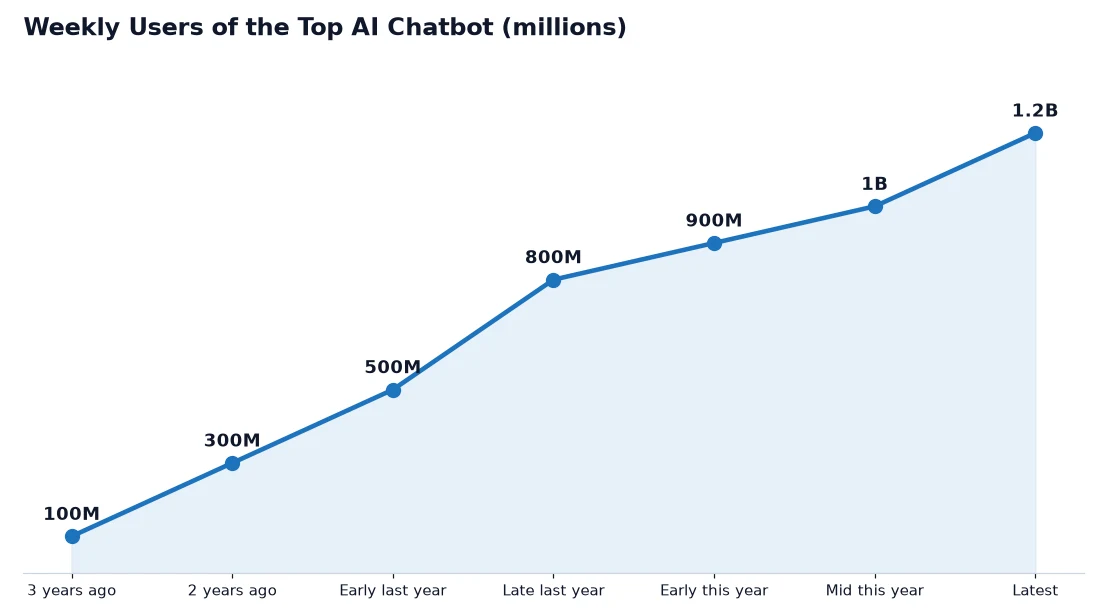
| Period | Weekly users of the top AI chatbot |
|---|---|
| Latest count, 2026 | 1.2 billion |
| Middle of 2026 | 1 billion |
| Early 2026 | 900 million |
| Late last year | 800 million |
| Three years ago | 100 million |
What this means: These AI chatbot statistics say your buyers already ask chatbots for advice weekly, so your brand needs to show up in those answers.
AI Chatbot Statistics: Market Size and Growth
The global chatbot market is worth an estimated $11.8 billion in 2026.
That is up from $9.6 billion last year, a jump of about 23%. The forecast points to $41.2 billion by 2033. That works out to 19.6% growth a year. Money is also shifting in search, as our guide on how LLM payments are changing search economics explains.
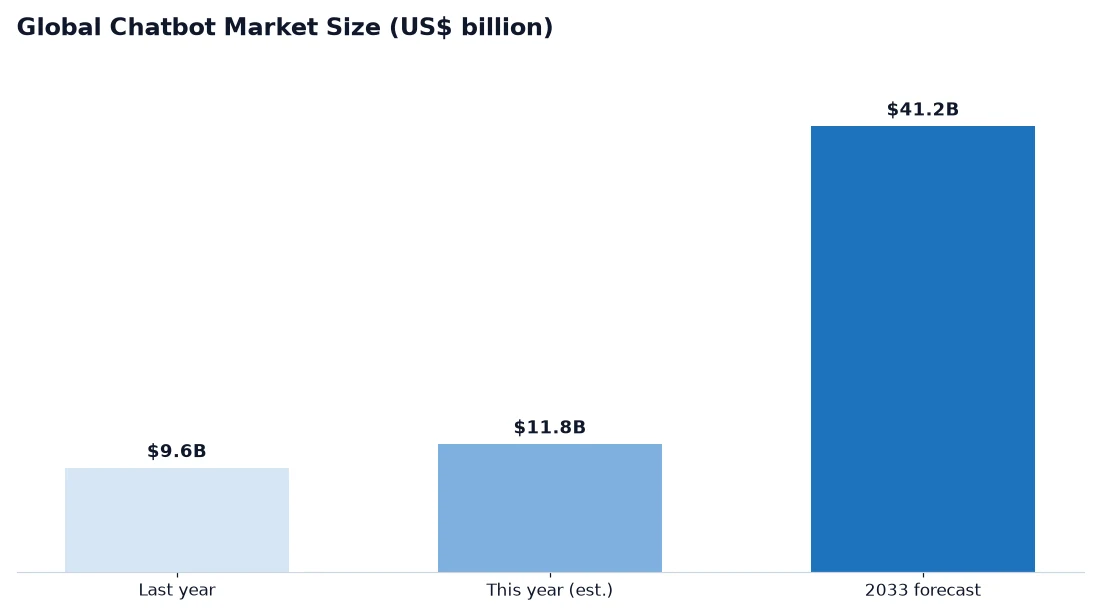
| Year | Global chatbot market value |
|---|---|
| 2033 forecast | $41.2 billion |
| 2026 estimate | $11.8 billion |
| Last year | $9.6 billion |
What this means: AI chatbot statistics on growth show a market rising near 20% a year, with room for new tools, agencies and niche players.
AI Chatbot Statistics on Daily Use: How Often Do People Use Them?
49% of US adults use AI chatbots, and 24% use them every day.
Two years ago, only 33% said they used one. Daily users split three ways. 12% use chatbots several times a day, 8% about once a day, and 4% almost constantly.
| How often US adults use AI chatbots | Share |
|---|---|
| Do not use them | 51% |
| Several times a week or less | 25% |
| Several times a day | 12% |
| About once a day | 8% |
| Almost constantly | 4% |
What this means: Half of adults still skip chatbots, so plain search and social still matter for reach.
What Do People Use AI Chatbots For?
42% of US adults use AI chatbots to search for information.
Search is the top job, followed by work. 38% of employed adults use chatbots for tasks at work. Only 4% use them for companionship.
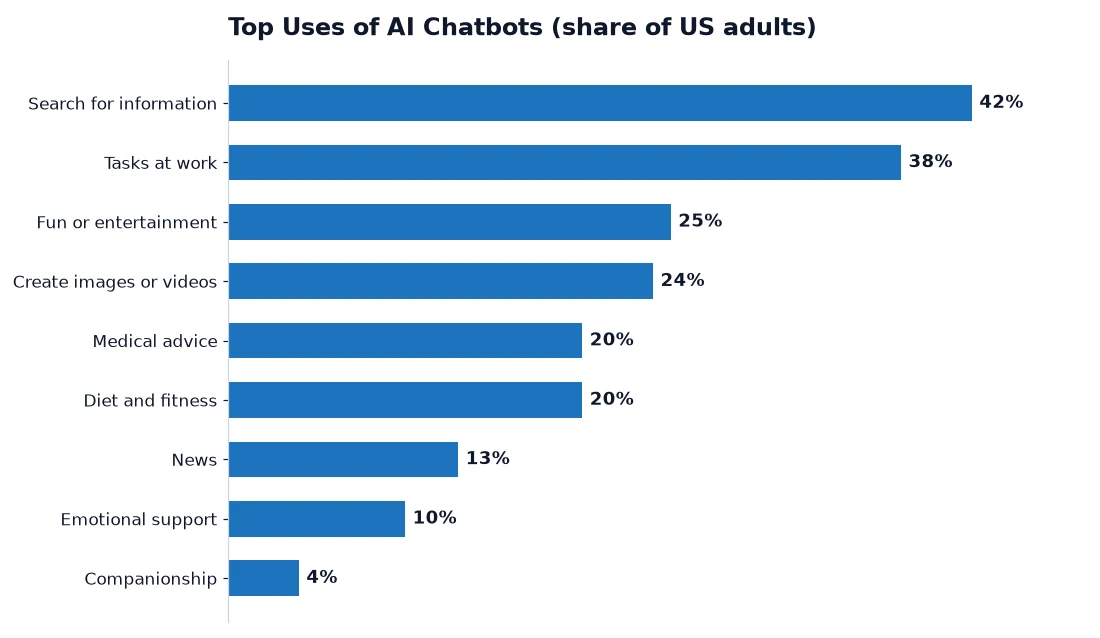
| Use | Share of US adults |
|---|---|
| Search for information | 42% |
| Tasks at work (employed adults) | 38% |
| Fun or entertainment | 25% |
| Create or edit images or videos | 24% |
| Medical advice | 20% |
| Diet and fitness information | 20% |
| News | 13% |
| Emotional support or advice | 10% |
| Companionship | 4% |
What this means: Chatbots now act like a search engine, so answer ready content is your best SEO bet.
AI Chatbot Statistics by Age and Gender
61% of US adults aged 18 to 29 use the leading AI chatbot.
Use drops with age. Adults under 50 are about twice as likely as older adults to use it, at 57% versus 28%. Visitors to the top chatbot site are 54% male and 46% female. The biggest visitor group is aged 25 to 34.
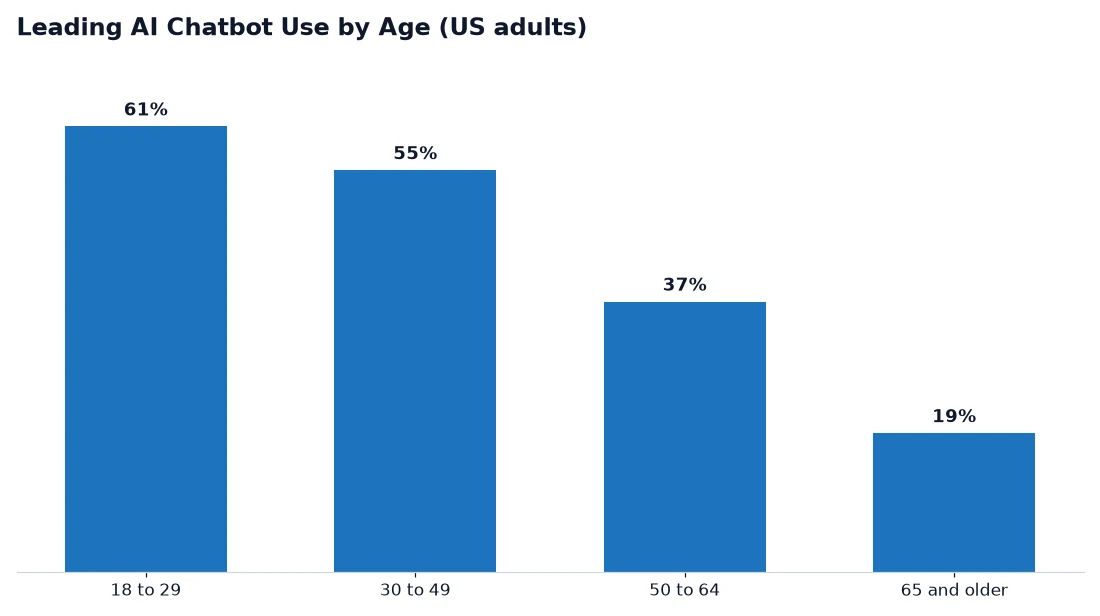
| Age group | Share using the leading chatbot |
|---|---|
| 18 to 29 | 61% |
| 30 to 49 | 55% |
| 50 to 64 | 37% |
| 65 and older | 19% |
What this means: Per these AI chatbot statistics, if you sell to buyers under 50, chatbot visibility is no longer optional.
AI Chatbot Statistics by Industry
Retail and ecommerce hold 27.95% of chatbot revenue, the largest share of any industry.
Most chatbot spending runs in the cloud, at 77.85%. Large firms pay 67.45% of the bills. Customer support is the biggest use case at 41.82% of revenue. Shops use bots for order tracking, product discovery and promo codes, while healthcare grows fastest.
| Chatbot segment | Share of revenue last year |
|---|---|
| Cloud deployment | 77.85% |
| Large enterprises | 67.45% |
| Customer support use | 41.82% |
| Retail and ecommerce | 27.95% |
What this means: Industry AI chatbot statistics show ecommerce and support teams see the clearest payback, so start your pilots there.
How Many Businesses Use AI Chatbots?
47% of organizations are scaling chatbots across the business in 2026.
Chatbots are the most widely scaled AI tool. Nearly nine in ten firms use AI in at least one function. 44% now scale AI across the company, up from 38% last year.
| Group | Share scaling AI across the company |
|---|---|
| Firms with $1 billion or more in revenue | 54% |
| All organizations | 44% |
| Smaller firms | 33% |
What this means: Small businesses that scale chatbots now can still beat slower big rivals on speed.
AI Chatbot Statistics on Revenue Impact for Marketers
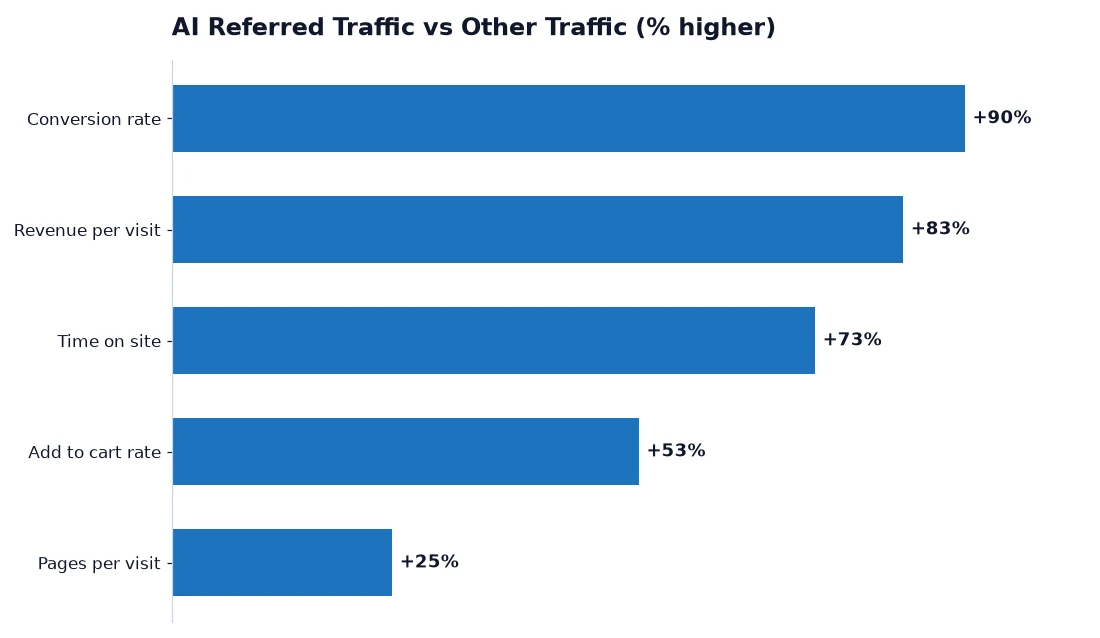
AI referred visitors earn US retailers 83% more revenue per visit than other traffic.
One year earlier, AI traffic was worth less than half of a normal visit. Now it beats other traffic on every metric below. AI traffic to US retail sites grew 71% year over year this fall. Ranking in chatbots is not the same as ranking in search, as our breakdown of how AI citations differ from search rankings shows.
| Metric | AI traffic versus other traffic |
|---|---|
| Conversion rate | 90% higher |
| Revenue per visit | 83% higher |
| Time on site | 73% higher |
| Add to cart rate | 53% higher |
| Pages per visit | 25% higher |
What this means: Chatbot referrals are now your most valuable visitors, so treat AI visibility as a revenue channel.
AI Chatbot Statistics for Customer Service
Only 7% of customers used a company chatbot in their latest service request.
50% say service feels easier when companies use AI. 49% would have used a company chatbot if offered. Yet customers are three times as likely to pick an outside AI tool, at 23%.
| Customer behavior | Share |
|---|---|
| Say AI makes service easier | 50% |
| Would use a company chatbot if offered | 49% |
| Used an outside AI tool for service | 23% |
| Used a company chatbot | 7% |
What this means: A bot that solves a few issues well beats a bot that tries everything and fails.
AI Chatbot Statistics on Cost Savings
One payments company’s AI assistant handled 2.3 million chats in its first month.
That was two thirds of all its service chats. It did the work of 700 full time agents. The company expected a $40 million profit boost from it. Service leaders also put a median 12% of last year’s budget into AI, more than any other function.
What this means: AI chatbot statistics on savings show volume matters, so automate your top repeat questions first.
AI Chatbot Statistics by Region
North America holds 31.3% of the global chatbot market, the largest regional share.
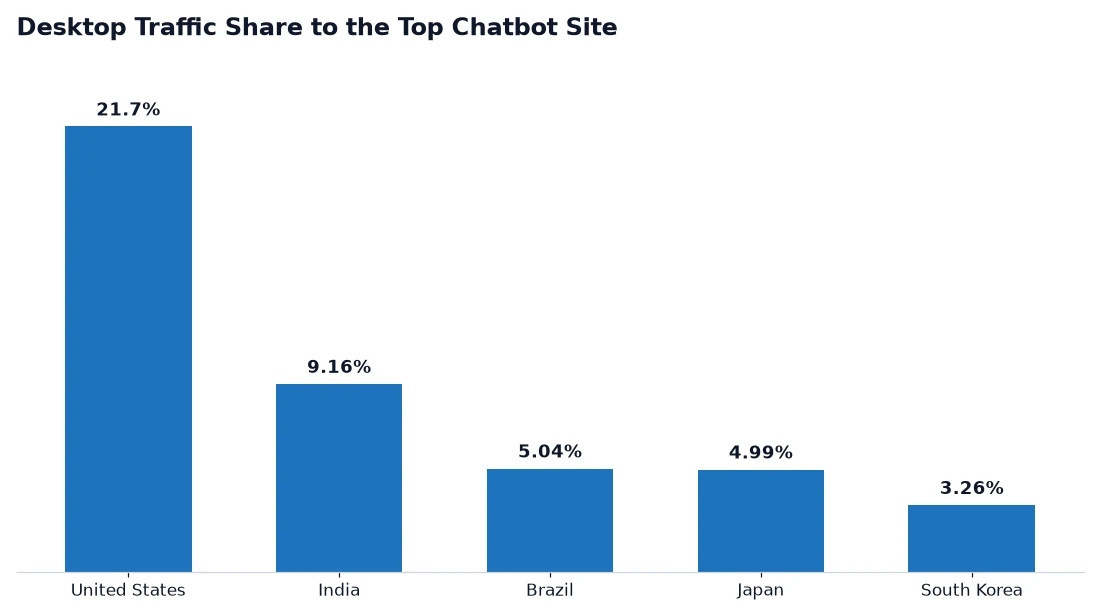
Asia Pacific follows with 25.6%. It earned $2.44 billion last year and should hit $11.3 billion by 2033. India is set to grow fastest in that region. The US also sends the most desktop traffic to the top chatbot site.
| Country | Share of desktop traffic to the top chatbot site |
|---|---|
| United States | 21.7% |
| India | 9.16% |
| Brazil | 5.04% |
| Japan | 4.99% |
| South Korea | 3.26% |
What this means: Regional AI chatbot statistics show English content wins the most reach, but India and Brazil are big growth markets for localized pages.
Challenges of AI Chatbots: Accuracy and Trust
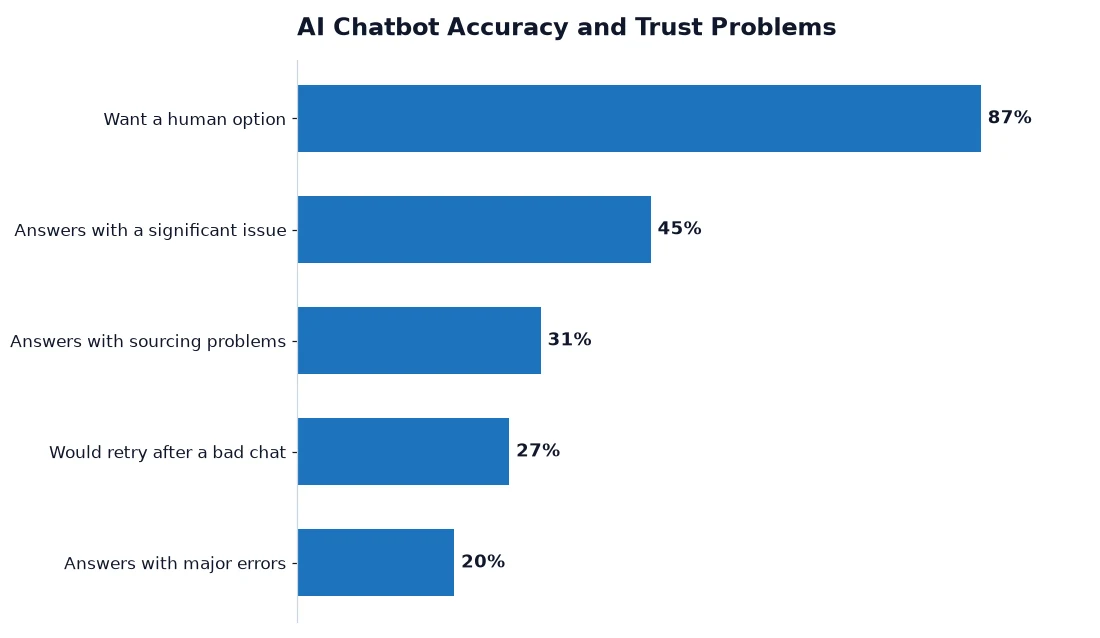
45% of AI assistant answers to news questions had at least one significant issue.
The test covered over 3,000 answers in 14 languages. These AI chatbot statistics also show that trust breaks fast after one bad chat.
| Problem | Share |
|---|---|
| Customers who want a human option | 87% |
| Answers with a significant issue | 45% |
| Answers with sourcing problems | 31% |
| Customers who would retry after a bad chat | 27% |
| Answers with major accuracy errors | 20% |
What this means: Always add a human handoff and fact check any bot that speaks for your brand.
Future of AI Chatbots: AI Chatbot Statistics and Forecasts
AI agents are expected to solve 80% of common service issues without humans by 2029.
That shift should cut service operating costs by 30%. AI traffic to US retail sites should rise 130% this holiday season. The chatbot market should reach $41.2 billion by 2033. Structured data will help, as our look at FAQPage schema growth in AI search shows.
| Forecast | Value |
|---|---|
| Holiday AI traffic growth to US retail sites | 130% |
| Common service issues solved by AI by 2029 | 80% |
| Service cost cut by 2029 | 30% |
What this means: Build for AI agents now, because they will soon book, buy and resolve on your customers’ behalf.
Pros and Cons of AI Chatbots 2026
Pros
- Reach 1.2 billion weekly users on the top chatbot
- AI visitors bring 83% more revenue per visit
- AI traffic converts 90% better
- One bot covered the work of 700 agents
- 24% of US adults use chatbots daily
- Market growing 19.6% a year
Cons
- 45% of news answers had a significant issue
- Only 7% of customers used a company bot
- 87% of customers still want a human option
These AI chatbot statistics show huge reach and real revenue, but trust still lags. Use chatbots for traffic and routine service, and keep humans close for anything sensitive.
Quick Links
- AI Assistant Usage Trends 2026
- AI Citations vs Search Rankings
- FAQPage Schema in AI Search
- Structured Data and AI Citations
- AI Content Creation Trends 2026
- Udemy Statistics 2026
- GTA 6 Statistics 2026
- US Immigration Statistics Guide
Frequently Asked Questions About AI Chatbot Statistics 2026
The top AI chatbot has 1.2 billion weekly users in 2026, 12 times its count from three years ago. In the US, 49% of adults use AI chatbots. These AI chatbot statistics show chatbots are now a daily habit for a big slice of the online world.
The global chatbot market is worth an estimated $11.8 billion in 2026. That is up from $9.6 billion last year, a rise of about 23%. Cloud deployments make up 77.85% of chatbot revenue, so most businesses buy chatbots as a hosted service.
The chatbot market should grow 19.6% a year and reach $41.2 billion by 2033. That is roughly three and a half times its 2026 value. Asia Pacific is the fastest growing region, and India leads growth there, so watch that market closely.
Young adults use AI chatbots the most. 61% of US adults aged 18 to 29 use the leading chatbot, versus 19% of those 65 and older. By industry, retail and ecommerce hold 27.95% of chatbot revenue, the largest share of any industry.
Yes, chatbots save money at high volume. One payments company's assistant handled 2.3 million chats in its first month and did the work of 700 agents. AI agents are also forecast to cut service operating costs by 30% by 2029.
The biggest benefit is high value traffic. AI referred visitors earn US retailers 83% more revenue per visit than other traffic. They also convert 90% better. For marketers, these AI chatbot statistics turn chatbot visibility into a real revenue channel, not just a trend.
Accuracy is the biggest risk. 45% of AI assistant answers to news questions had at least one significant issue. Trust also breaks fast. Only 27% of customers would try a chatbot again after a bad experience, so test your bot before launch.
Yes, for most businesses with repeat questions or online sales. 47% of organizations already scale chatbots across the business, more than any other AI tool. The AI chatbot statistics on revenue and savings back this up, so start small and measure.
Most customers still want a human option. 87% say companies using AI for service must offer a way to reach a person. The best setup blends both: a chatbot for quick tasks and a human for complex or sensitive issues.
Conclusion: AI Chatbot Statistics 2026
AI chatbot statistics for 2026 show a tool that has gone fully mainstream. The top chatbot reaches 1.2 billion people every week. The chatbot market is worth an estimated $11.8 billion and should hit $41.2 billion by 2033. AI referred visitors also earn retailers 83% more revenue per visit. Brands that make their content easy for chatbots to find and cite will win the next wave of buyers.
