
Google’s John Mueller made a comment this week that has been circulating in SEO circles and generating more confusion than clarity. He said that markdown pages can help with developer documentation and certain types of technical content. This has led some publishers to wonder whether they should be converting their content to markdown format for SEO reasons. The answer is more nuanced than the headline suggests.
What Mueller Actually Said and What It Means

Mueller’s full context was specific: markdown pages can be useful for developer documentation because they are clean, easily parseable, and align well with how developers search for and consume technical reference material. He was not saying that markdown is a general SEO advantage for all content types. He was not suggesting that regular publishers should switch formats.
The distinction matters because markdown-formatted pages strip out a lot of the HTML structure that Google uses to understand page hierarchy, headings, and content organization on standard web content. For a standard blog or affiliate site, converting to markdown would likely hurt rather than help.
What This Means for Schema and Structured Data
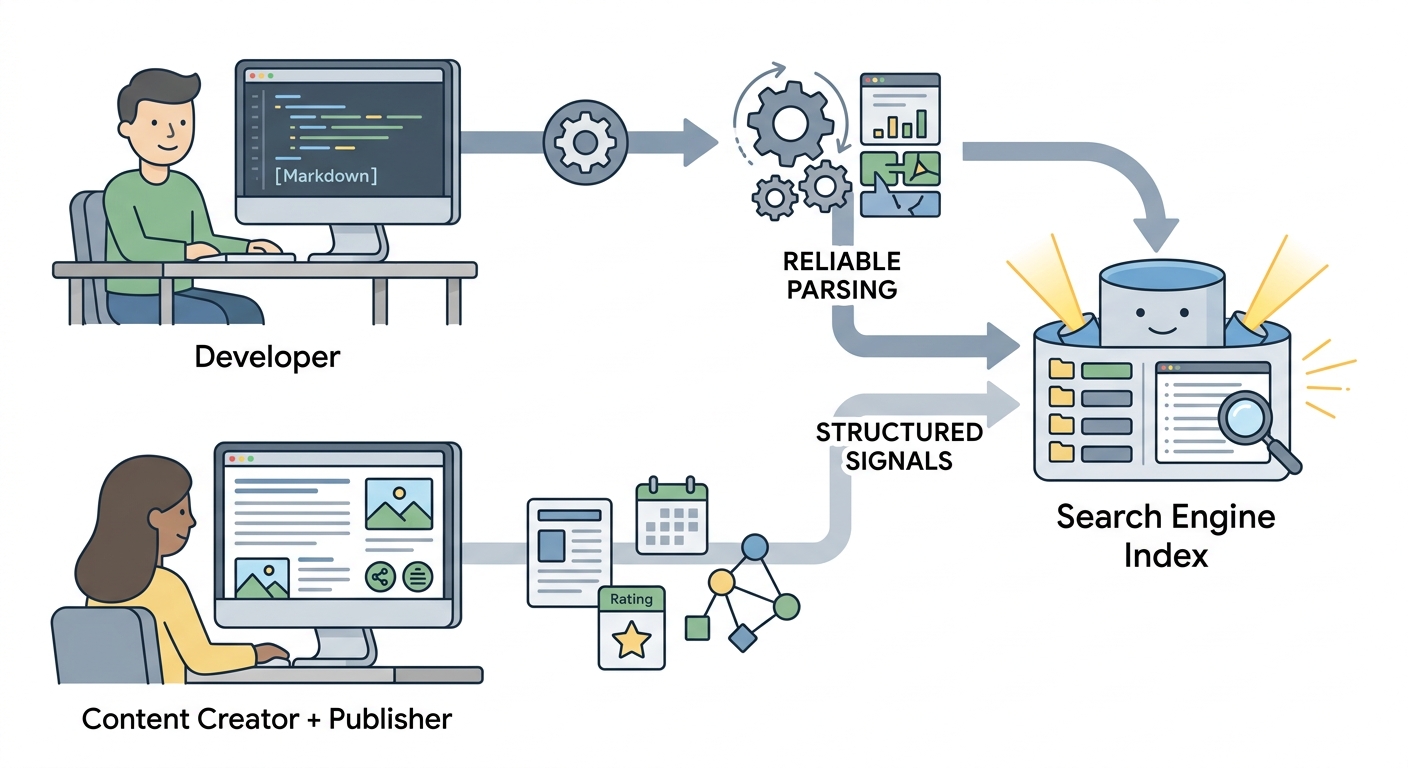
Mueller’s comment actually reinforces a broader point about structured data. The reason markdown works for developer docs is that it provides clean, predictable structure that machines can parse reliably. Schema markup does the same thing for standard web content — it provides structured signals that Google can parse without having to infer meaning from HTML layout alone.
If you are not a developer documentation site, the lesson from Mueller’s comment is not to use markdown. It is to make sure your standard HTML pages have the structured data markup that gives Google the same kind of clear, parseable signals. That is what schema accomplishes on a normal web page.
Do not change your content format based on a comment meant for a specific technical context. Focus on making your existing pages as structured and legible to Google as possible through proper schema implementation.
Quick Links:
