
Black Friday statistics for 2026 start with a record. US shoppers spent $11.8 billion online last Black Friday, up 9.1% in one year.
The crowds were huge too. A record 202.9 million people shopped over the five days from Thanksgiving to Cyber Monday.
This page covers spending, shoppers, online vs store sales, discounts, mobile, BNPL, AI, top categories and the 2026 forecast.
Black Friday Statistics 2026 (Key Highlights)
- US shoppers spent $11.8 billion online last Black Friday, up 9.1% year over year.
- Black Friday drove $79 billion in online sales worldwide, up 6%.
- A record 202.9 million Americans shopped over Thanksgiving weekend, up from 197 million.
- Cyber Week brought in $44.2 billion online, with Cyber Monday the top day at $14.25 billion.
- Mobile devices made 55.2% of Black Friday online sales, or $6.5 billion.
- AI driven traffic to US retail sites jumped 805% on Black Friday.
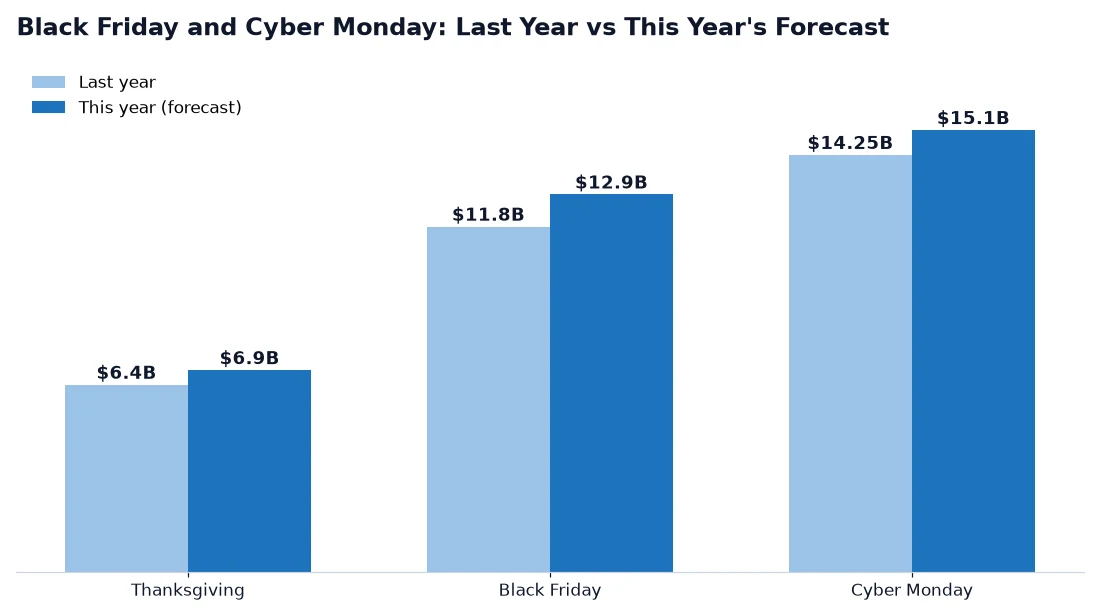
- Black Friday online sales are set to reach $12.9 billion in 2026, up 9.2%.
What this means: Black Friday is now an online event first. The money keeps growing even as store crowds level off.
How Much Do People Spend on Black Friday?
US shoppers spent $11.8 billion online last Black Friday.
That was a new record and a 9.1% jump over the year before. Worldwide, the day drove $79 billion in online sales, up 6%. Shoppers spent about $12.5 million every minute online during the peak hours from 10 a.m. to 2 p.m.
| Black Friday metric | Value |
|---|---|
| Global online sales | $79 billion |
| US online sales | $11.8 billion |
| US online spend per minute at peak | $12.5 million |
What this means: Black Friday spending still grows faster than overall retail, so it remains the best single day to plan sales around.
Black Friday Online Sales by Year
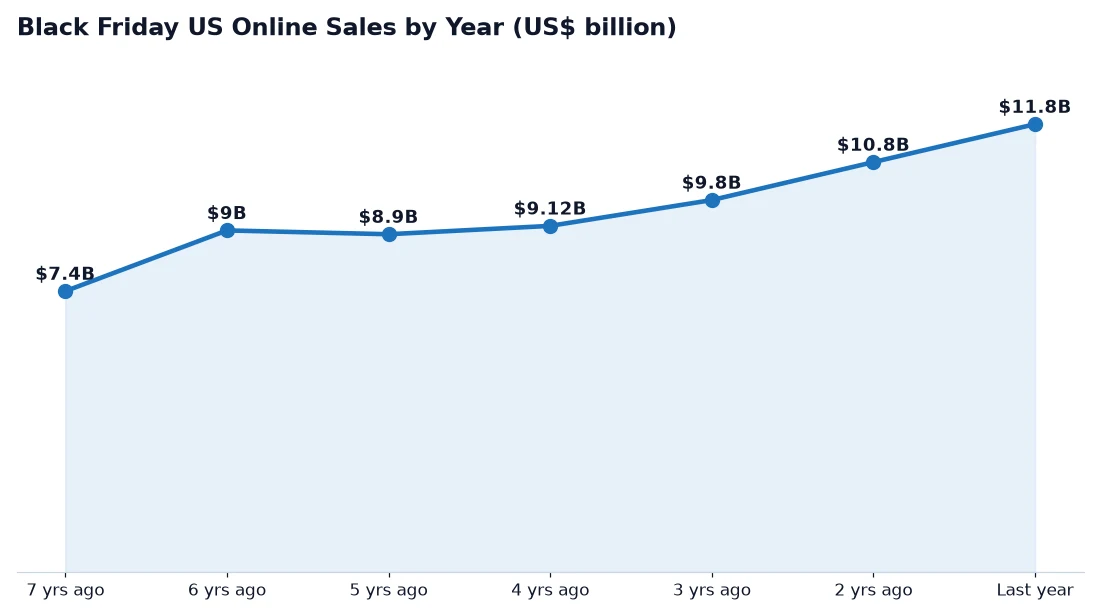
Black Friday online sales have grown in six of the last seven years.
US online spend rose from $7.4 billion seven years ago to $11.8 billion last Black Friday, a gain of about 60%. The only dip came five years ago, when sales slipped from $9.0 billion to $8.9 billion. Growth has stayed between 7% and 11% for the last three years.
| Black Friday | US online sales |
|---|---|
| Last year | $11.8 billion |
| 2 years ago | $10.8 billion |
| 3 years ago | $9.8 billion |
| 4 years ago | $9.12 billion |
| 6 years ago | $9.0 billion |
| 5 years ago | $8.9 billion |
| 7 years ago | $7.4 billion |
What this means: Black Friday statistics show steady, not explosive, growth. Plan for high single digit gains, not miracles.
How Many People Shop on Black Friday?
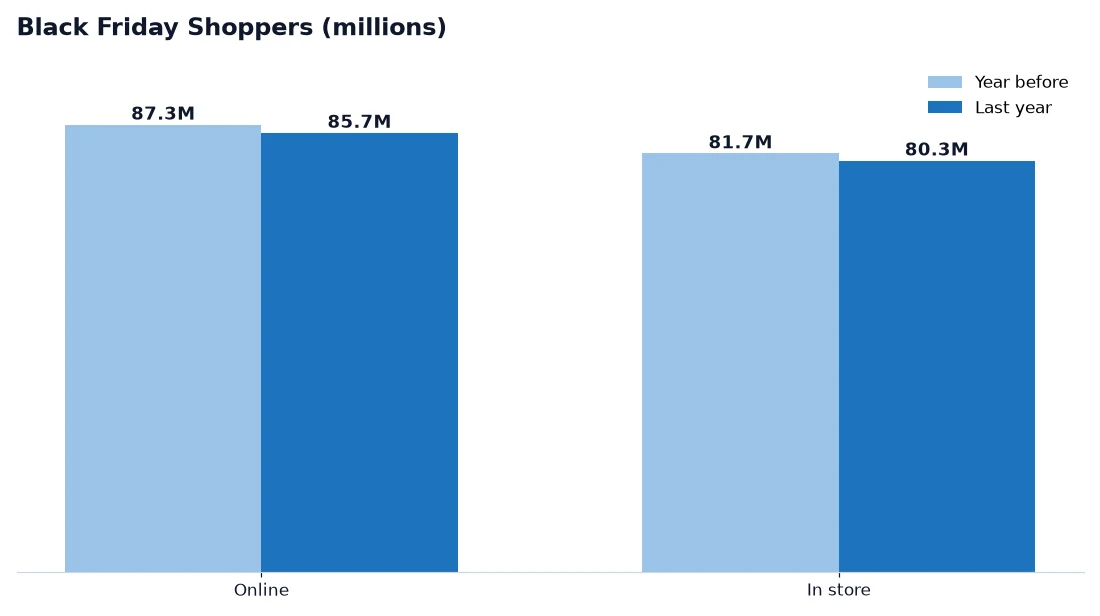
About 80.3 million people shopped in stores and 85.7 million shopped online last Black Friday.
Both numbers dipped slightly from 81.7 million and 87.3 million the year before. The full five day weekend still set a record with 202.9 million shoppers. In total, 134.9 million people shopped online over the weekend, up 9%, while 129.5 million shopped in stores, up 3%.
| Thanksgiving weekend shoppers | Last year | Year before |
|---|---|---|
| Total shoppers (five days) | 202.9 million | 197 million |
| Online shoppers (five days) | 134.9 million | 124.3 million |
| In store shoppers (five days) | 129.5 million | 126 million |
| Online shoppers on Black Friday | 85.7 million | 87.3 million |
| In store shoppers on Black Friday | 80.3 million | 81.7 million |
What this means: Shoppers now spread their buying across the whole weekend. One day promos leave money on the table.
Black Friday vs Cyber Monday Statistics
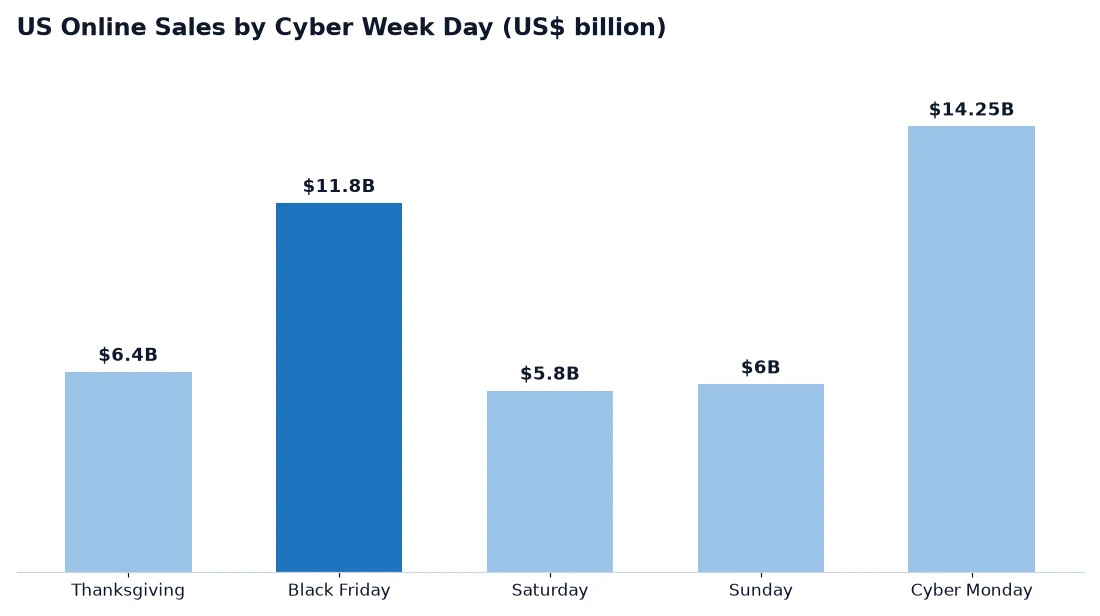
Cyber Monday is still the biggest online day, with $14.25 billion in US online sales last year.
Black Friday came second at $11.8 billion, but it grew faster: 9.1% vs 7.1% for Cyber Monday. Across the five days of Cyber Week, US shoppers spent $44.2 billion online, up 7.7%. Cyber Monday also drew 75.9 million online shoppers, up from 64.4 million.
| Cyber Week day | US online sales |
|---|---|
| Cyber Monday | $14.25 billion |
| Black Friday | $11.8 billion |
| Thanksgiving Day | $6.4 billion |
| Sunday | $6.0 billion |
| Saturday | $5.8 billion |
What this means: Treat Black Friday and Cyber Monday as one five day campaign. Black Friday wins on growth, Cyber Monday on total dollars.
Black Friday Online vs In Store Sales
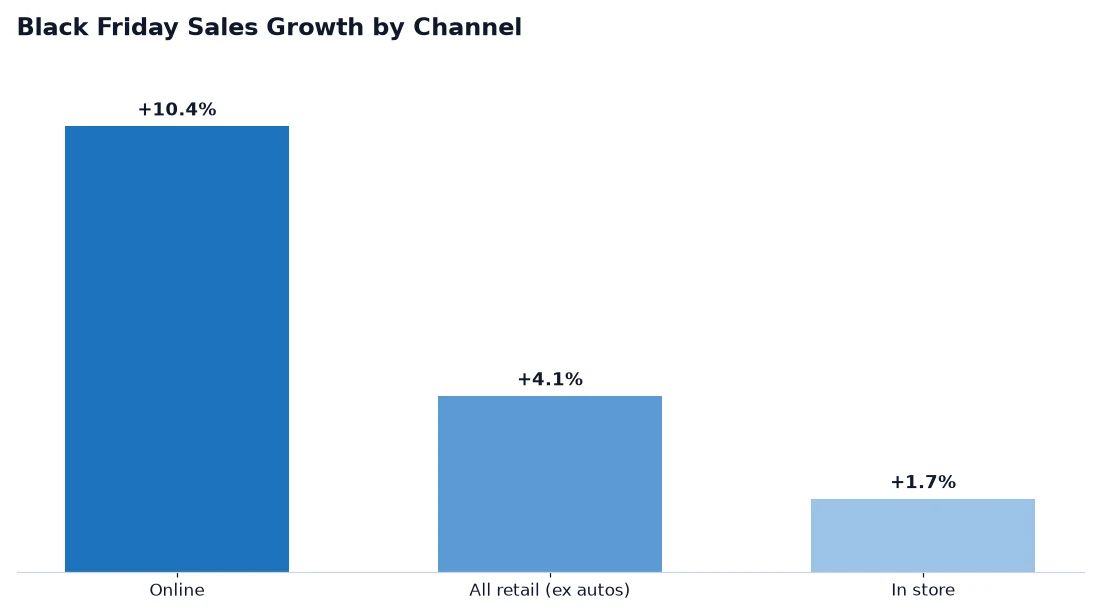
Online sales grew 10.4% last Black Friday, while in store sales grew just 1.7%.
Store foot traffic fell by about 2% to 4% on the day. Black Friday made up 31% of store sales during Cyber Week, the largest share of any day. Online was the second most popular weekend destination at 45%, just behind supermarkets at 47%.
| Black Friday channel | Sales growth |
|---|---|
| Online | 10.4% |
| All retail (excluding autos) | 4.1% |
| In store | 1.7% |
What this means: The growth sits online, but nearly a third of Cyber Week store sales still happen on Black Friday. Run both.
Black Friday Mobile Shopping Statistics
Mobile devices made 55.2% of US online sales last Black Friday.
That came to $6.5 billion, up 10.2% from the year before. Across the full holiday season, phones drove 56.4% of online spend. On Cyber Monday, 46.9 million people shopped on a mobile device, up from 40.4 million.
| Mobile metric | Value |
|---|---|
| Mobile sales on Black Friday | $6.5 billion |
| Mobile Cyber Monday shoppers | 46.9 million |
| Mobile share of holiday online spend | 56.4% |
| Mobile share of Black Friday online sales | 55.2% |
What this means: If your checkout is slow on a phone, you lose more than half of your Black Friday buyers.
Black Friday Discount Statistics
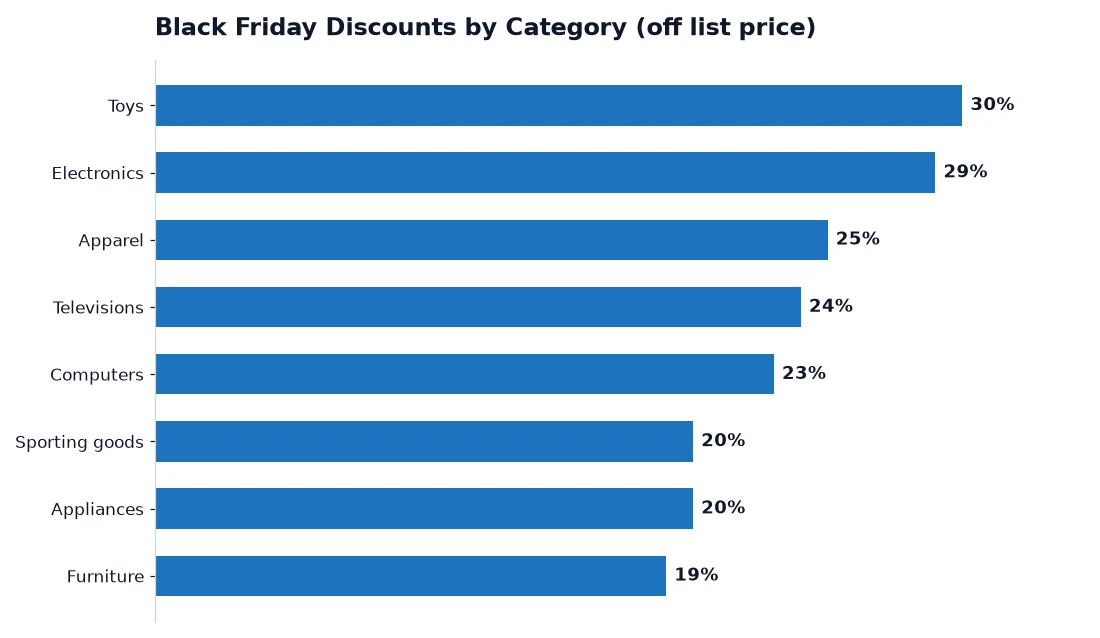
Black Friday discounts peaked at about 28% off in the US last year, flat with the year before.
Toys had the deepest cuts at 30% off listed prices, followed by electronics at 29%. Prices still rose overall. Average selling prices climbed 7%, while order volume fell 1% and shoppers bought 2% fewer items per order.
| Category | Black Friday discount |
|---|---|
| Toys | 30% |
| Electronics | 29% |
| Apparel | 25% |
| Televisions | 24% |
| Computers | 23% |
| Sporting goods | 20% |
| Appliances | 20% |
| Furniture | 19% |
What this means: Deep cuts on toys and tech pull traffic. Shoppers also used deals to trade up to pricier items, not just to pay less.
What Sells Most on Black Friday?
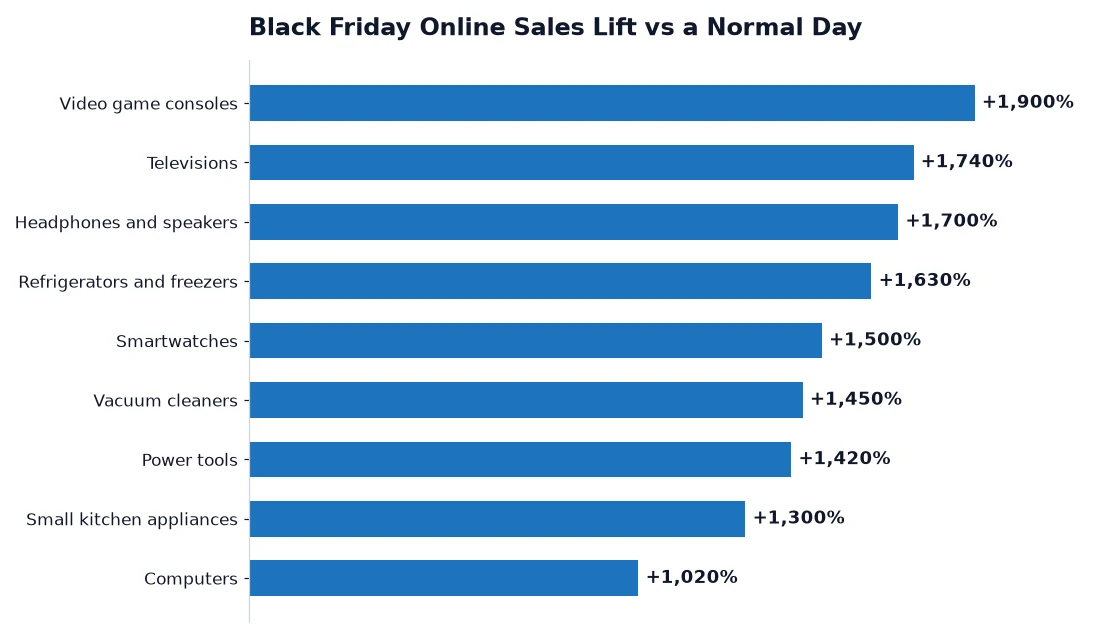
Video game consoles saw the biggest Black Friday jump, with online sales up 1,900% vs a normal October day.
Televisions rose 1,740% and headphones and speakers rose 1,700%. Home goods also surged, with refrigerators up 1,630% and vacuum cleaners up 1,450%. The share of units sold for the priciest electronics rose 64% too.
| Product | Black Friday sales lift |
|---|---|
| Video game consoles | 1,900% |
| Televisions | 1,740% |
| Headphones and speakers | 1,700% |
| Refrigerators and freezers | 1,630% |
| Smartwatches | 1,500% |
| Vacuum cleaners | 1,450% |
| Power tools | 1,420% |
| Small kitchen appliances | 1,300% |
| Computers | 1,020% |
What this means: Black Friday statistics favor high value items. Shoppers wait all year to buy the big stuff on this one day.
Buy Now Pay Later Black Friday Statistics
Buy now pay later (BNPL) drove $747.5 million in online spend last Black Friday, up 8.9%.
That equals about 6.3% of online sales on the day, and 80.7% of it came from phones. Cyber Monday crossed the billion dollar mark with $1.03 billion in BNPL spend. Over the full holiday season, BNPL hit $20 billion, up 9.8%.
| BNPL metric | Value |
|---|---|
| Holiday season BNPL spend | $20 billion |
| Cyber Monday BNPL spend | $1.03 billion |
| 2026 Black Friday BNPL forecast | $807 million |
| Black Friday BNPL spend | $747.5 million |
What this means: Flexible payments now sit at the center of big Black Friday baskets. Offer them, especially on mobile.
Did you know? During the peak hours of last Cyber Monday, US shoppers spent $16 million online every minute. See how the online stores behind those sales are growing in our Shopify statistics roundup.
How AI and Social Media Shape Black Friday Shopping
AI driven traffic to US retail sites jumped 805% last Black Friday.
Shoppers who arrived from an AI chat tool were 38% more likely to buy than other visitors. AI and shopping agents influenced $14.2 billion in global online sales on the day, including $3 billion in the US. Social media also grew, with its share of online revenue up 54.5% to 3.4%. Our AI chatbot statistics show how fast these tools are spreading.
| AI and social metric | Value |
|---|---|
| Growth in AI traffic to retail sites | 805% |
| Higher buying rate from AI visitors | 38% |
| Social share of US retail site traffic | 14% |
| Social share of online revenue | 3.4% |
What this means: Product pages now need to be readable by AI shopping tools, not just by people and search engines.
How Much Does the Average Black Friday Shopper Spend?
The average Thanksgiving weekend shopper spent $337.86 on holiday items last year.
That was up from $315.56 the year before and the highest level in six years. About $225.74 of it (67%) went on gifts. Gift cards are cooling. Only 39% of shoppers plan to give them in 2026, the lowest level in more than 20 years of tracking.
| Weekend spend | Amount |
|---|---|
| Average spend per shopper, last year | $337.86 |
| Average spend per shopper, year before | $315.56 |
| Average spend on gifts, last year | $225.74 |
What this means: Baskets are getting bigger, so bundles and gift sets are an easy win. Our dropshipping tips for higher sales cover more ideas.
Black Friday 2026 Forecast and Holiday Season Outlook
Black Friday 2026 online sales are forecast to hit $12.9 billion, up 9.2%.
Cyber Monday should pass $15 billion for the first time, at $15.1 billion. Cyber Week is set to reach $47.5 billion, or 17.3% of the full season. US online holiday spend is forecast at $275.1 billion, up 6.7%, and total holiday retail sales should top $1 trillion ($1.013 trillion, up 4.2%). About 126 million people plan to shop on Black Friday, and 182.7 million over the whole weekend.
| 2026 holiday forecast | Value |
|---|---|
| US holiday retail sales | $1.013 trillion |
| US online holiday spend | $275.1 billion |
| Cyber Week online sales | $47.5 billion |
| Cyber Monday online sales | $15.1 billion |
| Black Friday online sales | $12.9 billion |
| Thanksgiving Day online sales | $6.9 billion |
What this means: Another record is likely. Sellers who prepare stock, ads and offers early stand to gain the most. Grab tools early too, like this Rank Math Black Friday coupon.
Challenges of Black Friday for Shoppers and Retailers
Black Friday order volume fell 1% last year, even as sales hit records.
Average selling prices rose 7%, and shoppers bought 2% fewer items per order. Budgets are tight this season too: 82% of shoppers are taking steps to manage holiday costs, such as buying cheaper gifts or shopping for fewer people. Retailers who want to keep margins should check their ecommerce platform can handle the rush.
| Black Friday challenge | Value |
|---|---|
| Shoppers managing holiday costs | 82% |
| Rise in average selling prices | 7% |
| Drop in items per order | 2% |
| Drop in order volume | 1% |
What this means: Record sales hide softer demand. Value, bundles and free shipping matter more than ever.
Pros and Cons of Black Friday 2026
Pros
- Record $11.8 billion in US online sales
- 202.9 million shoppers over Thanksgiving weekend
- Toy discounts peak at 30% off
- AI visitors 38% more likely to buy
- Mobile drives 55.2% of online sales
- Average weekend spend up to $337.86
Cons
- Order volume fell 1% as prices rose 7%
- Store foot traffic down about 2% to 4%
- Black Friday store shoppers dipped to 80.3 million
Black Friday statistics point to a bigger, more digital event every year. The dollars keep rising, but shoppers are choosier, so sellers need sharp prices and a fast mobile checkout.
Quick Links
- Shopify Statistics 2026
- AI Chatbot Statistics 2026
- YouTube Statistics 2026
- Rank Math Black Friday Coupon
- Shopify Coupon Codes
- Best Ecommerce Platforms
- Dropshipping Tips
- Best Sales Funnel Software
Frequently Asked Questions About Black Friday Statistics 2026
US shoppers spent $11.8 billion online last Black Friday, a record and up 9.1% in one year. Worldwide, the day drove $79 billion in online sales, up 6%. These Black Friday statistics confirm it is now one of the two biggest online shopping days of the year.
About 80.3 million people shopped in stores and 85.7 million shopped online last Black Friday. Over the full Thanksgiving weekend, a record 202.9 million Americans shopped. For 2026, about 126 million people plan to shop on Black Friday itself, and 89% of them plan to shop online.
Cyber Monday is bigger online, with $14.25 billion in US sales last year vs $11.8 billion for Black Friday. Black Friday grows faster though, up 9.1% vs 7.1%. Black Friday statistics also show it is still the top day for in store shopping.
Black Friday 2026 online sales are forecast at $12.9 billion, up 9.2% year over year. Cyber Monday should reach $15.1 billion and Cyber Week $47.5 billion. Total US holiday retail sales are expected to pass $1 trillion for the first time.
Electronics lead Black Friday sales. Online sales of video game consoles rose 1,900% vs a normal October day, televisions rose 1,740% and headphones and speakers rose 1,700%. Big home items also see huge jumps, with refrigerators up 1,630% and vacuum cleaners up 1,450%.
Black Friday discounts peaked at about 28% off in the US last year. Toys had the deepest cuts at 30% off, followed by electronics at 29% and apparel at 25%. These Black Friday statistics show discounts were flat with the year before.
The average Thanksgiving weekend shopper spent $337.86 on holiday items last year, up from $315.56. About $225.74 of that, or 67%, went on gifts. These Black Friday statistics mark the highest weekend spend in six years, so shoppers are opening their wallets wider.
The biggest risk is softer demand behind the record totals. Order volume fell 1% last Black Friday as prices rose 7%, and shoppers bought 2% fewer items per order. Stores also saw foot traffic slip by about 2% to 4%.
Yes. Online sales grew 10.4% last Black Friday while in store sales grew only 1.7%. Mobile made 55.2% of online sales, and AI driven traffic to retail sites jumped 805%. Black Friday statistics show online now drives most of the event's growth.
Conclusion: Black Friday Statistics 2026 in Numbers
Black Friday statistics for 2026 show an event that keeps breaking records. US shoppers spent $11.8 billion online last Black Friday, a record 202.9 million people shopped over Thanksgiving weekend, and this year’s Black Friday is forecast to reach $12.9 billion online. Mobile, BNPL and AI shopping tools now shape how people find and pay for deals. Expect the next Black Friday to be even more online, more mobile and more driven by smart shopping tools.
