
Shopify statistics for 2026 start with one giant number. Shopify merchants sold $378.4 billion worth of goods last year.
The platform is still growing fast. About 3.35 million live stores now run on Shopify, up 15% in a single year.
This page covers users, stores, Plus brands, countries, revenue, quarterly results, GMV, market share, payments, apps and trends.
Shopify Statistics 2026 (Key Highlights)
- Shopify merchants sold $119.1 billion of goods (GMV) in Q3 2026, up 29% year over year.
- Shopify revenue reached $3.74 billion in Q3 2026, a 32% jump from a year earlier.
- About 3.35 million live stores run on Shopify, up 15% in one year.
- Roughly 84,179 domains run Shopify Plus, owned by about 56,100 merchants.
- 68% of all Shopify GMV now flows through Shopify Payments.
- Shopify merchants made more than 14% of all US ecommerce sales last year.
- Shopify earned $11.6 billion in revenue last year on $378.4 billion of GMV.
- Shopify is worth about $173 billion on the stock market right now.
What this means: Shopify is no longer a small business tool. It is core retail infrastructure, and its numbers keep compounding.
How Many People Use Shopify in 2026?
Millions of merchants in more than 175 countries use Shopify.
Shopify statistics no longer include an exact merchant count. The store count gives a sharper view of Shopify numbers of users, with about 3.35 million live storefronts today.
How Many Customers Does Shopify Have?
More than 81 million shoppers bought from Shopify stores over Black Friday and Cyber Monday weekend last year.
Those shoppers spent $14.6 billion in four days, 27% more than the year before.
What this means: These Shopify statistics say a big slice of your buyers already trust a Shopify checkout.
How Many Shopify Stores Are There?
About 3,353,136 live stores run on Shopify right now.
That count grew 15% year over year by Q3 2026, and 7.9% in Q3 2026 alone. Store numbers move weekly, so treat Shopify statistics on store counts as approximate.
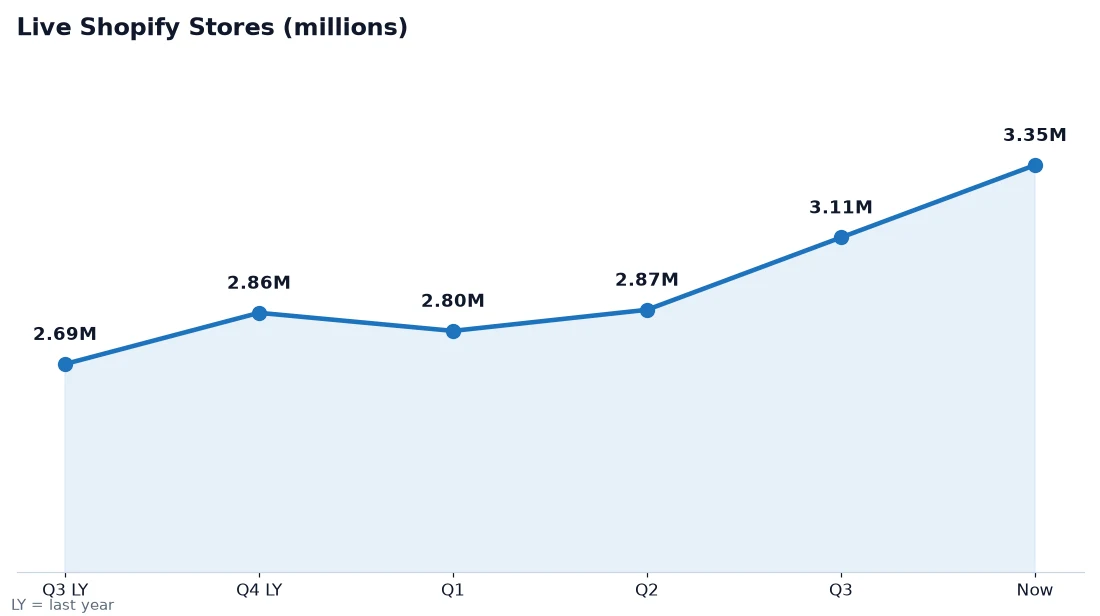
| Period | Live Shopify stores |
|---|---|
| Right now | 3,353,136 |
| End of Q3 2026 | 3,108,808 |
| End of Q4 last year | 2,859,828 |
| End of Q3 last year | 2,692,227 |
How Many Shopify Plus Stores Are There?
About 84,179 domains run Shopify Plus, owned by roughly 56,100 merchants.
Many Plus brands run one store per country or brand, so domains outnumber merchants. Plus also pulled in 874 merchants from other platforms in the last 90 days. Curious what those brands pay? Our Shopify Plus pricing 2026 guide breaks it down.
Shopify Stores by Country
The United States hosts 1,326,871 live Shopify stores, or 39.6% of the total.
The UK, Canada and Australia follow far behind. In these Shopify statistics, India now sits fifth, ahead of France and Germany.
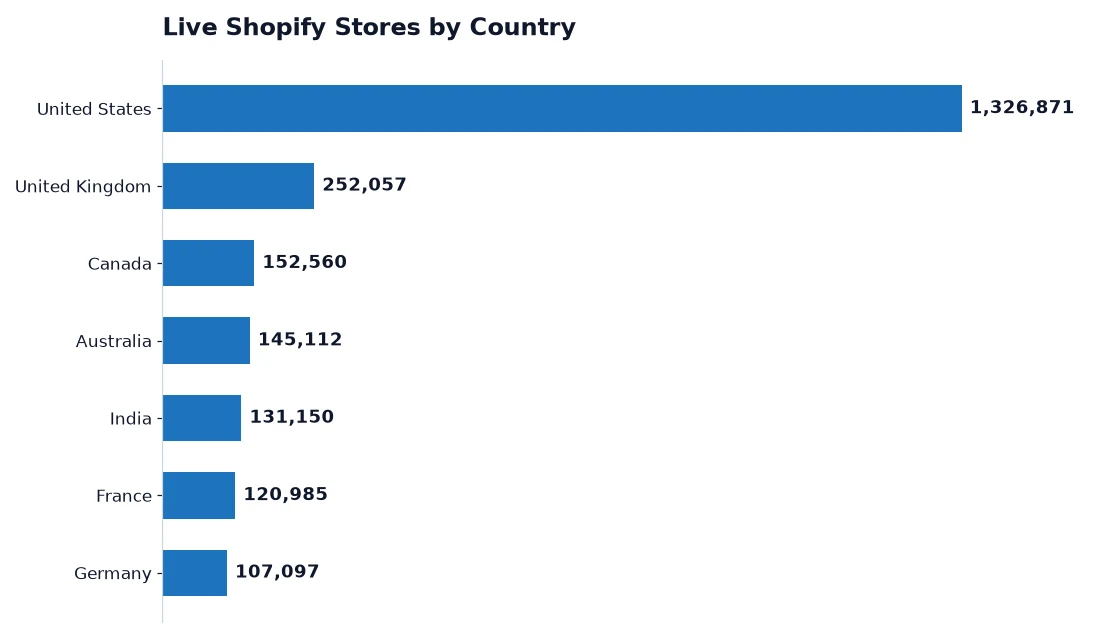
| Country | Live Shopify stores | Share of all stores |
|---|---|---|
| United States | 1,326,871 | 39.6% |
| United Kingdom | 252,057 | 7.5% |
| Canada | 152,560 | 4.5% |
| Australia | 145,112 | 4.3% |
| India | 131,150 | 3.9% |
| France | 120,985 | 3.6% |
| Germany | 107,097 | 3.2% |
Shopify Plus Stores by Country
The US holds 30,377 Shopify Plus stores, or 36.1% of all Plus domains.
Plus has a more European tilt. Germany and France both rank higher for Plus than for regular stores.
| Country | Shopify Plus stores | Share of Plus stores |
|---|---|---|
| United States | 30,377 | 36.1% |
| United Kingdom | 6,479 | 7.7% |
| Germany | 5,801 | 6.9% |
| France | 4,578 | 5.4% |
| Australia | 3,952 | 4.7% |
| Canada | 3,890 | 4.6% |
What this means: Selling to Plus brands? Europe deserves a bigger slice of your sales plan than raw store counts suggest.
Shopify Merchant Statistics
44% of Shopify merchants are based in the United States.
Shopify statistics on merchant location show a global spread beyond that. Most merchants are small, and many connect a CRM to manage buyers, as our list of the best CRM for Shopify integration shows.
| Merchant region | Share of Shopify merchants |
|---|---|
| United States | 44% |
| Europe, Middle East and Africa | 31% |
| Asia Pacific | 16% |
| Canada | 5% |
| Latin America | 5% |
More Shopify statistics on merchants:
- 27.5% of Shopify stores sell fewer than 10 products.
- Shopify won 33,582 stores from other platforms in the last 90 days.
- It lost 23,433 stores to other platforms in the same window.
Did you know? Shopify gains about 10,149 more stores from rival platforms than it loses every 90 days. See what the winners do with these Shopify spy tools to track competitors.
What this means: Shopify is still a net winner in platform switching, so its merchant base keeps getting bigger and stronger.
Shopify Revenue Statistics
Shopify earned $11.6 billion in revenue last year, up 30%.
Revenue reached $10.5 billion in the first nine months of 2026, up 33%. The last four quarters add up to $14.2 billion. Shopify statistics also show it keeps about 3.1 cents of every dollar merchants sell.
| Period | Shopify revenue |
|---|---|
| Last four quarters | $14.2 billion |
| Last year | $11.6 billion |
| First nine months of 2026 | $10.5 billion |
| Q3 2026 | $3.74 billion |
Shopify Revenue by Solution
Merchant Solutions made $8.80 billion last year, or 76% of Shopify revenue.
Merchant Solutions covers payments, lending and shipping labels. Subscription Solutions covers plan fees, which you can compare in our Shopify pricing plans 2026 guide. In Q3 2026, Merchant Solutions grew 35% to $2.91 billion. Subscription Solutions grew 20% to $836 million, and monthly recurring revenue hit $230 million.
| Revenue stream (last year) | Revenue | Share |
|---|---|---|
| Merchant Solutions | $8.80 billion | 76% |
| Subscription Solutions | $2.75 billion | 24% |
What this means: These Shopify statistics show it earns most when merchants sell, so its success is tied to yours.
Shopify Revenue by Region
US merchants brought in $7.33 billion, or 63% of Shopify revenue last year.
Europe, the Middle East and Africa came second at $2.43 billion. Shopify statistics show revenue outside North America grew 36% last year, faster than the company overall.
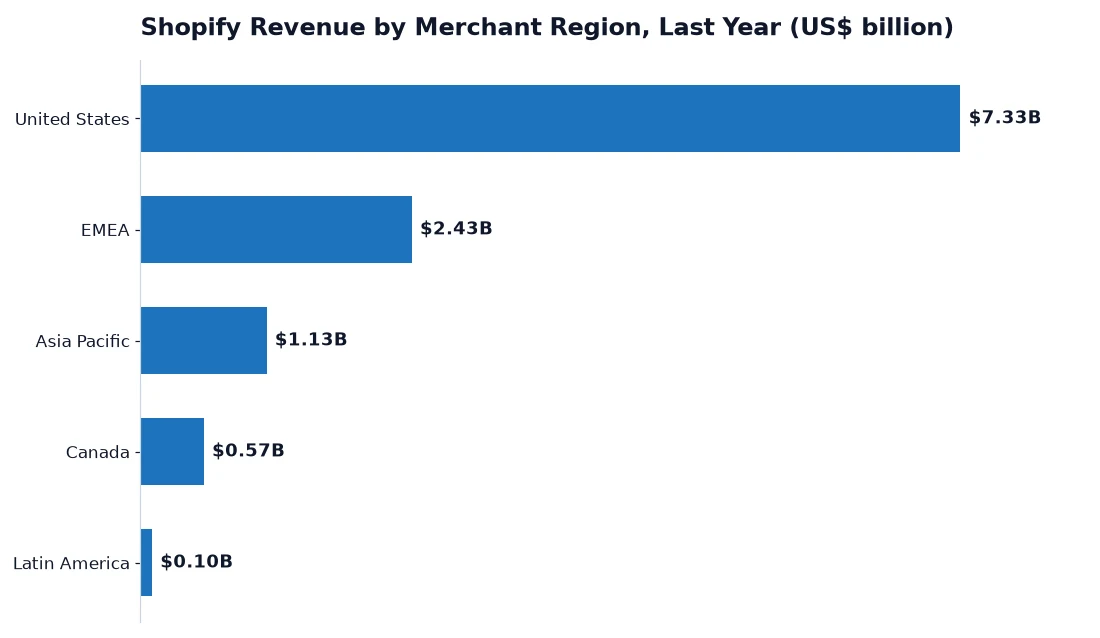
| Region (last year) | Revenue | Share |
|---|---|---|
| United States | $7.33 billion | 63% |
| Europe, Middle East and Africa | $2.43 billion | 21% |
| Asia Pacific | $1.13 billion | 10% |
| Canada | $567 million | 5% |
| Latin America | $104 million | 1% |
What this means: The US pays the bills, but international growth is where the next leap will come from.
Shopify Financial Statistics by Quarter
Q3 2026 was Shopify’s biggest revenue quarter ever at $3.74 billion.
Every quarter in these Shopify statistics grew revenue by 31% or more.
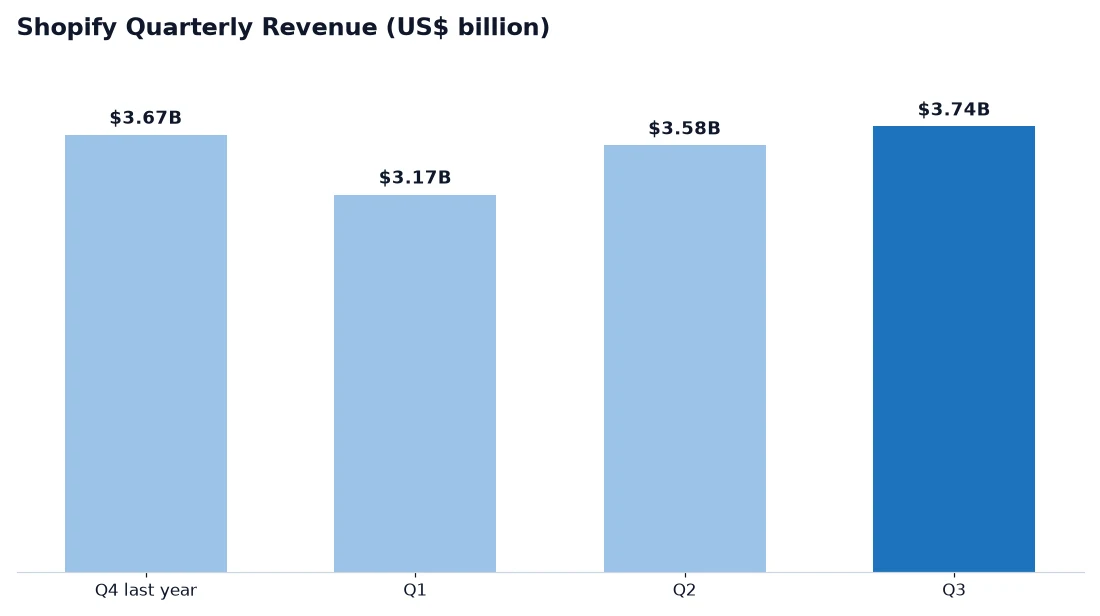
| Quarter | Revenue | GMV |
|---|---|---|
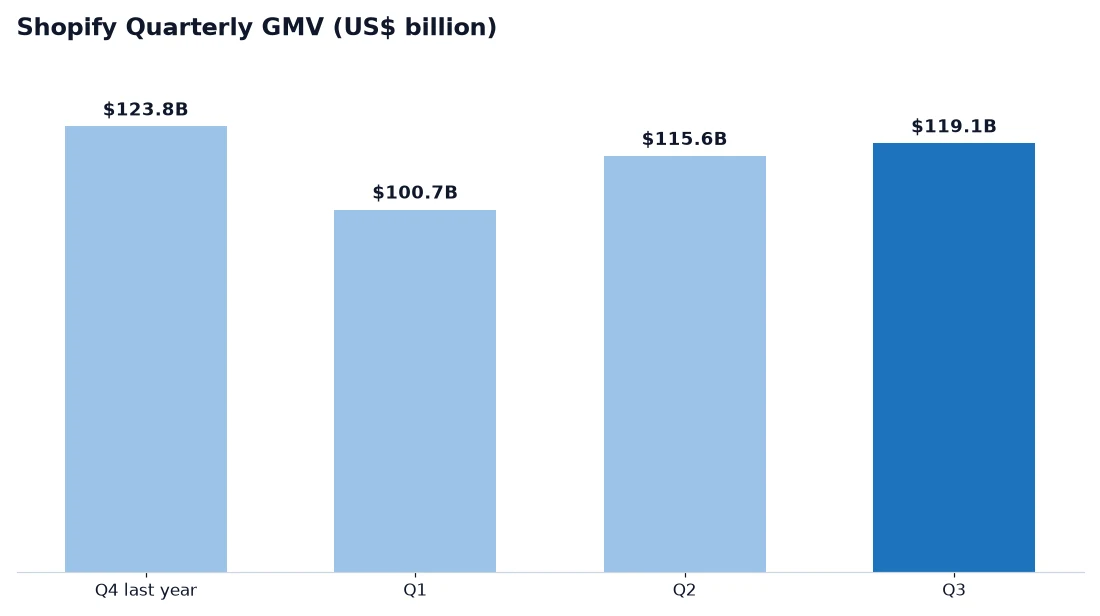
| Q3 2026 | $3.74 billion | $119.1 billion |
| Q4 of last year | $3.67 billion | $123.8 billion |
| Q2 2026 | $3.58 billion | $115.6 billion |
| Q1 2026 | $3.17 billion | $100.7 billion |
Shopify Financial Statistics for the 3rd Quarter
Revenue grew 32% to $3.74 billion in Q3 2026.
GMV rose 29% to $119.1 billion. Operating income climbed to $568 million, and the free cash flow margin hit 22%.
Shopify Financial Statistics for the 2nd Quarter
Revenue grew 34% to $3.58 billion in Q2 2026.
GMV rose 32% to $115.6 billion. Operating income reached $488 million with an 18% free cash flow margin.
Shopify Financial Statistics for the 1st Quarter
Revenue grew 34% to $3.17 billion in Q1 2026.
GMV crossed $100 billion for a first quarter, landing at $100.7 billion, up 35%. Operating income was $382 million with a 15% free cash flow margin.
Shopify Financial Statistics for the 4th Quarter
Revenue grew 31% to $3.67 billion in Q4 of last year.
GMV hit $123.8 billion, Shopify’s first quarter above $100 billion. Operating income was $631 million with a 19% free cash flow margin. For Q4 2026, Shopify expects revenue to grow at a low thirties percentage rate.
What this means: Quarterly Shopify statistics with growth above 30% at this size are rare, and they show strong demand.
Shopify GMV Statistics
Shopify merchants sold $119.1 billion of goods in Q3 2026, up 29%.
GMV, or gross merchandise volume, is the total value of orders on Shopify, not Shopify’s own revenue. Shopify statistics put GMV for the last four quarters at $459.3 billion.
| Period | Shopify GMV |
|---|---|
| Last four quarters | $459.3 billion |
| Last year | $378.4 billion |
| First nine months of 2026 | $335.5 billion |
| Q3 2026 | $119.1 billion |
What this means: Q3 2026 alone almost matched a full pandemic year of sales, so the shopper demand is real.
Shopify Market Share
Shopify powers 33.7% of all ecommerce sites whose platform is known.
It also runs 5.5% of all websites. You can see how it stacks up in our roundup of the best ecommerce platforms.
| Measure | Shopify share |
|---|---|
| Active US online stores | 34.7% |
| Ecommerce sites worldwide | 33.7% |
| US ecommerce sales | 14%+ |
| All websites | 5.5% |
Shopify Market Share in the US
Shopify merchants made more than 14% of all US ecommerce sales last year.
Shopify also runs 34.7% of active US online stores, 2.4 times the next biggest platform. US Shopify statistics also show its merchants captured nearly half of all new US ecommerce sales since the start of last year.
What this means: In the US, Shopify is the default choice for new brands, so expect your rivals to be on it.
Shopify Market Capitalization
Shopify’s market cap is about $173 billion right now.
That is down from about $209.6 billion at the end of last year, and roughly 10% lower than 12 months ago. Business results kept growing while the stock cooled.
| Point in time | Shopify market cap |
|---|---|
| End of last year | $209.6 billion |
| Right now | About $173 billion |
What this means: Investor mood swings fast, but the operating Shopify statistics above tell a steadier story.
Shopify Payments Statistics
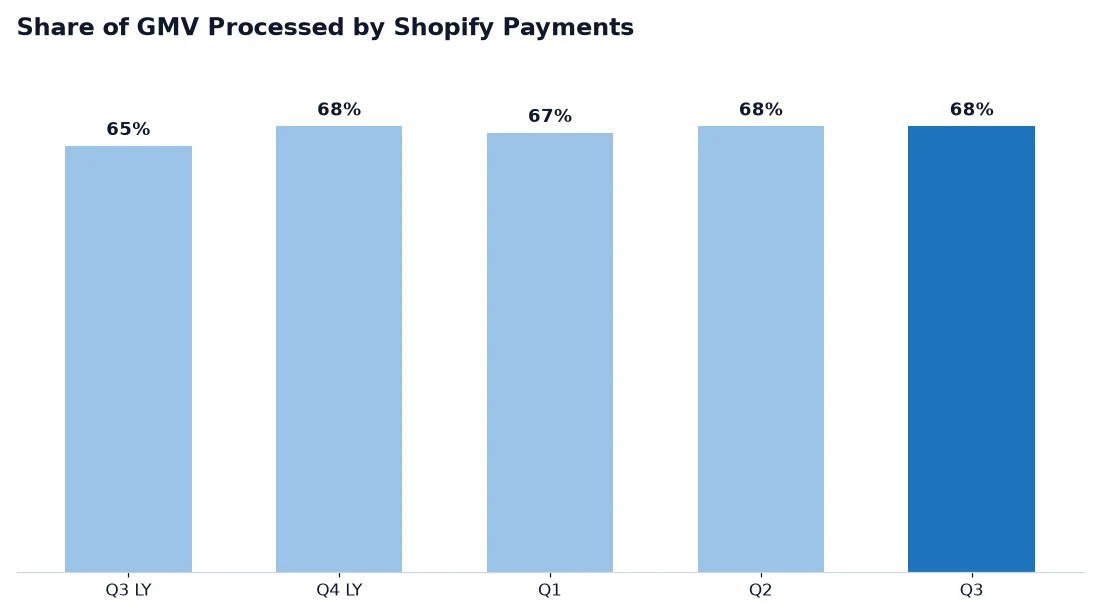
Shopify Payments processed 68% of all GMV in Q3 2026.
That equals $81.4 billion in one quarter, up 35%, versus a 65% rate a year earlier. Lifetime payments volume on Shopify passed $1 trillion in Q2 2026.
| Quarter | GMV through Shopify Payments |
|---|---|
| Q3 2026 | $81.4 billion |
| Q2 2026 | $78.1 billion |
| Q3 of last year | $60.2 billion |
Shopify Payment Market Share
Shop Pay appears on about 57.4% of live Shopify stores.
That is about 1.93 million storefronts. Shopify statistics also show Shop Pay GMV grew 50% year over year in Q3 2026.
What this means: Most Shopify merchants keep payments in house, and shoppers clearly like the one tap checkout.
Popular Categories on Shopify
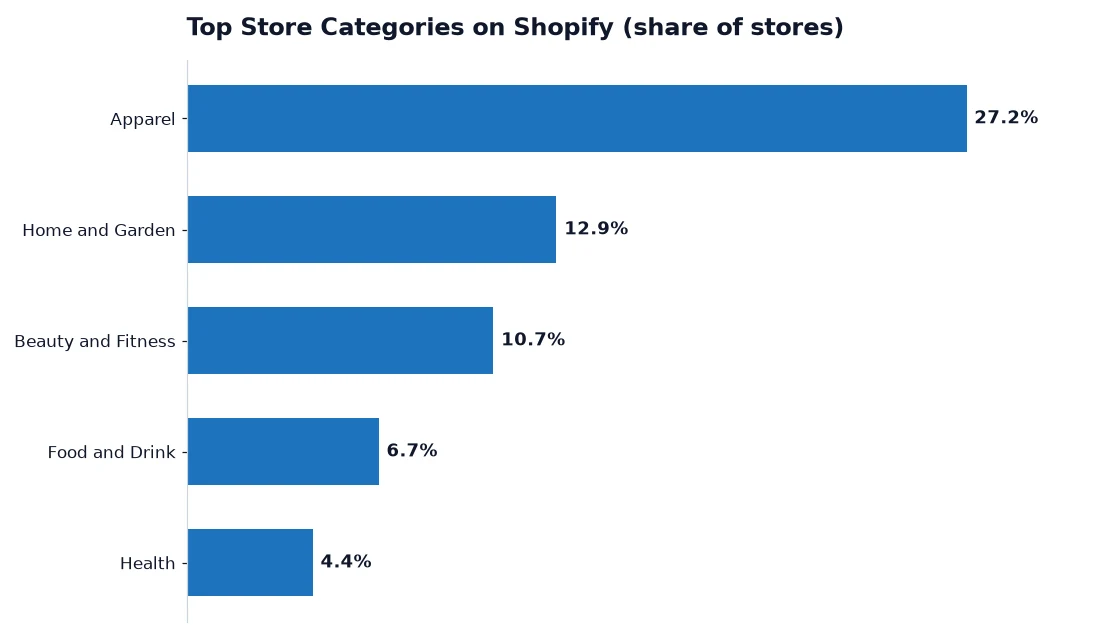
Apparel leads with 27.2% of all Shopify stores, about 912,109 shops.
Home and garden comes second in these Shopify statistics, followed by beauty and fitness. Fashion brands love Shopify themes, as our picks of the best converting Shopify themes show.
| Category | Share of Shopify stores |
|---|---|
| Apparel | 27.2% |
| Home and garden | 12.9% |
| Beauty and fitness | 10.7% |
| Food and drink | 6.7% |
| Health | 4.4% |
What this means: Category Shopify statistics show apparel is crowded, while niches like health leave room.
Shopify App Statistics
The Shopify App Store lists 33,767 apps from 21,256 developers.
Shopify statistics on apps show merchants lean hard on reviews and email. The most installed app, a product reviews tool, sits on 19.9% of stores.
| App type | Share of Shopify stores |
|---|---|
| Product reviews | 19.9% |
| Email and SMS marketing | 14.2% |
| Buy now, pay later messaging | 11.3% |
| Shopify Inbox | 10.5% |
| Social media feed | 7.2% |
| Shopify Forms | 7.1% |
What this means: Reviews and email come first for most stores, so start there before you buy fancy add ons.
Success Rate of Shopify Stores
There is no official success rate, but Shopify merchants grow about three times faster than the market.
Over three years, Shopify merchants grew online sales 37% a year in Europe and 23% in the US, against 8% for ecommerce in both regions. Plenty of stores still stall: live stores dipped 1.9% after last year’s holidays, and 27.5% of stores sell fewer than 10 products.
| Group | Yearly online sales growth (3 years) |
|---|---|
| Shopify merchants in Europe | 37% |
| Shopify merchants in the US | 23% |
| US ecommerce overall | 8% |
| European ecommerce overall | 8% |
What this means: The platform helps, but product, traffic and follow through still decide whether your store lasts.
Shopify Trends to Know in 2026
AI referred orders on Shopify stores grew 3.3 times in the past year.
AI referred traffic grew 2.6 times, so these Shopify statistics show orders rising faster than visits. Our AI chatbot statistics 2026 show how big that shopper pool is. Other trends worth watching:
- B2B GMV grew 74% year over year in Q3 2026.
- Multilocation store locations rose 52%.
- Offline GMV grew 30%, and lifetime in store GMV passed $200 billion.
- 55% of merchants adding point of sale in Q3 2026 were new to Shopify.
| Trend (Q3 2026) | Growth |
|---|---|
| B2B GMV | 74% |
| Multilocation store locations | 52% |
| Shop Pay GMV | 50% |
| International GMV | 32% |
| Offline GMV | 30% |
What this means: Get your catalog ready for AI shopping agents and wholesale buyers now, before rivals do.
Pros and Cons of Shopify 2026
Pros
- $119.1 billion in GMV in Q3 2026, up 29%
- Revenue grew 32% to $3.74 billion in Q3
- 68% of GMV runs on Shopify Payments
- 3.35 million live stores, up 15% in a year
- Over 33,700 apps in the App Store
- AI referred orders grew 3.3 times in a year
Cons
- Market value down about 10% in a year
- Subscription revenue grows slower, at 20%
- Live stores dipped 1.9% after last year's holidays
These Shopify statistics point to a platform that keeps winning on scale, payments and growth. The stock has cooled and subscription growth trails. For most brands, the upside still outweighs the risks.
Quick Links
- Shopify Pricing 2026
- Shopify Plus Pricing 2026
- Best Shopify Alternatives 2026
- Shopify Themes for Dropshipping
- Best CRM for Shopify Integration
- Shopify Coupon Codes 2026
- AI Chatbot Statistics 2026
- Udemy Statistics 2026
Frequently Asked Questions About Shopify Statistics 2026
Millions of merchants in more than 175 countries use Shopify in 2026. About 3.35 million live stores run on the platform, up 15% in a year. On the buyer side, more than 81 million shoppers bought from Shopify stores over one holiday weekend last year. These Shopify statistics put its reach among the largest in online retail.
Shopify earned $11.6 billion in revenue last year on $378.4 billion of GMV. Over the last four quarters, revenue reached $14.2 billion. Shopify statistics also put its market value at about $173 billion right now, among the largest software companies in the world.
Shopify is growing above 30% a year. Revenue rose 32% in Q3 2026, and GMV rose 29% to $119.1 billion. For Q4 2026, Shopify expects revenue growth at a low thirties percentage rate. Shopify statistics on store counts show the same pace, with live stores up 15% in a year.
The United States leads by a wide margin with 1,326,871 live Shopify stores, or 39.6% of the total. The UK, Canada and Australia follow. Apparel is the top category, with 27.2% of all stores selling clothing, so US fashion brands are the most common Shopify merchants.
Shopify keeps about 3.1 cents of every dollar its merchants sell. Most of that comes from payments and other merchant services, which made 76% of revenue last year. Plan fees make up the other 24%, so your total cost depends heavily on payments volume and the plan you choose.
The biggest benefit is access to a fast growing buyer network. Shopify merchants grew US online sales 23% a year over three years, versus 8% for US ecommerce overall. Built in payments help too, since 68% of GMV runs through Shopify Payments. These Shopify statistics favor brands that want growth.
The biggest risk is crowded competition. Apparel alone accounts for 27.2% of stores, and 27.5% of stores sell fewer than 10 products. Live stores also dipped 1.9% after last year's holidays. Shopify statistics like these show strong products matter more than the platform.
Yes, for most online brands Shopify is still worth it in 2026. The latest Shopify statistics show revenue up 32% and live stores up 15% in a year. AI referred orders also grew 3.3 times, so Shopify stores are ready for the next wave of shopping.
Yes. Shopify runs 34.7% of active US online stores, which is 2.4 times the next biggest platform. Worldwide, it powers 33.7% of ecommerce sites whose platform is known. Shopify statistics on new stores also show it gaining about 10,149 more stores than it loses every 90 days.
Conclusion: Shopify Statistics 2026 in Numbers
Shopify statistics for 2026 show a platform growing faster than most of online retail. Merchants sold $378.4 billion of goods last year, and Shopify turned that into $11.6 billion in revenue. About 3.35 million live stores now run on the platform. With AI shopping agents, B2B and in store sales all rising, Shopify looks set to claim an even bigger share of commerce next year.
