
Zoom statistics for 2026 start with a business that now books $4.87 billion in a full fiscal year.
In the latest quarter, Zoom revenue reached $1.29 billion, and 4,732 customers each contributed more than $100,000 over a trailing 12 months.
This page covers Zoom active users, revenue, net income, downloads, meeting minutes, market share, and employee counts.
Zoom Statistics 2026 (Key Highlights)
- Revenue reached $4.87 billion in the latest full fiscal year, up 4.4%.
- The latest quarter brought in $1.29 billion, up 4.9%.
- Net income was $1.90 billion in the latest full year.
- 4,732 customers contributed more than $100,000 in trailing 12 month revenue.
- The company had 7,438 full time employees, including 3,457 in the United States.
- Zoom Phone has surpassed 10 million seats.
- The last official usage peak was more than 300 million daily meeting participants.
- The Americas accounted for 72.1% of latest full year revenue.
What this means: The hard official numbers now sit in revenue, profit, and large customers, not in a fresh public user total.
How Many Zoom Users Are There?
Zoom does not publish a current official user count.
The last official peak was more than 300 million daily meeting participants in April 2020. That figure counts joins, not unique people, so one person in three meetings counts three times. Zoom Phone has since passed 10 million seats, and 4,732 customers now contribute more than $100,000 of trailing 12 month revenue. I still use Zoom most weeks, and those are the official usage markers that still stand.
| Official usage marker | Figure |
|---|---|
| Daily meeting participants, April 2020 peak | More than 300 million |
| Zoom Phone seats | More than 10 million |
| Customers above $100,000 trailing 12 months | 4,732 |
What this means: Treat any current active users total you see elsewhere as an estimate, because the company no longer publishes one.
What Are the Latest Zoom Active Users and Usage Statistics?
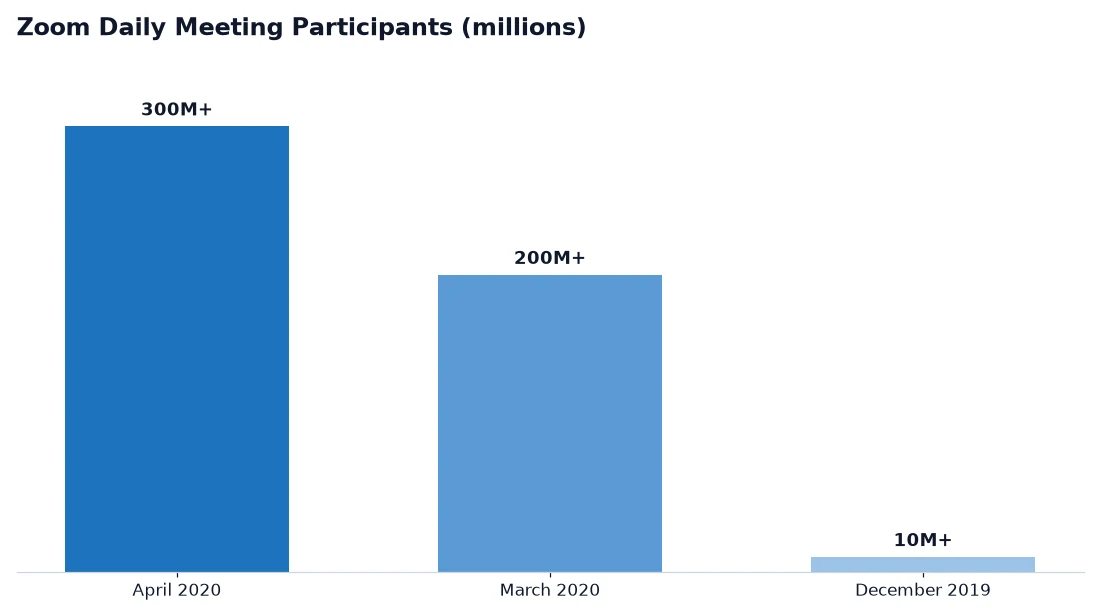
Official Zoom usage statistics still start with that 2020 jump, from about 10 million daily meeting participants to more than 300 million.
In December 2019, daily meeting participants were about 10 million. By March 2020 they had passed 200 million, and in April 2020 they topped 300 million. Zoom has not refreshed that series. What it does publish now is narrower: Zoom Phone has more than 10 million seats, AI Companion monthly users more than tripled in the latest full fiscal year, enterprise net dollar expansion sits at 100%, and monthly online churn is 2.8%.
| Point in time | Daily meeting participants |
|---|---|
| April 2020 | More than 300 million |
| March 2020 | More than 200 million |
| December 2019 | About 10 million |
What this means: Usage statistics today mix an old official peak with a few product level metrics, not a fresh count of current users.
What Do Zoom Meeting Minute Statistics Show?
The last official meeting minute statistics put the annualized run rate at 3.5 trillion minutes.
That reading came at the end of October 2020, after the run rate had already climbed from 100 billion minutes at the end of January 2020 to more than 2 trillion by April 2020. Zoom has not published a later official minutes total. I would not project today’s minutes from a figure that is several years old.
| Point in time | Annualized meeting minutes |
|---|---|
| October 2020 | 3.5 trillion |
| April 2020 | More than 2 trillion |
| January 2020 | 100 billion |
What this means: Meeting minutes were a pandemic era yardstick, and they are no longer part of the official update cycle.
Did you know? Daily Zoom meeting participants jumped from about 10 million to more than 300 million in early 2020. That kind of spike is rare even among other video platforms, which is why I also keep an eye on YouTube Statistics 2026 when I compare how people spend time on video.
What Are the Latest Zoom Revenue Statistics?
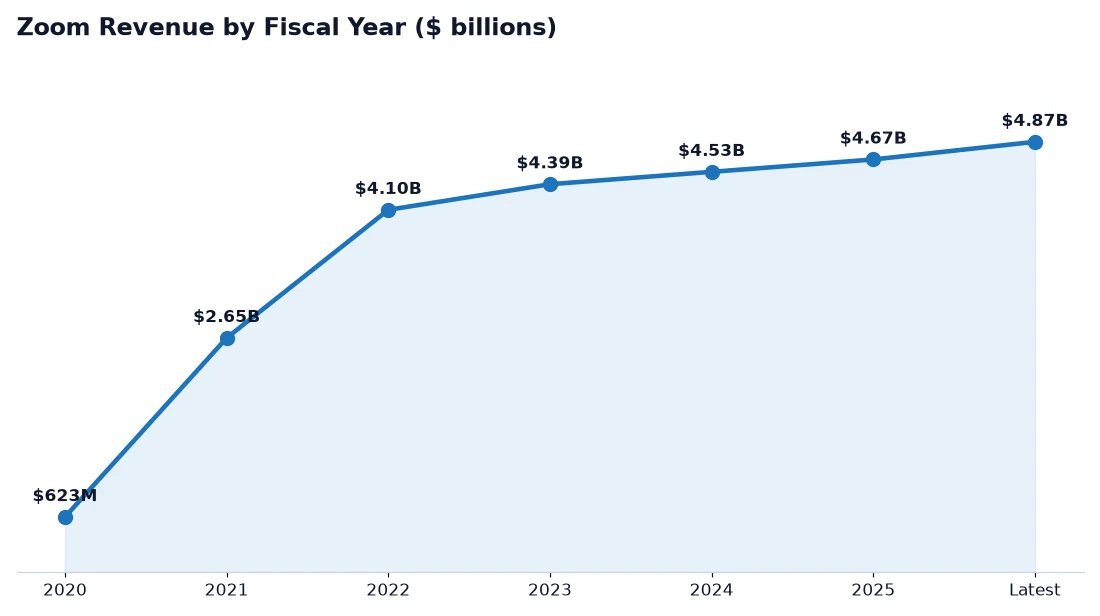
Zoom revenue reached $4.87 billion in the latest full fiscal year, up 4.4%.
The most recent quarter added $1.29 billion, up 4.9%. Across the last four reported quarters, revenue totals $5.05 billion. In the latest full year, enterprise accounts brought in $2.93 billion and online accounts $1.93 billion. Growth is slower than the 2021 surge, but it has stayed positive every year since.
| Fiscal year | Revenue | Growth |
|---|---|---|
| Latest full year | $4.87 billion | 4.4% |
| 2025 | $4.67 billion | 3.1% |
| 2024 | $4.53 billion | 3.1% |
| 2023 | $4.39 billion | 7.1% |
| 2022 | $4.10 billion | 54.6% |
| 2021 | $2.65 billion | 326% |
| 2020 | $623 million | 88.4% |
What this means: This is already a $5 billion scale business on a trailing four quarter basis, growing in the mid single digits.
What Is Zoom Net Income in 2026?
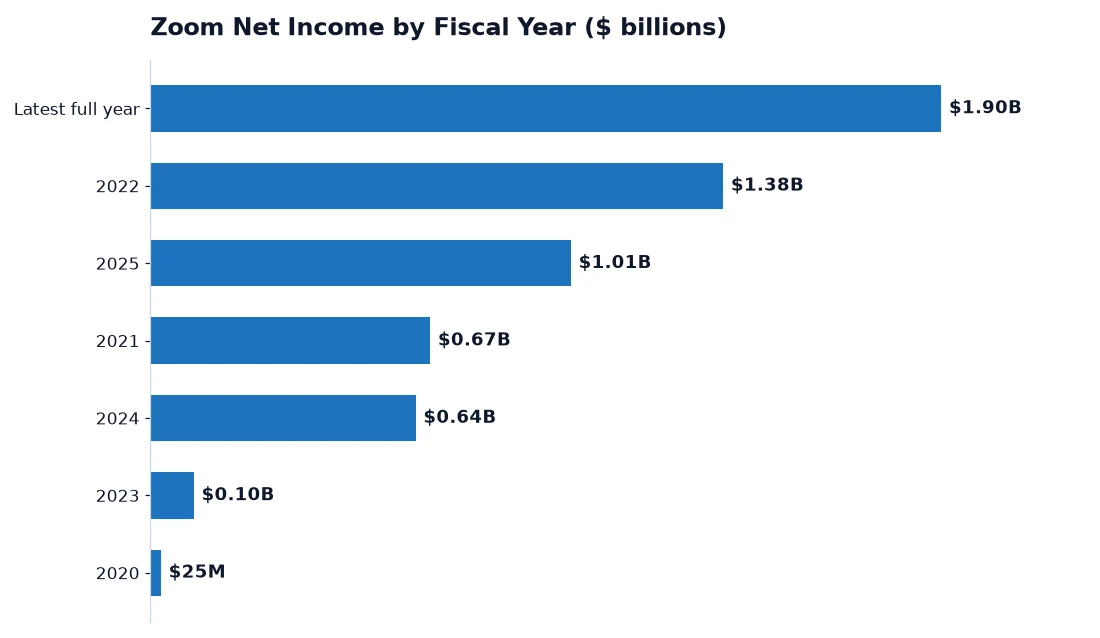
Zoom net income was $1.90 billion in the latest full fiscal year.
That was up from $1.01 billion the year before. In the most recent quarter, net income was $312.4 million. Profit can swing when investment gains land in one period and not the next, so I read the full year figure first. Even with those swings, the company has stayed profitable in every year shown below.
| Fiscal year | Net income |
|---|---|
| Latest full year | $1.90 billion |
| 2022 | $1.38 billion |
| 2025 | $1.01 billion |
| 2021 | $672 million |
| 2024 | $637 million |
| 2023 | $104 million |
| 2020 | $25.3 million |
What this means: Net income is large and real, but a single quarter can look jumpy because of investment results.
What Is Zoom Market Share Today?
Zoom does not publish an official industry market share percentage.
What it does report is the mix of its own sales. In the latest full year, the Americas brought in 72.1% of revenue, EMEA 15.8%, and APAC 12.1%. In the latest quarter, enterprise accounts made up 62.4% of revenue, and customers above $100,000 contributed 34.0%. Those slices tell you where the platform is strong, not how much of the wider video meeting market it owns.
| Share of the company’s own revenue | Figure |
|---|---|
| Americas, latest full year | 72.1% |
| Enterprise, latest quarter | 62.4% |
| Customers above $100,000, latest quarter | 34.0% |
| EMEA, latest full year | 15.8% |
| APAC, latest full year | 12.1% |
What this means: Market share headlines that quote a precise industry percentage are not coming from the company itself.
Was Zoom the Most Downloaded App in the United States?
Yes, in 2020 Zoom was the most downloaded free smartphone app in the United States.
That year is still the official peak story for downloads. The company does not currently publish official Zoom downloads by region or Zoom downloads by year, so I am not going to invent current install totals. The honest read is that the download surge belonged to the remote work wave, and it has not been updated as an official series.
| Download fact | What is official |
|---|---|
| Most downloaded free app in the United States, 2020 | Yes |
| Current official totals by region | Not published |
| Current official totals by year | Not published |
What this means: The 2020 download title is real, and current regional or yearly install counts are not official.
How Many Employees Does Zoom Have?
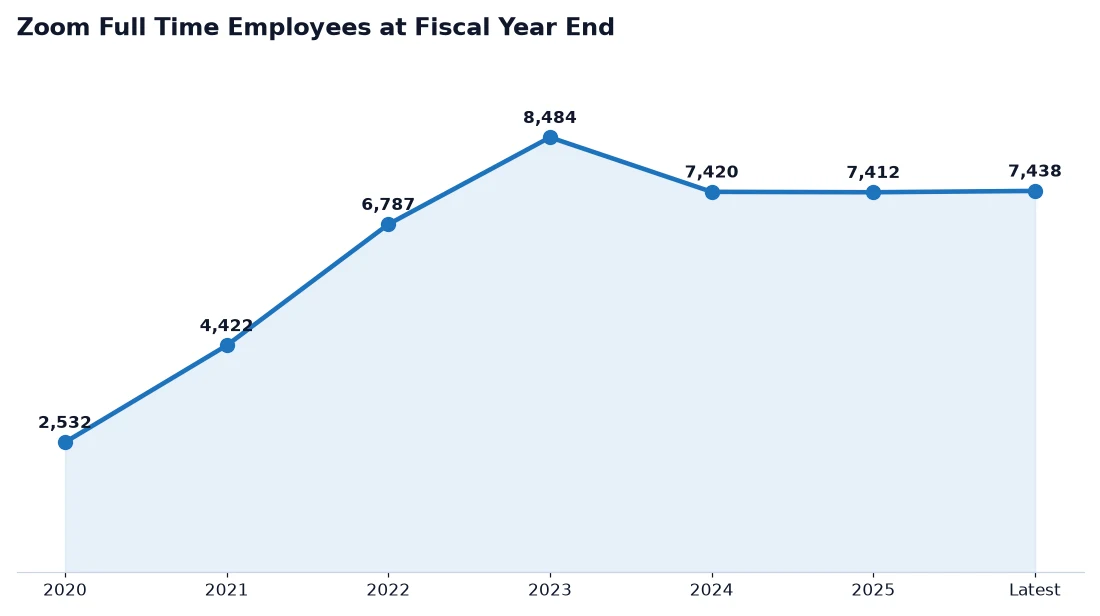
Zoom had 7,438 full time employees at the latest fiscal year end.
Of those, 3,457 were in the United States and 3,981 were in international offices. The team peaked at 8,484 in 2023, then settled near 7,400. Headcount barely moved in the last two reported years, which matches a company that is growing steadily rather than hiring in a rush.
| Fiscal year end | Full time employees |
|---|---|
| 2023 | 8,484 |
| Latest | 7,438 |
| 2024 | 7,420 |
| 2025 | 7,412 |
| 2022 | 6,787 |
| 2021 | 4,422 |
| 2020 | 2,532 |
What this means: Staffing is stable after the 2023 peak, with a slight majority of people working outside the United States.
How Many Large Zoom Customers Are There?
Zoom now has 4,732 customers that contribute more than $100,000 in trailing 12 month revenue.
That count is up 8.5% from a year earlier, and those accounts delivered 34.0% of revenue in the latest quarter. At the latest fiscal year end the same group numbered 4,468, up 9.3% from the year before. The company no longer publishes a total customer count, so this large account tally is the official scale marker I watch.
| Point in time | Customers above $100,000 |
|---|---|
| Latest reported quarter | 4,732 |
| Latest fiscal year end | 4,468 |
| 2025 year end | 4,088 |
| 2024 year end | 3,810 |
| 2023 year end | 3,471 |
| 2022 year end | 2,725 |
What this means: The company is still adding large accounts even though it no longer reports a total user or customer headcount.
Where Does Zoom Revenue Come From by Region?
The Americas generated $3.51 billion, or 72.1% of revenue, in the latest full fiscal year.
EMEA followed with $770 million, or 15.8%. APAC contributed $591 million, or 12.1%. That mix has been stable, with the Americas still the clear center of official revenue.
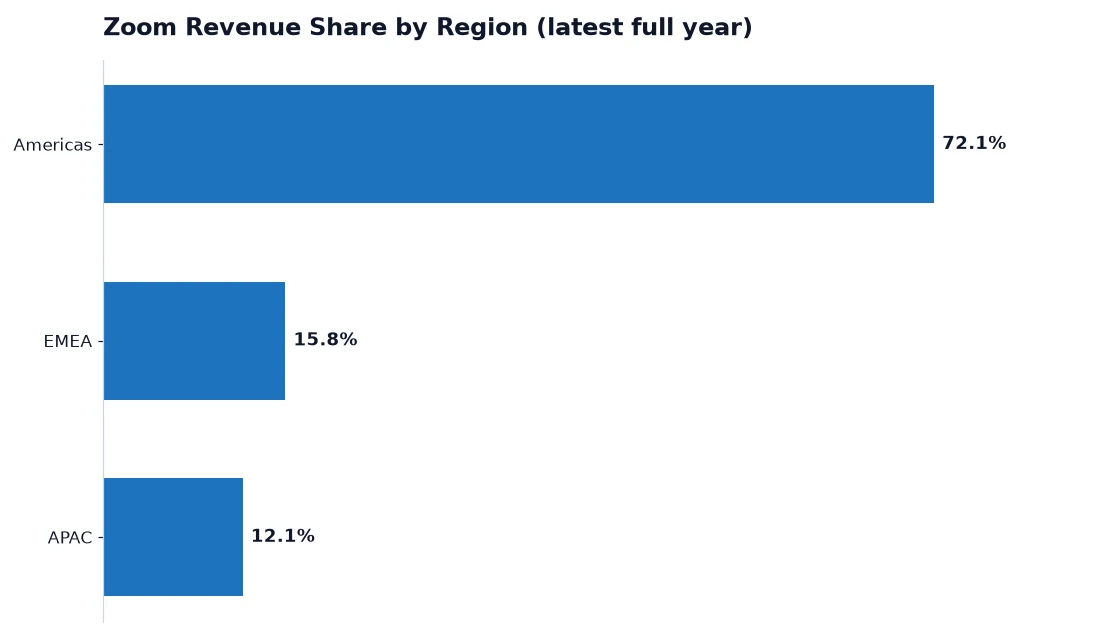
| Region | Latest full year revenue | Share |
|---|---|---|
| Americas | $3.51 billion | 72.1% |
| EMEA | $770 million | 15.8% |
| APAC | $591 million | 12.1% |
What this means: This remains an Americas first business, with EMEA as the next largest official slice.
How Is Zoom Usage Split Between Enterprise and Online Accounts?
Enterprise accounts produced 62.4% of revenue in the latest quarter, and online accounts produced 37.6%.
Enterprise revenue was $805.4 million, up 8.6%. Online revenue was $485.3 million, down 0.6%. In the latest full year, enterprise revenue was $2.93 billion and online revenue was $1.93 billion. Enterprise net dollar expansion is 100%, and monthly online churn is 2.8%. The growth is coming from larger organizations, not from the self serve side.
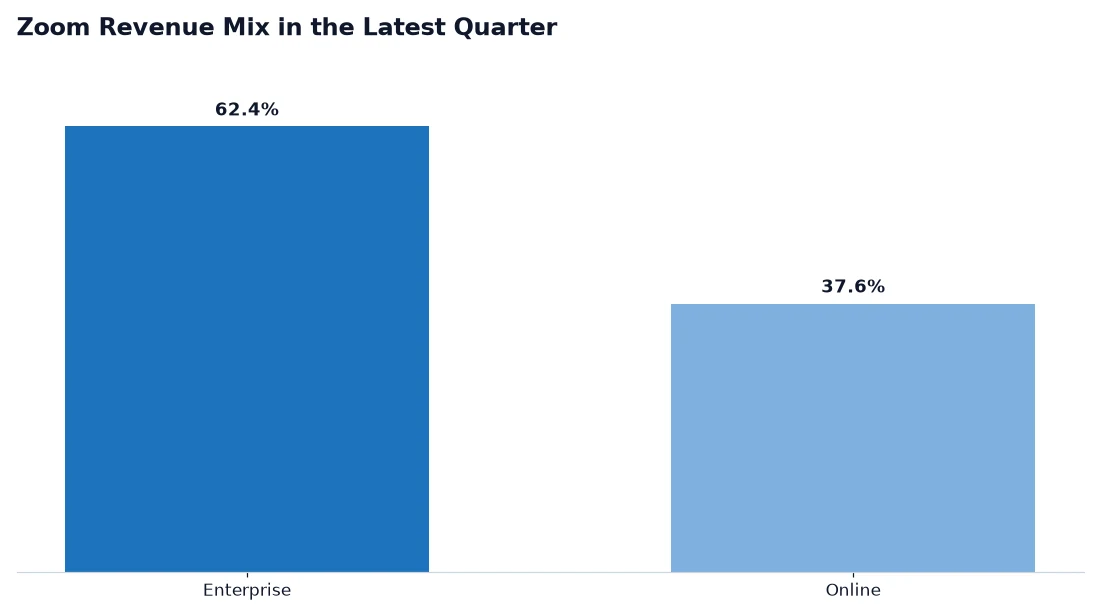
| Segment, latest quarter | Revenue | Share |
|---|---|---|
| Enterprise | $805.4 million | 62.4% |
| Online | $485.3 million | 37.6% |
What this means: Enterprise demand is carrying growth, while the online side has flattened.
What Limits Should You Watch in Zoom Statistics?
The biggest gap in these figures is the missing current user count.
The company also no longer publishes official meeting minutes, industry market share, or download totals by region and year. Online revenue slipped 0.6% in the latest quarter, and full year revenue growth was 4.4%. Those are real limits: you can measure money and large customers with confidence, and you cannot measure today’s total audience the same way.
| Gap or limit | Latest official reading |
|---|---|
| Current user or monthly active total | Not published |
| Meeting minutes after 2020 | Not published |
| Official industry market share | Not published |
| Online revenue, latest quarter | Down 0.6% |
| Full year revenue growth | 4.4% |
What this means: Use official revenue, profit, and large customer counts as the hard numbers, and treat leftover user or download figures with caution.
What Is the Outlook for Zoom Statistics in 2026?
The latest figures point to steady enterprise growth rather than another usage boom.
Enterprise revenue rose 8.6% in the latest quarter, net dollar expansion returned to 100%, and Zoom Phone has more than 10 million seats. Trailing four quarter revenue is already $5.05 billion, and the company held $7.3 billion in cash and marketable securities at the latest quarter end. AI Companion monthly users more than tripled in the latest full year, a reminder that product use is shifting into assistants as well as meetings. I cover that wider shift in my AI Chatbot Statistics 2026.
| Outlook marker | Figure |
|---|---|
| Trailing four quarter revenue | $5.05 billion |
| Cash and marketable securities | $7.3 billion |
| Enterprise revenue growth, latest quarter | 8.6% |
| Enterprise net dollar expansion | 100% |
| Zoom Phone seats | More than 10 million |
What this means: The next chapter will be about enterprise depth and AI use, not about reprinting a 2020 participant peak.
Pros and Cons of Zoom 2026
Pros
- $4.87 billion in latest full year revenue, still growing at 4.4%
- $1.90 billion in latest full year net income
- 4,732 large customers, up 8.5%
- Enterprise revenue up 8.6% in the latest quarter
- Zoom Phone has passed 10 million seats
- $7.3 billion in cash and marketable securities
Cons
- Zoom does not publish a current official user count
- Online revenue slipped 0.6% in the latest quarter
- Full year revenue growth remains in the mid single digits
Zoom statistics for 2026 describe a profitable, still growing communications business with a thinner official usage record than people expect. The money, the large customers, and the phone seats are solid. The missing current user total is the number I wish were still public.
Quick Links
- YouTube Statistics 2026
- AI Chatbot Statistics 2026
- Shopify Statistics 2026
- Tumblr Statistics 2026
- Xbox Statistics 2026
Frequently Asked Questions About Zoom Statistics
Zoom does not publish a current official user count. The last official peak was more than 300 million daily meeting participants in April 2020, and that figure counts joins rather than unique people. Zoom Phone has since passed 10 million seats, and 4,732 customers contribute more than $100,000 in trailing 12 month revenue. Those are the official markers that still stand.
Zoom does not publish an official industry market share percentage. In the latest full year, the Americas accounted for 72.1% of revenue, with EMEA at 15.8% and APAC at 12.1%. In the latest quarter, enterprise accounts made up 62.4% of revenue, and the largest customers contributed 34.0%. Those shares describe the company's own mix, not the wider market.
Revenue reached $4.87 billion in the latest full fiscal year, up 4.4%. The latest quarter brought in $1.29 billion, up 4.9%. Across the last four reported quarters, the total is $5.05 billion. Enterprise revenue was $2.93 billion in the latest full year, and online revenue was $1.93 billion.
Zoom net income was $1.90 billion in the latest full fiscal year, up from $1.01 billion the year before. The most recent quarter produced $312.4 million in net income. Profit can move around when investment gains hit one period, so the full year total is the cleaner read.
The last official Zoom meeting minute statistics put the annualized run rate at 3.5 trillion minutes at the end of October 2020. That followed a rise from 100 billion minutes at the end of January 2020 to more than 2 trillion by April 2020. A later official minutes total has not been published.
The company had 7,438 full time employees at the latest fiscal year end, including 3,457 in the United States and 3,981 in international offices. The team peaked at 8,484 in 2023 and has stayed close to 7,400 since. Headcount is stable after that earlier reduction.
In 2020, Zoom was the most downloaded free smartphone app in the United States. Official Zoom downloads by region and Zoom downloads by year are not published now, so current install totals should not be treated as official. The 2020 title remains the last clear public download fact.
The biggest benefit is a profitable, still growing platform that large organizations keep expanding. Latest full year revenue was $4.87 billion, net income was $1.90 billion, and 4,732 customers now spend more than $100,000 a year. Enterprise revenue rose 8.6% in the latest quarter, and Zoom Phone has more than 10 million seats.
Yes, it is still growing, just more slowly than during the pandemic peak. Revenue was up 4.4% in the latest full year and 4.9% in the latest quarter, while enterprise revenue rose 8.6%. Trailing four quarter revenue is $5.05 billion. It is worth it if you want a stable, widely used meeting platform, not if you expect another 2020 style jump.
Conclusion: Zoom Statistics 2026 in Numbers
Zoom statistics for 2026 show a $4.87 billion business with $1.90 billion in latest year net income and 4,732 large customers. I still see Zoom as a core work tool, even though the company no longer publishes a current user count or fresh meeting minute totals. The path ahead looks like steady enterprise growth, more phone seats, and deeper AI use, not a return to the 300 million daily participant headlines.
